Quick Summary
- Ajrakh is a resist-dyed, hand block printed textile from Sindh, Kutch in Gujarat and Barmer in Rajasthan, made with natural dyes and printed on one or both sides of the cloth.
- The name has three common explanations: the Arabic azrak (blue, after indigo), the Sindhi phrase aaj rakh (keep it for today, a nod to how slow the process is) and the Sanskrit a-jharat (that which does not fade).
- The craft is carried by the Khatri community, who migrated from Sindh to Kutch and settled in Dhamadka. After the 2001 Gujarat earthquake damaged local water quality, many families moved and founded a new village, Ajrakhpur.
- A traditional piece passes through around 14 to 16 stages of washing, resist printing, mordanting and dyeing, and can take two to three weeks to complete.
- The classic palette is indigo blue, madder red, iron black and undyed white, arranged in strict geometric patterns rather than human or animal figures.
- Genuine double-sided Ajrakh, called bi-puri, is printed on both faces with no obvious reverse side, which is one of the hardest skills in Indian block printing.
- Kutch Ajrakh is protected by a Geographical Indication registered under Application No. 1050, with the certificate granted to the artisans in 2024.
- Water is the craft’s biggest vulnerability. Falling water tables, rising salinity and iron contamination continue to threaten colour quality in Ajrakhpur.
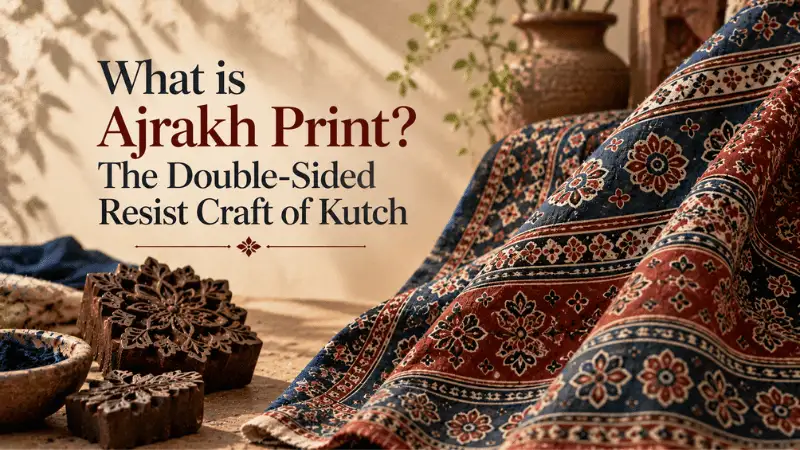
Most buyers who come across Ajrakh for the first time notice the geometry before anything else. Dense stars, interlocking lattices and medallions repeat across the cloth in deep indigo and red, with fine white lines holding everything together. It looks almost architectural. Then they turn the fabric over and find the same pattern on the back.
That second discovery is where Ajrakh starts to separate itself from almost every other block print in India. Here is what the craft is, how it is made, and what international buyers should know before sourcing it.
Also Read: What is Hand Block Printing?
What the Word “Ajrakh” Means
There is no single agreed origin for the name, and the three explanations each say something true about the cloth.
The most common links Ajrakh to azrak, the Arabic and Persian word for blue. Indigo has always been the backbone of the palette, so the connection is a natural one.
The second is the one artisans in Kutch tend to share themselves. In Sindhi, aaj rakh means “keep it for today”. As the Crafts Museum overview on Sahapedia explains, the work is so laborious that printers would set a piece aside and continue the next day. The name is almost an instruction: this cloth cannot be rushed.
The third interpretation traces the word to the Sanskrit a-jharat, “that which does not fade”, which reflects the exceptional colourfastness that comes from its metallic mordants.
Where Ajrakh Comes From
Roots in Sindh and the Indus Valley
Ajrakh is often connected to the Indus Valley Civilisation. The well-known Priest-King figure from Mohenjo-Daro wears a shawl decorated with a trefoil pattern, and a very similar motif, known today as kakad (cloud), still appears in Ajrakh printed in Kutch. Whether that is direct continuity or shared visual language is debated, but the resemblance is striking and widely cited.
Fragments of resist-dyed cotton from Gujarat have also been found at Fustat in Old Cairo, showing that textiles from this coastline were being traded across the Arabian Sea and Red Sea centuries before European trading companies arrived. Our guide to the history of Indian textiles covers that trade in more depth.
Sindh, in present-day Pakistan, is still considered the heartland of the craft. In Sindh, the ajrak shawl remains a powerful symbol of cultural identity.
The Khatri Migration to Kutch
The Khatri community, whose name is linked to the work of colouring cloth, are the hereditary Ajrakh printers of Kutch. Their ancestors migrated from Sindh, and many accounts link their settlement to an invitation from Rao Bharmalji I, the ruler of Kutch. The families settled in Dhamadka, near the Saran river, where flowing, mineral-rich water suited the washing and dyeing that Ajrakh depends on.
The 2001 Earthquake and Ajrakhpur
On 26 January 2001, a major earthquake struck Kutch. Beyond the loss of homes and workshops, it changed the groundwater in Dhamadka. Iron levels in the bore wells rose, and iron reacts with natural dyes. Cloth came out with black spots and dull, uneven reds, which made it unsaleable.
Rather than give up the craft, a group of Khatri families bought land near Bhuj and built a new village around better water. They named it Ajrakhpur. Today it is the main centre of Ajrakh printing in India, while Dhamadka still has active workshops.
Barmer, the Second Centre
Barmer in western Rajasthan is the other major Ajrakh centre in India. It shares the same Sindhi roots but often uses bolder, brighter variations of the traditional geometric patterns and sometimes a different printing sequence from the Kutch method.
The Khatri Artisans Today
Through the 1970s and 1980s, synthetic dyes had pushed natural Ajrakh close to extinction. Its revival owes a great deal to master craftsmen such as Dr. Ismail Mohammad Khatri, who returned his workshop to natural indigo and madder at a time when most printers had moved away from them. He was later awarded an honorary doctorate by De Montfort University in the UK.
The younger generation has built on that foundation. Artisans from the ninth and tenth generations of Khatri families now exhibit internationally, collaborate with designers and sell under their own names rather than as anonymous suppliers. Kala Raksha Vidhyalaya, founded in Kutch in 2005 as a design school for traditional artisans, played a big part in that shift by teaching colour theory, market awareness and business skills to craft families.
Ajrakhpur today is home to roughly a hundred artisan families working in Ajrakh, with labour divided across block carving, fabric preparation, printing, dyeing and washing.
How Ajrakh is Made: The Process Step by Step
Authentic Ajrakh involves around 14 to 16 stages, sometimes more for layered colours, and a batch typically takes two to three weeks. The V&A, discussing the technique during its Fabric of India exhibition, put the count for some versions as high as 30 steps. Here is the core sequence as practised in Kutch.
| Stage | Local term | What happens |
| 1 | Saaj | Raw cotton is soaked in a mix of camel dung, castor oil and soda ash, sun-dried and beaten. This is repeated several times until the cloth foams when rubbed, which shows it is fully scoured and absorbent |
| 2 | Kasanu (harda) | The cloth is soaked in myrobalan (harda) solution. The tannin acts as a primer so later mordants can bond to the cotton |
| 3 | Rekh | Outline blocks print a resist paste of gum arabic and lime. These lines stay white in the finished cloth |
| 4 | Kat | An iron paste made from fermented scrap iron, jaggery and tamarind seed powder is printed. It reacts with the harda to form a permanent black |
| 5 | Kan | A paste of alum, clay and gum is printed where red will appear later |
| 6 | Gadh | A mud resist of alum, clay and millet flour covers the white and red areas to protect them from indigo |
| 7 | Indigo dyeing | The cloth is dipped in a natural indigo vat. It comes out green and turns blue as it oxidises in the air |
| 8 | Vichharnu | The cloth is washed in running water to remove the mud resist and loose indigo |
| 9 | Rang | The cloth is boiled with madder root and dhavdi flowers. The alum-printed areas turn red |
| 10 | Final wash and drying | The cloth is washed again and dried in the sun, which also brightens the white areas |
Stages seven to ten are often repeated to deepen the indigo and red. Every repetition adds washing, drying time and water, which is why genuine Ajrakh carries a higher price than direct block prints. For comparison, the Jaipur process is covered in our guide to how hand block print fabric is made.
Double-Sided Printing: Bi-puri vs Ek-puri
Ajrakh printed on one side is called ek-puri. Ajrakh printed on both sides is bi-puri, and it is considered the high point of the craft.
In bi-puri work, the artisan prints the reverse of the fabric so precisely that the two faces match, and there is effectively no wrong side. The alignment is done by eye and touch, sometimes guided by small pins set in the block corners, on cloth that shifts slightly as it absorbs paste. There is very little margin for error.
The double-sided tradition came from practical use. Ajrakh was worn as turbans and shoulder cloths by herding communities, so both faces were visible when draped. Printing both sides also drives mordants deeper into the cotton, which helps the colour last.
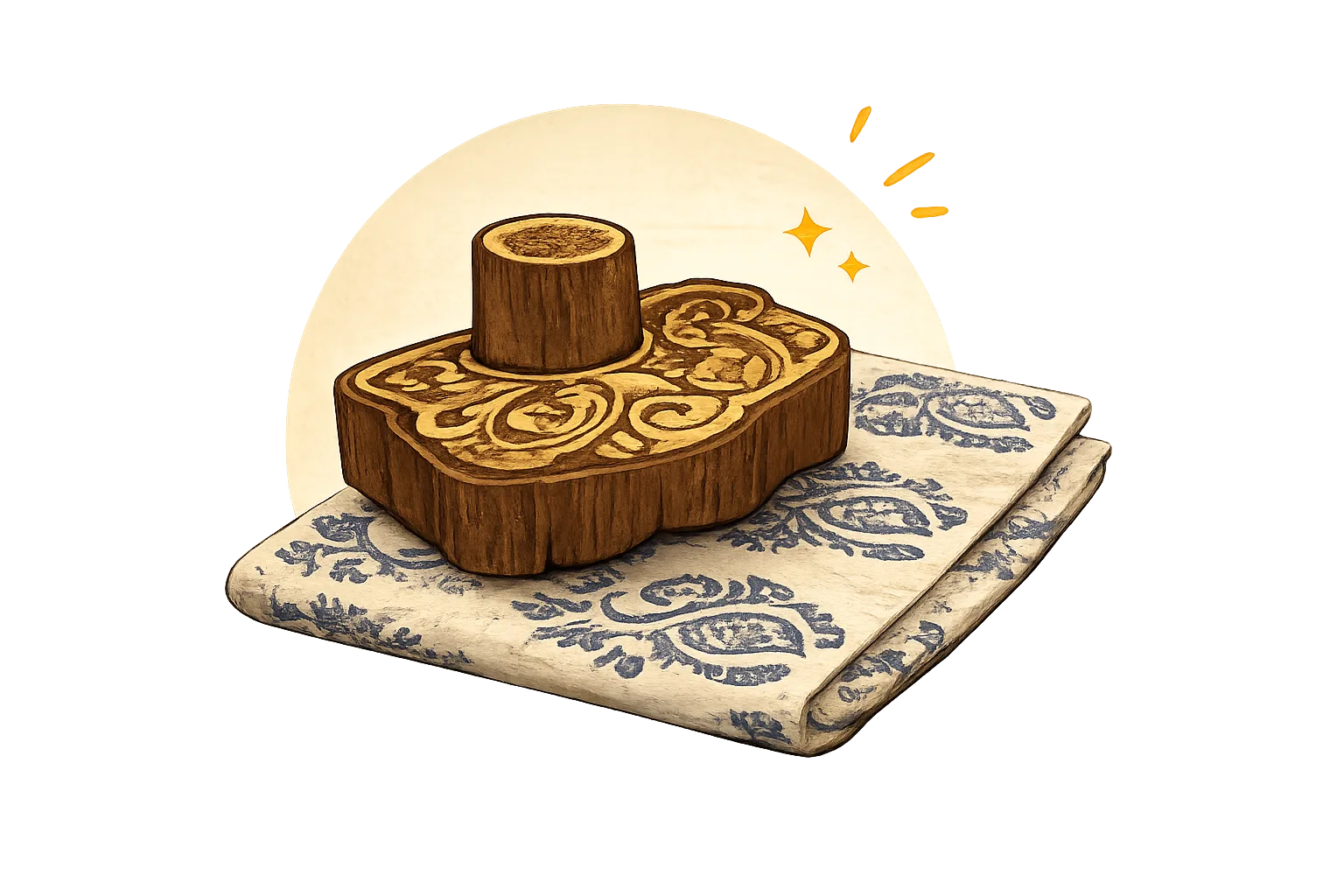
Each design needs a set of hand-carved blocks, usually sheesham or teak, including the gadh (background), rekh (outline) and datta (filler) blocks. The finest outline blocks sometimes have brass strips set into the wood for sharper lines.
The Natural Dyes Behind the Palette
Ajrakh is applied chemistry, and every colour comes from a different reaction.
Blue comes from natural indigo (Indigofera tinctoria). Indigo is not water-soluble in its natural form, so it is reduced in a fermentation vat. It bonds to the cloth when it meets oxygen, not through a mordant. Keeping a vat healthy is a skill in itself.
Red comes from madder root. Madder will not fix to cotton on its own. It needs an alum mordant, and the shade can be adjusted from soft pink to deep crimson by changing the alum concentration.
Black is not a dye at all. Fermented iron paste reacts with the tannin from the harda pre-treatment, and the black forms inside the fibre.
Yellow and brown come from sources such as pomegranate rind, turmeric and catechu.
The same chemistry appears in Jaipur’s traditions, although the techniques differ. Our article on Dabu printing shows how Bagru uses mud resist and indigo in its own way. When evaluating any natural dyed fabric manufacturer, whether in Kutch or Jaipur, it is worth asking which mordants are used and how dye water is treated, since “natural” on its own tells you little about either.
Also Read: What Are the Best Natural Fabrics from India for Block Printing?
Colour and Motif Symbolism
Traditional Ajrakh avoids human and animal figures, in keeping with the Islamic aesthetic of the communities who wore it. Instead it relies on geometry that repeats with no clear centre or edge.
Artisans often describe the palette as a picture of the sky: black for night, red for twilight, blue for the open sky, and the small white motifs as stars.
Many patterns echo the stone jali screens and trefoil arches of Indo-Islamic architecture. Key motifs include the eight-pointed star, the kakad cloud, and riyal, a design built around circular forms. Historically, the choice and spacing of patterns could also signal the wearer’s community and life stage.
From Herders’ Turbans to International Collections
For generations, the Khatris printed Ajrakh for specific local communities, including Maldhari herders, Rabaris and Ahirs. It was worn mostly by men as turbans, lungis and shoulder cloths, and given as gifts at weddings and Eid. Worn-out pieces were reused as baby wraps or stitched into quilts, so very little went to waste.
Today, the craft’s survival depends largely on urban and export buyers. Ajrakh now appears in yardage for fashion labels, dresses, kurtas, scarves and stoles, as well as quilts, cushion covers and table linen. Its international profile rose sharply after the V&A’s The Fabric of India exhibition in London (October 2015 to January 2016), which showed the stages of Ajrakh production alongside contemporary designer pieces.
GI Protection: Kutch Ajrakh
Kutch Ajrakh is protected by a Geographical Indication. The application was filed on 31 January 2023 by the Ajrakhpur Hastkala Vikas Sangathan, published in GI Journal No. 188 in December 2023, and the certificate was granted to the artisans in 2024. The official GI Registry record for Application No. 1050 lists the registered details and Authorized Users.
As with Sanganeri and Bagru prints, the tag protects the regional name, not every seller using it. A supplier can describe fabric as Ajrakh without being an Authorized User, so ask to see the certificate and check that the name matches. We explain how GI status works for Jaipur’s traditions in our comparison of Sanganeri and Bagru prints.
Water: The Craft’s Biggest Risk
A single piece of Ajrakh can be washed more than a dozen times, in one of the driest regions in India. That makes water quality and supply the craft’s central vulnerability.
The problem that forced the move from Dhamadka has followed artisans to Ajrakhpur. Mongabay India reported that rising iron content, a falling water table and increasing salinity were again spoiling batches, with spotted and discoloured cloth being discarded. Some printers turned to chemical dyes as a result.
Two responses stand out. Local NGO KHAMIR piloted a small effluent treatment plant to recycle dye water, and a larger Common Effluent Treatment Plant was developed through the Northern India Textile Research Association. Because Ajrakh’s natural dyes do not leave synthetic residues, treated water can be reused in printing or for irrigation. For sustainability-focused brands, asking whether a workshop is connected to treated water is a sensible part of supplier checks.
How Ajrakh Differs from Bagru Dabu and Sanganeri
Buyers who already work with a Jaipur block print supplier often ask how Ajrakh compares with the Rajasthan traditions. The short version:
| Feature | Ajrakh | Bagru Dabu | Sanganeri |
| Method | Multi-stage resist and mordant dyeing | Mud resist and natural dyes | Direct printing |
| Ground | Deep indigo and red | Earthy, indigo and dark grounds | White or pastel |
| Motifs | Strict geometric tessellations | Bold, folk and geometric | Fine florals and botanicals |
| Double-sided | Yes, in bi-puri work | Not typical | Not typical (except rare doo-rookhi) |
| Region | Kutch, Barmer, Sindh | Bagru, near Jaipur | Sanganer, near Jaipur |
Our complete guide to Bagru block printing goes deeper into the Dabu process.
How to Identify Genuine Ajrakh
Screen-printed and digitally printed “Ajrakh style” fabric is widely sold, and some of it is convincing at first glance. These checks help:
- Check both sides. Bi-puri Ajrakh shows matching pattern and colour on both faces. Even ek-puri pieces show strong dye penetration on the reverse. Digital and screen prints are clearly one-sided.
- Look at the outlines. Hand-stamped rekh lines show slight overlaps and small shifts at the joins. Perfectly seamless repeats over long lengths point to machine printing.
- Expect some first-wash bleeding. Loose surface dye can release in the first few washes, while the mordanted colour underneath stays fast.
- Ask about the process and the GI. A genuine workshop can explain its dye sources and stages, and an Authorized User can show their certificate.
Our guide to spotting real hand block print vs machine-printed imitations covers the general tests in more detail.
Sourcing Ajrakh for International Markets
Demand for Ajrakh is strongest in the USA, UK, EU, Australia and the Middle East, driven by the slow fashion and natural dye movements. Yardage for boutique garment production, resort wear, scarves and stoles, and home textiles such as quilts, cushion covers and table linen all perform well.
For boutiques building a broader collection through block print fabric wholesale, Ajrakh often sits alongside Jaipur’s Sanganeri and Bagru prints, giving a range that moves from fine florals to bold geometry.
Certification questions apply here as with any natural fibre textile. GOTS covers organic fibre and the full processing chain, while OEKO-TEX Standard 100 tests the finished product for harmful substances. Our guide to GOTS certification explains how to verify certificates, and if you are new to sourcing from India, start with our guide on how to source clothing from India.
Also Read: What to Look for in a Hand Block Print Manufacturer in India
Current Challenges
- Water scarcity and quality. Every stage depends on clean, low-iron water, and Kutch’s water table continues to fall.
- Imitations. Cheap screen prints use Ajrakh motifs and undercut genuine artisans on price.
- Losing young artisans. The physical demands of the process lead some younger family members toward other work, although design education has helped keep many in the craft as designers rather than labourers.
Three Things Most People Do Not Know About Ajrakh
The name is a working instruction. If you follow the aaj rakh explanation, the cloth is named after the pause it requires. Mordants and dyes need time to react and oxidise, and rushing them ruins the colour.
A 4,000-year-old motif is still in use. The kakad cloud pattern printed in Ajrakhpur today closely resembles the trefoil on the Priest-King’s shawl from Mohenjo-Daro.
An earthquake created a village. Ajrakhpur exists because the 2001 earthquake changed the chemistry of Dhamadka’s groundwater. A whole community relocated to protect the colour of its cloth.
Conclusion
Ajrakh is one of the most demanding block printing traditions in the world. Its geometry, natural dye chemistry and double-sided precision take weeks to produce, and its survival depends on water in one of India’s driest regions. That is exactly why genuine pieces command attention in international markets, and why buyers need to verify what they are paying for.
Understanding the process, the GI protection and the signs of authenticity puts buyers in a much better position to source Ajrakh well, and to tell their own customers a story that holds up.
Explore our wholesale catalog at Moharis to see hand block printed clothing, fabrics and home linen made in Jaipur. Or read about the artisan community behind every piece we make.
Moharis is a Jaipur-based manufacturer, exporter and wholesaler of hand block printed clothing, fabrics and home linen. We work with boutiques, sustainable fashion brands and sourcing companies across the USA, Europe and the Middle East. For wholesale inquiries, write to us at info@moharis.com or visit our wholesale page.