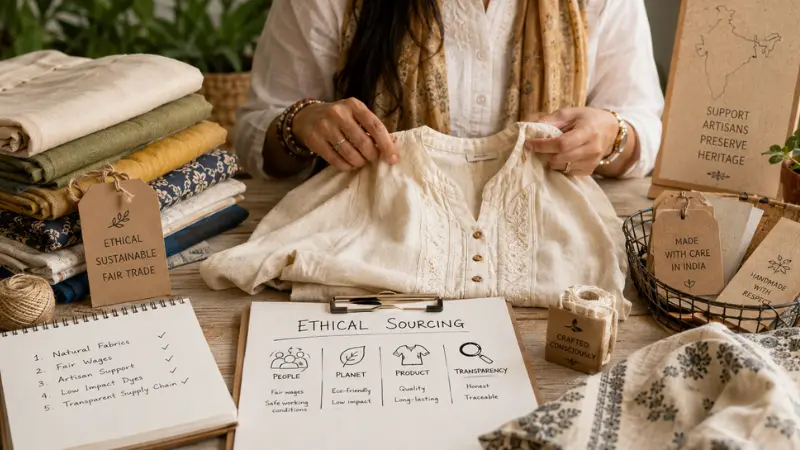
Quick Summary
- India is the second-largest textile manufacturer globally, with a fully integrated supply chain from raw fibre cultivation through to finished garment. For boutique buyers, this means traceable, vertically integrated sourcing is genuinely achievable.
- “Ethical,” “sustainable,” “organic” and “fair trade” are not interchangeable terms. Each covers a different part of the supply chain and buyers need to ask different questions for each.
- The most important certifications for ethical Indian sourcing are GOTS, OEKO-TEX Standard 100, Fair Trade, SEDEX SMETA, Craftmark and GI tags. No single certification covers everything. A composite approach is required.
- The single most dangerous sourcing risk in India is unauthorized subcontracting, where a certified flagship facility quietly offloads production to unmonitored informal units. Transaction Certificates, not Scope Certificates alone, are how buyers verify this does not happen.
- Ethical manufacturing costs more. A price that competes with fast fashion is a mathematical indicator that standards have been compromised somewhere in the chain.
- Hand block printing from Jaipur, specifically the GI-protected Sanganeri and Bagru traditions, offers a specific ethical advantage over factory manufacturing: decentralized community production, minimal energy use, natural materials and a verifiable 400-year heritage.
- EU regulations including the Digital Product Passport, the Empowering Consumers Directive and Extended Producer Responsibility are creating new mandatory traceability requirements for all brands selling into European markets. Buyers must begin building data infrastructure now.
- The USA requires precise fibre content labelling, country of origin disclosure and, under the Uyghur Forced Labor Prevention Act, chain-of-custody documentation proving cotton origin.
- For Middle Eastern markets, Saudi Arabia requires a Product Certificate of Conformity via the SABER platform and Arabic-primary labelling. UAE operates the ECAS scheme with more flexible bilingual labelling requirements.
- Long-term collaborative partnerships, where buyers commit to consistent volumes and support corrective action rather than exit on non-compliance, produce better ethical outcomes than transactional audit-and-cut relationships.
India is where a significant portion of the world’s hand block printed, artisan-made, natural-fibre clothing comes from. It is also where a significant portion of the world’s textile industry problems are concentrated: water contamination, wage suppression, certification fraud, unauthorized subcontracting, and the slow economic marginalisation of the skilled artisan communities that make the most valuable products.
Both of those things are true simultaneously. Navigating the space between them is what ethical sourcing from India actually requires.
This guide is for boutique buyers, sustainable fashion brands and sourcing managers who want to do it properly: not just to check a compliance box, but to build a supply chain that is genuinely honest from raw fibre to finished garment.
Why India Is the Right Sourcing Decision
The scale of India’s textile industry is significant in ways that matter directly to ethical sourcing. As the second-largest textile manufacturer globally, India’s domestic market was valued at USD 248.70 billion in 2025 and is projected to reach USD 656.31 billion by 2034. Export values in recent fiscal cycles have reached between USD 37 and USD 44 billion annually.
But the number that matters most for boutique buyers is not the export value. It is the integration.
India possesses the domestic capability to execute the entire textile lifecycle from field to finished garment: cotton cultivation, spinning, weaving, wet processing, printing and garment assembly. For buyers making ethical claims about their supply chain, this vertical integration is a practical advantage. Tracing a garment from cotton field to shipping container is considerably more achievable within one country than across four.
Natural fibres account for 56% of India’s textile market share. Cotton, linen, silk and wool are grown, processed and manufactured domestically in quantities that make genuine organic and natural fibre sourcing commercially viable at boutique scale. This is not true of most competing sourcing destinations, which primarily offer high-volume cut-make-trim operations on imported synthetic fabrics.
For boutique brands with both aesthetic and ethical requirements, India’s dual-sourcing model is uniquely valuable. Hyper-modern, vertically integrated eco-factories operating alongside culturally rich, artisanal craft clusters in the same geography is a combination that Vietnam, Bangladesh or Cambodia cannot replicate.
What “Ethical Clothing” Actually Means When Sourcing from India
The terminology around responsible production is frequently conflated in ways that create misaligned sourcing strategies and, ultimately, unintentional greenwashing. Before asking any manufacturer a single question, buyers need to be clear on what they are actually asking about.
Ethical fashion is focused on people. It asks whether the workers who made the garment were treated fairly: legal wages at minimum, safe working conditions, no child or forced labour. A factory producing petroleum-derived polyester garments can be accurately described as ethical if its labour practices are exemplary, even though the material has significant ecological impact.
Sustainable fashion is focused on the environment. It asks whether the production process minimised ecological damage: resource efficiency, reduced water consumption, zero discharge of hazardous chemicals, biodegradable or recyclable end-of-life options. A factory can be environmentally sustainable and still pay its workers below a living wage.
Organic fashion applies specifically to agricultural input. Organic cotton is grown without synthetic pesticides, fertilisers or genetically modified seeds. The organic label covers the fibre only. If that organic cotton is subsequently dyed with toxic heavy metals or sewn in exploitative conditions, the finished garment has failed on both sustainability and ethics.
Fair trade is an economic framework. It guarantees a minimum price floor to protect farmers and artisans from volatile market conditions, alongside a mandatory premium paid to worker cooperatives for community investment. Fair trade does not inherently guarantee organic materials or environmental standards, though it strongly encourages both.
A robust sourcing strategy demands intersectionality across all four. Buyers must seek organic materials, processed sustainably, manufactured under ethical conditions, with fair economic terms for the producers. Asking a manufacturer whether they are “sustainable” without specifying which dimension of sustainability you mean is a question that can be answered in almost any direction without technically lying.
The Certifications That Actually Matter
Independent third-party certifications are the primary mechanism for validating manufacturer claims. No single certification covers everything. Buyers need a composite approach based on their specific product categories and markets.
GOTS (Global Organic Textile Standard) is the gold standard for organic textile processing. It verifies a minimum of 70% certified organic fibres, strictly regulates wet processing to ban toxic dyes, and mandates ILO-compliant labour practices throughout the supply chain. For buyers sourcing organic cotton apparel or home textiles and making full supply chain claims, GOTS is the most comprehensive and internationally recognised standard available. Its limitation is that it does not assess the carbon footprint of the transportation network or broader corporate governance.
OEKO-TEX Standard 100 is a consumer safety certification. Every component of the finished product, including threads, zippers and labels, is tested against over 100 harmful substances including heavy metals and formaldehyde. It does not certify organic farming or evaluate labour conditions, but it is essential for intimate apparel, infant clothing and any garment intended for prolonged skin contact.
OEKO-TEX MADE IN GREEN combines the chemical testing of Standard 100 with verified guarantees about the environmental performance and working conditions of the manufacturing facility. It is the more comprehensive of the two OEKO-TEX options for buyers making supply chain claims.
Fair Trade (FLO-CERT) ensures economic equity: fair wages and a community premium for farmers and factory workers. It is particularly important for buyers sourcing agricultural raw materials or working with artisan cooperatives vulnerable to market exploitation.
SEDEX SMETA (4-Pillar) is a comprehensive ethical audit covering Labour Standards, Health and Safety, Environmental practices and Business Ethics. It uses a findings-based Corrective Action Plan rather than a pass-or-fail grade, which makes it more nuanced than a binary certification but also means a factory can be SMETA-audited while still having open non-compliances. Preferred by premium boutique brands for complex garment sourcing.
Craftmark, an initiative of the All India Artisans and Craftworkers Welfare Association (AIACA), certifies genuine handcrafted processes, ensures minimum wages and prohibits child labour in the informal craft sector. It is specifically designed for the artisan economy and is vital for distinguishing genuine hand embroidery or hand block printing from machine-made imitations.
GI (Geographical Indication) Tags from the Government of India protect regional craft traditions by law. Both Sanganeri and Bagru hand block printing hold GI certifications. For buyers marketing the cultural provenance and authenticity of Indian textiles, a GI-tagged supply provides legally verifiable regional origin that no imitation can claim. The full significance of these GI tags for block print buyers is explained in our comparison of the two Jaipur printing traditions.
Finding Genuine Ethical Manufacturers
Locating authentic ethical manufacturers requires a more rigorous process than browsing online directories. General B2B platforms present a significant structural risk. Many entries are shadow trading houses: entities with impressive online profiles and borrowed certifications that route actual production to unauthorized, unmonitored units to maximise margins.
Closed-network sourcing platforms that mandate real-time integration with audit databases, such as the Sedex platform, are significantly more reliable. Scope certificates and corrective action reports are verifiable in real time rather than being presented as static documents.
Physical trade fairs in India remain one of the most effective validation mechanisms. Exhibitions like Bharat Tex in New Delhi aggregate verified suppliers and allow buyers to assess fabric quality, printing precision and compliance documentation simultaneously. There is no substitute for handling the actual fabric and seeing the production capability in person.
India-based ethical buying agents are highly valuable for boutique buyers who cannot travel frequently. A good agent provides localized linguistic fluency, geographic proximity for unannounced factory visits, and inline quality control management. The commercial structure matters enormously here. Insist on a transparent fee: either a fixed retainer or a declared percentage of the FOB price. An agent earning undisclosed commissions from the factory is financially incentivised to suppress factory margins, which invariably compromises labour standards and material quality.
The Vetting Process: What to Actually Ask and Check
Vetting an Indian manufacturer is a multi-stage process covering documentary analysis, financial scrutiny and physical inspection. Here is what each stage must cover.
Wages and Labour Compliance
India’s labour regulatory framework is undergoing systemic change with the full implementation of the Code on Wages, 2019, between 2025 and 2026. This Code establishes universal minimum wage coverage and introduces what is known as the 50% Rule: an employee’s Basic Pay and Dearness Allowance must constitute at least 50% of their total compensation package.
This rule closes a significant historical loophole. Many factories previously inflated non-taxable allowances to artificially lower their mandatory contributions to worker provident funds and statutory bonuses, making their wage structures appear compliant on paper while underpaying workers in practice. Buyers reviewing payroll records must now actively verify that base wages are not hidden inside discretionary allowances.
In Rajasthan, the statutory minimum wages for garment and textile workers as of 2025 to 2026 are approximately ₹285 per day for unskilled workers, ₹297 for semi-skilled, ₹309 for skilled artisans including block printers, and ₹359 for highly skilled supervisors. It is critical to understand that these statutory minimums frequently fall well below the true living wage calculated by bodies like the Asia Floor Wage Alliance, the amount actually required for a worker to afford adequate housing, nutrition and healthcare for their family.
Physical Factory Inspection
A factory visit must go well beyond the showroom or sample room. Walk the production floor and verify that the machinery count aligns with the stated production capacity. A significant disparity between claimed capacity and installed machinery is a strong indicator of unauthorized subcontracting.
Inspect the Effluent Treatment Plant physically. Request ETP maintenance logs and the latest wastewater analysis reports. A plant that is installed for inspection but not operational will have inconsistent maintenance records and a treatment log that does not match the production volume. This is one of the clearest indicators that environmental compliance is a facade rather than an operational reality.
Subcontracting Policies
Ask specifically and directly about subcontracting policies. Ask which specific stages of production, if any, are outsourced, to whom, and whether those facilities are subject to the same audit standards as the primary unit. A manufacturer who hesitates on this question or provides vague answers is telling you something important.
The Red Flags: What to Walk Away From
The premium attached to sustainable and ethical apparel has produced sophisticated methods for greenwashing and compliance fraud. Knowing what to look for protects buyers from both reputational and regulatory risk.
Certification fraud through scope misrepresentation. A frequent deception occurs when a garment manufacturer presents a GOTS or OEKO-TEX Scope Certificate that actually belongs to their fabric mill or yarn supplier, using it to imply that their own cutting and sewing facility is certified. The way to detect this is to demand Transaction Certificates rather than Scope Certificates alone. Transaction Certificates track the specific volume of certified material moving through each node of the supply chain to the final invoice. If a manufacturer cannot or will not provide TCs, the certification claim is unverifiable.
Unauthorized subcontracting. A facility can pass a SMETA 4-pillar audit at its flagship unit and simultaneously be offloading overflow production to informal, unmonitored shadow units where the risks of bonded labour and safety failures are acute. The clearest red flag is a factory that consistently accepts lead times or order volumes that are mathematically impossible for their in-house machinery to produce. Push on the numbers.
The natural dye greenwashing trap. This is one of the most common misconceptions in sustainable fashion sourcing and it deserves specific attention. While the dyestuffs themselves, madder root, indigo, pomegranate rind, are biodegradable and plant-derived, they have poor natural affinity with cotton fibres and require mordants to achieve commercial colorfastness. Historically, many artisan dyers used heavy metal salts including potassium dichromate (chrome) and copper sulphate as mordants. These produce wastewater with dangerously high toxic heavy metal concentrations, regardless of how natural the dye source was.
A manufacturer marketing “natural dyes” without being able to demonstrate their mordant chemistry, their wastewater treatment standards and their effluent test results is making a claim that cannot be verified and may be actively misleading. Authentic natural dye operations at Moharis use low-impact mordants and AZO-free certified dye systems. Our sustainable practices page details exactly what that means in practice.
Prices that compete with fast fashion. This is the simplest red flag of all. Ethical manufacturing carries genuine, unavoidable cost premiums: fair wages, certified materials, effluent treatment infrastructure and compliance overhead. When a quotation lands at a price that matches or undercuts conventional fast fashion manufacturing, it is a mathematical certainty that one or more of those elements has been removed from the equation. The question is only which one.
Understanding MOQs and Pricing
Minimum Order Quantities in India vary significantly by production method and this distinction matters for boutique buyers.
Industrial rotary screen printing and large-scale garment manufacturing typically require MOQs of 1,000 to 2,000 metres per design to justify machinery setup and calibration. This places them out of reach for boutique brands testing new products.
Hand block printing operates differently. The decentralized, artisanal nature of the craft allows for MOQs starting as low as 200 metres, and for finished garments, some specialist manufacturers work from as few as 20 pieces per style. This is one of the most commercially significant advantages of artisan-led sourcing for small and medium boutique brands: market testing without inventory risk.
On pricing, the approach to negotiation matters as much as the outcome. Aggressive downward pressure on unit cost forces the factory to extract those savings from the most vulnerable part of the operation: worker wages. Ethical negotiation works differently. Open-book costing, where the manufacturer transparently details raw material costs, labour, factory overhead and profit margin, makes the conversation honest on both sides. Better pricing is achieved through structural efficiencies: offering higher upfront deposits to ease cash flow pressure, extending lead times to prevent forced overtime, committing to consistent seasonal volumes that allow investment in infrastructure.
A manufacturer who is willing to show you their cost breakdown is a manufacturer who has nothing to hide. A manufacturer who will not is telling you something.
The Specific Ethical Advantage of Artisan-Made Traditions
This is where hand block printing from Jaipur sits in a category of its own compared to conventional factory manufacturing.
Industrial textile production is centralised, heavily automated and reliant on fossil-fuel-derived energy throughout. Traditional Indian artisan craft operates on a fundamentally different model. A single hand block printed textile from Jaipur passes through the hands of specialist artisans across multiple disciplines: wood carvers, fabric scourers, dyers, printers and washers. The process takes between 7 and 14 days. Each of those stages is described in detail in our step-by-step guide to how hand block print fabric is made.
This slow-fashion methodology is highly labour-intensive. That is not an inefficiency. It is the mechanism through which it sustains robust micro-economies across entire communities, generating localised employment that keeps skilled workers in their villages rather than forcing migration to urban industrial areas where their specific knowledge has no value.
Ecologically, the process uses virtually no electricity during the actual printing phase and relies on traditional sun-drying at multiple stages. Carbon footprint per garment, calculated honestly, is a fraction of mechanically produced equivalents.
The inherent aesthetic of genuine hand block printing, the slight tonal variation in dye penetration, the organic ghost impressions where a block lifted unevenly, the visible registration marks where one colour meets the next, these are not defects. They are the authentication marks of the handmade process and they are increasingly prized by the premium consumers your boutique customers are trying to reach.
When you source from these communities, you are not purchasing yardage. You are capitalising the continuation of a 500-year-old living tradition. That tradition, and the people who carry it, is central to everything Moharis does.
Supply Chain Traceability: What It Means in Practice
Traceability means being able to verify exactly where every component of a garment came from and what happened to it at every stage of production. In 2025 and 2026, this is moving rapidly from a marketing advantage to a legal requirement in key export markets.
Full traceability for an Indian-sourced garment means tracking backward through four tiers: from the finished garment assembly (Tier 1), through fabric weaving and wet processing (Tier 2), to yarn spinning (Tier 3), and back to the agricultural cultivation of the raw fibre (Tier 4).
For boutique buyers, the most practical route to achieving this is consolidating and shortening the supply chain. Working directly with vertically integrated manufacturers or geographically concentrated artisan clusters, where the distance between raw material and finished product is short and all production happens within the same community, makes data collection achievable. The Jaipur block printing ecosystem, where cotton sourcing, dyeing, printing and finishing happen within the same geographic cluster, is a natural fit for this approach.
The Indian government is actively facilitating digital traceability through initiatives like the Kasturi Cotton Bharat programme, which aims to codify the traceability and global branding of premium Indian cotton. Buyers should ask manufacturers specifically whether their cotton sourcing is enrolled in any verified traceability programme.
Regulatory Requirements: What Buyers Must Know
European Union
The EU is deploying a suite of legislative tools that will fundamentally change the documentation requirements for all brands selling into European markets.
The Digital Product Passport (DPP), mandated under the Ecodesign for Sustainable Products Regulation (ESPR), will require every garment sold in the EU to carry a scannable QR code or NFC tag linking to a verified digital record of material composition, substances of concern, carbon footprint, water consumption and recyclability data. The EU Central Registry launches in July 2026, with the Delegated Act for textiles expected in 2027 and full market enforcement projected for 2029. Brands must begin building the data infrastructure for this now. The QR code on the label is five percent of the work. The other ninety-five percent is the upstream data collection from every tier of the supply chain.
The Empowering Consumers Directive (EmpCo), applying from September 2026, bans generic environmental claims including “eco-friendly,” “green” and “climate-friendly” unless directly substantiated by verified, approved certification schemes. Every environmental claim about an India-sourced textile must be backed by primary data, not marketing language.
The EU Textile EPR Directive makes brands financially and logistically responsible for the end-of-life collection, sorting and recycling of textiles placed on the EU market. This reinforces the commercial case for sourcing highly durable, natural mono-material garments from India rather than synthetic blends that are difficult to recycle and will carry higher EPR fees.
The Destruction Ban under ESPR, effective July 2026 for large enterprises, prohibits the destruction of unsold clothing, accessories and footwear, forcing more accurate inventory planning and genuinely considered production volumes.
United States
US import requirements operate through the Harmonized Tariff Schedule (HTS). Cotton garments from India carry duty rates in the range of approximately 16.6% ad valorem for certain categories. Beyond duties, the Federal Trade Commission requires precise fibre content disclosure, accurate country of origin labelling and standardised care instructions on every garment.
The Uyghur Forced Labor Prevention Act (UFLPA) has significantly heightened supply chain documentation requirements. US Customs and Border Protection can detain shipments if buyers cannot definitively demonstrate through chain-of-custody documentation that their Indian cotton was not blended with prohibited inputs at any stage of spinning or processing. This makes Transaction Certificate documentation not just commercially useful but potentially legally necessary for US import clearance.
Middle East
For brands exporting to Saudi Arabia, the SABER platform operates the SALEEM programme requiring a Product Certificate of Conformity valid for one year and a Shipment Certificate of Conformity for every individual import consignment. Children’s wear and high-risk categories require factory audits in addition to product testing. Labelling must be in Arabic as the primary or sole language.
The UAE operates the Emirates Conformity Assessment Scheme (ECAS) with more flexible bilingual Arabic and English labelling requirements. Across the GCC, all regulated textile products must meet GSO chemical limits covering pH, formaldehyde and AZO dyes, tested by ISO-accredited laboratories. The G-Mark and a QR code linking to the Gulf Conformity Tracking System must be affixed to regulated products, and technical documentation must be retained for ten years.
The Jaipur Opportunity: What Boutique Buyers Need to Know
For boutique buyers seeking artisan-made, ethically sourced, naturally dyed clothing with a verifiable provenance and a compelling brand story, the Jaipur block printing ecosystem is one of the strongest sourcing opportunities available anywhere in the world.
Sanganer, located on the Amanishah river south of Jaipur, has a 400-year continuous tradition of block printing. It is internationally recognised for its delicate Sanganeri floral motifs on fine white cotton: the buta, the buti and the interlocking floral jaal. Bagru, located to the west, specialises in deep indigo bases and Dabu mud-resist printing, producing the earthy, bold, textured aesthetic that anchors the sustainable and bohemian fashion markets globally. Both traditions have held GI certifications since 2010.
The environmental infrastructure of the Jaipur ecosystem has been significantly modernised over the past decade. Common Effluent Treatment Plants with capacities of 12 and 20 million litres per day have been commissioned to treat wastewater from connected printing units. Progressive manufacturers are implementing Zero Liquid Discharge protocols using reverse osmosis to recover and reuse process water. Some units now satisfy up to 95% of their power requirements from solar installations and deploy large-scale rainwater harvesting systems capable of recharging 100 lakh litres of groundwater annually.
Flexible MOQs starting from 20 pieces per style, full customisation across prints, colours, fabrics, sizing, labels and packaging, and the ability to supply across both apparel and home linen categories from a single artisan ecosystem make Jaipur a commercially practical choice for boutique buyers at every scale.
Common Mistakes First-Time Buyers Make
Treating artisan imperfections as defects. The slight misregistration of colours, the varying tonal depth from manual stamping pressure and the organic ghost impressions where a block was lifted, these are not quality control failures. They are the authentication markers of genuine hand block printing. Rejecting artisan fabric against the aesthetic standards of computerised rotary screen printing demonstrates a fundamental misunderstanding of what you are sourcing and why it has value. Understanding what makes each impression unique is explained in our guide to how hand block print fabric is made.
Compressing lead times. Complex block prints require up to 16 sequential steps, with mandatory sun-drying periods between colour applications that cannot be shortened. Forcing industrial timelines onto artisan production results in compromised quality, forced overtime and the subcontracting of work to unregulated units. Build lead time into your buying calendar, not as an afterthought but as a structural element of your sourcing model.
Confusing Scope Certificates with Transaction Certificates. Using a fabric woven from GOTS-certified yarn does not automatically make the finished garment GOTS-certified. Without Transaction Certificates tracking the material through every subsequent production stage, the certification is voided. This mistake has legal implications for brands making certified claims in EU markets under EmpCo.
Not understanding decentralised subcontracting in artisan contexts. In the Indian handcraft economy, not all subcontracting is a red flag. Master artisans routinely distribute specialised tasks, Kantha embroidery, mirror work, certain dyeing stages, to networks of women working from home. This transparent, culturally integrated decentralised production provides vital income to rural women who cannot commute to factories. The distinction buyers must make is between this open, community-based model and unauthorized, opaque factory subcontracting designed to bypass safety regulations. Ask specifically how the decentralised work is structured, who the workers are, and how their wages are verified.
Building a Partnership That Actually Works
The difference between a transactional vendor relationship and a genuinely collaborative ethical partnership is consistency and the shared willingness to work through problems rather than exit on them.
Transactional buyers move between suppliers chasing fractional margin reductions and using audits as instruments to terminate contracts when non-compliance is discovered. This approach destabilises factory economics and harms the workers the audits are supposed to protect.
Collaborative buyers treat compliance as a continuous trajectory. When an audit reveals a structural deficit, they initiate Corrective Action Plans and provide capacity-building support rather than issuing an exit notice. Consistent, cross-seasonal order volumes give manufacturers the financial predictability to invest in solar installations, ETP upgrades and moving informal piece-rate workers onto stable salaried contracts. These are investments that require financial security to make. Buyers who provide that security create the conditions for genuinely better ethical outcomes, not just better audit scores.
The most important question you can ask a manufacturer you are considering working with is not about their certifications. It is about their last non-compliance and what they did about it. A manufacturer who can speak honestly about where they fell short and what they changed is a manufacturer you can build a real partnership with.
That is the kind of partnership Moharis has been building since we started with half a printing table and one artisan. It is the only kind worth having.
Moharis is a Jaipur-based manufacturer, exporter and wholesaler of hand block printed clothing, fabrics and home linen. We work with boutiques, sustainable fashion brands and sourcing companies across the USA, Europe and the Middle East. For wholesale inquiries, explore our catalog or write to us at info@moharis.com.