Quick Summary
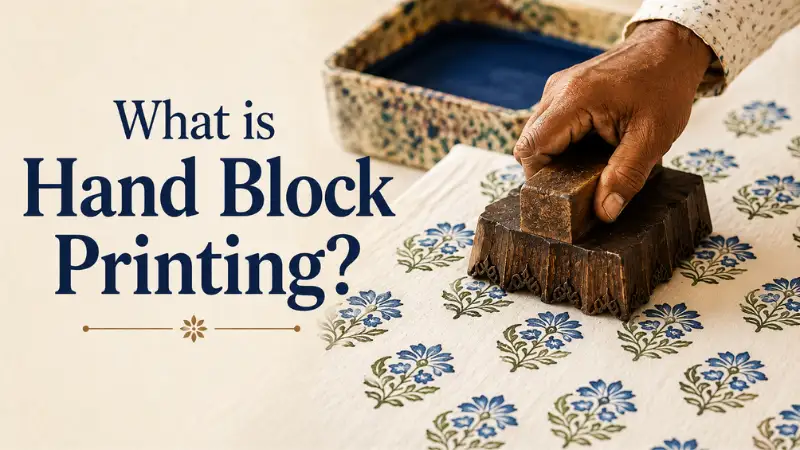
What is hand block printing? Hand block printing is an ancient textile art where carved wooden blocks are hand-stamped onto fabric, one impression at a time, using natural or pigment-based dyes. No machines. No automation. Every print is made by a skilled artisan.
Where does it come from? The craft has a 500-year-old history rooted in Sanganer and Bagru, two towns near Jaipur, Rajasthan, India. Both towns are home to the Chippa community, whose name literally means “to print.”
What are the main techniques? Sanganeri print, Bagru print, Dabu (mud resist), Phadat (discharge printing) and Kalamkari-influenced motifs are the primary techniques practiced in the Jaipur region.
What fabrics are used? Primarily 100% cotton. Sometimes silk, linen or cotton-silk blends depending on the technique and end product.
Why does it matter today? Hand block printing is low-waste, artisan-led and fully traceable. It is one of the most sustainable textile production methods in the world and is increasingly sought after by conscious fashion brands and wholesale buyers globally.
Who practices it? Close to 20,000 artisans across Sanganer and Bagru depend on this craft for their livelihood, according to the Craft Council of India.
There is a sound that stays with you once you have heard it. A steady, rhythmic thud of carved wood meeting stretched cotton, repeated hundreds of times across a single piece of fabric. To the artisans who have grown up with it, it is not noise. It is music. It is the sound of a craft that has been alive for over 500 years, and the sound of a family tradition being carried forward one stamp at a time.
That rhythm is the heartbeat of hand block printing. An art form practiced across generations in the narrow lanes of Jaipur’s twin textile towns, Sanganer and Bagru. It is not a factory process. It is not a machine simulation. It is a skill passed from grandparent to grandchild, learned through years of watching, practising and slowly earning the right to call yourself a craftsperson.
At Moharis, this is not just the product we make. It is the reason we exist.
What Exactly is Hand Block Printing?
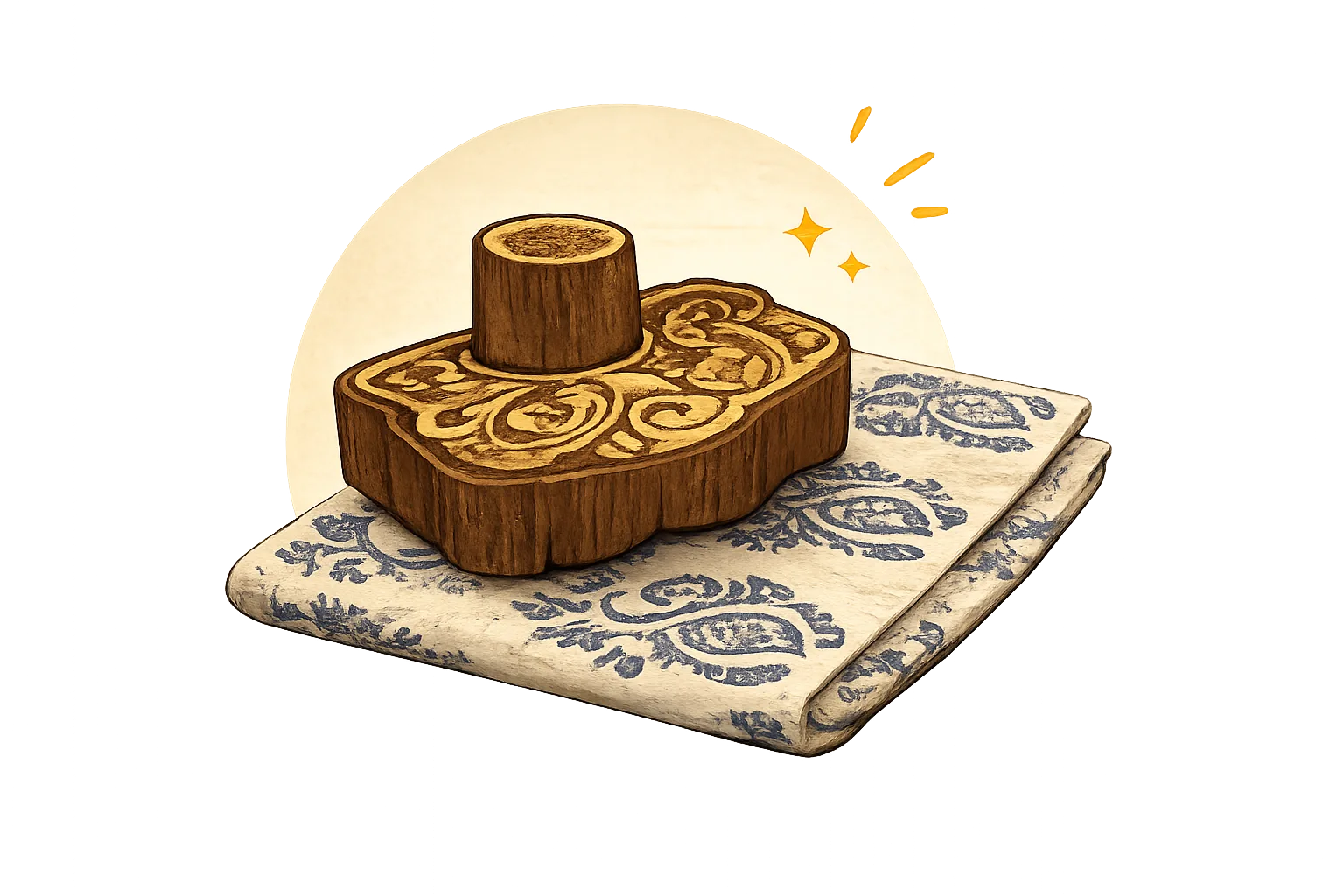
Hand block printing is a textile printing method where carved wooden blocks are dipped in dye or pigment and pressed by hand, one stamp at a time, onto fabric. The word “Mohari” itself comes from the Hindi word Mohar, meaning stamp. That connection is not accidental. It is the entire philosophy of what we do.
Each block is carved from seasoned sheesham (rosewood) or teak wood by specialist wood carvers. The carving alone can take days, sometimes weeks, depending on the intricacy of the motif. Once ready, a block becomes a tool that a skilled artisan will use thousands of times, pressing it with exactly the right pressure, at exactly the right angle, to create a print that is precise yet visibly human.
That visible humanity is the whole point. A slight variation in pressure, a ghost impression where the block lifted unevenly, a hairline irregularity in the repeat, these are not flaws. They are proof. Proof that a person made this, not a machine.
A 500-Year-Old Craft with Deep Roots in Jaipur
The towns of Sanganer and Bagru, both located near Jaipur in Rajasthan, carry a 500-year-old history of hand block printing. According to the Craft Council of India, between these two towns alone, close to 20,000 people depend on this craft for their livelihood. Entire families, entire communities, entire generations.
The craft arrived in Jaipur through the Chippa community, whose very name means “to print.” For centuries, block printing was not a business. It was a way of life. Patterns were printed onto fabric for personal use, for local markets, for celebrating seasons and rituals. The blocks carved in one generation were used by the next.
Sanganer’s printing tradition is so distinct and so regionally specific that it has received a Geographical Indication (GI) certificate from the Government of India. This means that only fabric printed within Sanganer can legally be called Sanganeri print. It is a recognition of authenticity that very few crafts in India have earned, and a protection that matters enormously for the artisans who have built their lives around it.
How Hand Block Printing is Actually Done
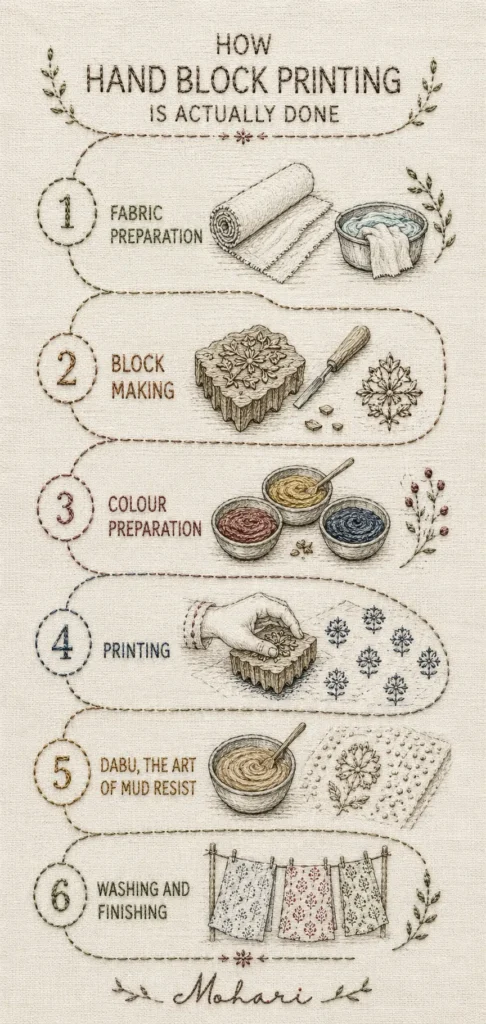
The process is longer and more layered than most people imagine. Here is what actually happens before a piece of block printed fabric reaches your hands.
Step 1: Fabric Preparation
Raw fabric, most commonly 100% cotton, is washed thoroughly and soaked in warm water for up to 12 hours. This removes all traces of starch, oil and dust from the manufacturing process. The fabric then dries in the sun before anything else begins.
For natural dye methods used in Bagru, the fabric isx (myrobalan fruit), which is naturally rich in tannin. This treatment prepares the fabric to accept and hold natural dyes, and gives it a faint warm yellow tone that is characteristic of traditionally processed cloth.
Step 2: Block Making
A few streets away from the printing tables, specialist carvers chip away at sheesham blocks with small chisels and mallets. Designs are first drawn onto paper, then transferred onto the wood and carved out entirely by hand. The finest motifs, a buti smaller than your thumbnail repeated 200 times across a length of fabric, can take a carver a full week to complete.
The craft of block making is its own specialisation. Good carvers are as rare and respected as good printers. At Moharis, the quality of a print begins here.
Step 3: Colour Preparation
This is where the two great traditions of Jaipur block printing part ways, and it is worth understanding both.
In Sanganer, vibrant pigments are mixed with binders to create colour pastes that produce clear, sharp impressions on the fabric surface. Sanganeri prints are known for their brightness, fine detailing and light-coloured backgrounds.
In Bagru, the tradition runs deeper into natural materials. Indigo blues are derived from the Indigofera tinctoria plant, stored and fermented in dye vats 10 to 12 feet deep. Reds are created by mixing alum, red clay (lal mitti) and babul bark in carefully balanced proportions. Grays come from alum alone. Blacks come from syahi, a fermented mixture of iron scraps, jaggery and water, a preparation that can take several months to mature before it is ready to use.
Step 4: Printing
The artisan stands at a long, padded printing table covered in layers of jute and cloth. The block is dipped into a tray of colour, tapped lightly to distribute the dye evenly across its surface, then pressed firmly onto the fabric with the heel of the palm and a downward knock of the fist.
The block is lifted, repositioned along a guide mark, and pressed again. And again. And again. For a dress with an all-over pattern, this action may be repeated 400 or 500 times. The artisan keeps the pressure consistent, the alignment accurate, the rhythm steady. This is where years of practice become visible. A beginner’s print and a master’s print are not the same thing, and anyone with a trained eye can tell.
Step 5: Dabu, the Art of Mud Resist
Dabu is a technique unique to Bagru and one of the most extraordinary processes in Indian textile making. Rather than printing colour onto fabric, Dabu blocks print a resist paste made from black clay, lime water, natural gum (bedan) and spoiled wheat onto the areas of the fabric that should remain uncoloured.
A fine dusting of sawdust is sprinkled over the wet paste to prevent the fabric from sticking to itself during drying. The fabric is then dipped into the dye vat. The areas covered in mud resist accept no colour. When the fabric is finally washed, the mud comes off and reveals a pale or white motif against a richly dyed background, a photographic negative of the standard block printing technique.
The result is unlike anything a machine can replicate. It carries the organic texture of mud, the depth of natural indigo, and an imprecision that makes each piece feel genuinely alive.
Step 6: Washing and Finishing
After printing, the fabric goes through kulai, a thorough washing process that removes excess colour and, in Dabu printing, the remaining mud paste. The fabric is then laid flat on the ground or on drying racks in open air. Sunlight plays an active role here. Certain natural dyes deepen and lock in colour when exposed to UV light during drying.
The finished fabric is inspected, folded and prepared either for cutting and stitching or for shipping as fabric. Every piece is slightly different from the last. That is not a quality issue. That is the entire point.
The Techniques: More Than One Kind of Block Printing
Hand block printing is not a single technique. It is a family of techniques, and Jaipur is home to several distinct traditions.
Sanganeri Print: Fine, delicate motifs. Often floral. Always detailed. Bright pigments on white or light backgrounds. The signature print of Sanganer, protected by GI tag.
Bagru Print: Earthy, bold, deeply traditional. Natural dyes on natural fabrics. Strong geometric and paisley motifs. The print tradition of the Chippa community of Bagru.
Dabu Print: The mud-resist technique described above. Produces light motifs on dark backgrounds. Always hand-applied, always organic in character, always beautiful.
Phadat: A discharge printing technique where dye is removed from pre-dyed fabric to create the pattern, rather than adding dye to undyed fabric. A technique that requires precise control and deep material knowledge.
Kalamkari-influenced prints: Although Kalamkari originates from Andhra Pradesh, its motifs and narrative visual language, drawn with a pen-like brush called a kalam, are widely incorporated into Jaipur block printing as part of the region’s design vocabulary.
Each technique produces a different visual character, a different feel and a different story. At Moharis, our catalog draws from all of these traditions, blending heritage techniques with contemporary silhouettes designed for global markets.
Why This Craft is Worth Fighting For
Here is something that is rarely said clearly: this craft faces a real threat. Not from lack of demand. Ironically, global demand for hand block printed textiles has never been stronger. Boutiques across Europe, lifestyle brands in North America, conscious wholesale buyers worldwide, they want exactly what Jaipur makes.
The challenge comes from within the industry itself. According to research conducted by the Hazard Centre under the European Commission’s Switch Asia project, occupational health concerns are among the leading causes of disillusionment among block printing artisans. Years of working in confined spaces, handling dyes, and maintaining precise posture at printing tables take a cumulative physical toll. Studies found respiratory concerns among a significant proportion of artisans engaged in colour mixing and printing work.
Beyond physical conditions, there is an economic reality. Artisans who have spent decades mastering this craft often feel disconnected from the value their work generates in global markets. Wages have not kept pace with the rising commercial value of the product. And so, experienced craftspeople hesitate to encourage the next generation to follow the same path.
This is the contradiction at the heart of the Indian block printing industry. A booming market. A shrinking workforce of genuinely skilled practitioners.
The solution is not charity. It is fair, consistent, long-term partnership between makers and buyers. At Moharis, that partnership is built into our model. Artisans working with us earn above living wage. Their families are stable. More than half of our team are women. We began small, with limited equipment and a large conviction, and we have grown by staying true to the belief that a craft this extraordinary deserves to sustain the people who practice it.
Why Hand Block Printing is the Right Choice for Conscious Wholesale Buyers
For brands and boutiques sourcing from India, the question is increasingly not just “what does it look like?” but “how was it made, by whom, and at what cost to people and planet?”
Hand block printing answers all three better than almost any other textile process.
It is low-waste by nature. The technique uses significantly less water than screen printing or rotary printing. Blocks are reused for years. At Moharis, fabric scraps are turned into quilts, bags, scrunchies and patchwork products. Nothing goes to landfill.
It uses natural and certified materials. Our fabrics carry GOTS certification. Our dyes are AZO-free and REACH compliant. The full detail of our sustainable manufacturing process is available here.
It is genuinely handmade. Not “handmade-inspired.” Not “artisan-style.” A human being made every single print on every single piece of fabric you receive. That is a story your customers want to hear, and one you can tell with complete honesty.
It supports real communities. According to the UNESCO Creative Cities Network, Jaipur’s craft economy is one of the most significant in Asia. When you place a wholesale order with a responsible manufacturer, you are not just buying a product. You are sustaining a 500-year-old skill, keeping families employed, and contributing to a living cultural heritage that the world would be genuinely poorer without.
How to Identify Genuine Hand Block Printing
As demand grows globally, so does the imitation. Machine-printed fabric is increasingly marketed as “block print” in wholesale and retail channels. Here is what to look for when verifying authenticity.
Slight irregularities in the repeat. A machine repeat is mathematically perfect. A hand block repeat carries tiny shifts, overlaps and organic breathing room between motifs. This variation is your proof.
Ghost impressions. When a block is lifted after printing, it sometimes leaves a faint secondary impression nearby. This only occurs in hand printing
Variation in colour depth within a single motif. Hand-dipped blocks carry slightly more colour at the centre than at the edges. This gradation is a signature of the handmade process that machine printing cannot replicate.
The feel of natural dyes. Genuine natural-dye block prints have a softness and depth of colour that synthetic machine prints do not possess. The colour sits within the fabric, not on top of it.
A Living Craft, Not a Museum Piece
It would be easy to frame hand block printing as a relic, something to be preserved under glass and admired from a careful distance. That would be exactly the wrong way to think about it.
This is a living craft. It evolves with demand, with design, with the creative instincts of the artisans and designers who practice it every day. At Moharis, antique Mughal-inspired motifs sit alongside contemporary geometric patterns. Traditional Sanganeri florals appear on modern silhouettes. Dabu-dyed fabrics are cut into dresses that sell in boutiques from Berlin to Brisbane.
The craft is not stuck in the past. It is being carried forward, one stamp at a time, by skilled hands that learned from their parents, who learned from theirs. And as long as buyers, brands and boutiques continue to choose genuine over imitation, craft over convenience, this sound, the rhythm of wood on cotton, will keep going.
It is beautiful work. It deserves to last.
Moharis is a Jaipur-based manufacturer, exporter and wholesaler of hand block printed clothing, fabrics and home linen. We work with boutiques, sustainable fashion brands and sourcing companies across the USA, Europe and the Middle East. For wholesale inquiries, explore our catalog or visit our sustainable practices page.