Quick Summary
- Sanganeri print is a direct hand block printing tradition from Sanganer, a town about 16 kilometres south of Jaipur, known for fine floral motifs on white or pastel cotton.
- The craft was built by Chhipa artisans who migrated to Sanganer in the 17th century, drawn by river water that suited their bleaching and dyeing methods.
- It reached its peak under Maharaja Sawai Jai Singh II, the founder of Jaipur, and was later exported to Europe as chintz through the East India Companies.
- After a sharp decline in the industrial era, the craft was revived from the 1970s through partnerships between artisans and design-led brands such as Anokhi.
- The motif vocabulary is built on four structures: buti, buta, bel and jaal, drawing on Mughal botanicals and, later, European florals.
- Sanganeri Hand Block Printing holds a Geographical Indication under Application No. 147. The GI specification permits both natural and synthetic dyes, so “Sanganeri” alone does not mean naturally dyed.
- Environmental compliance is now the cluster’s biggest pressure point, with court orders, closures and a push toward Zero Liquid Discharge treatment.
- Genuine Sanganeri print shows strong dye penetration on the reverse, small registration overlaps and soft, slightly uneven block edges.
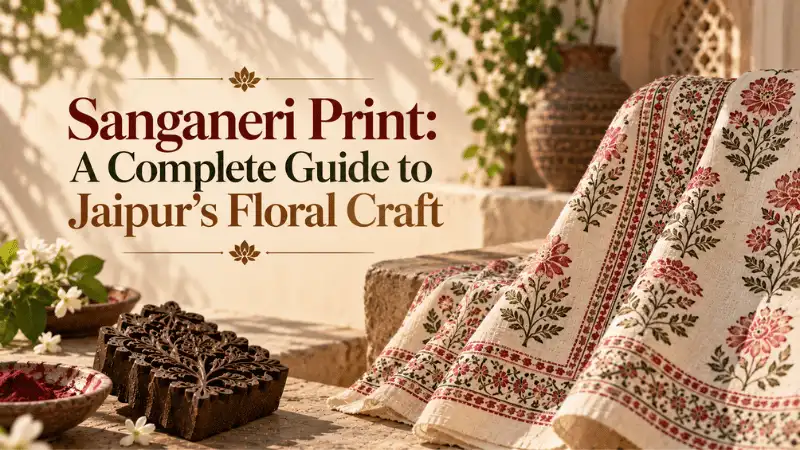
Put a length of Sanganeri print on a table and the first thing you notice is the space. Small flowers sit on a clean white ground, evenly spaced, with crisp dark outlines and soft fills of red, ochre and green. Nothing feels crowded. It is one of the most recognisable looks in Indian textiles, and one of the most copied.
We have already compared it with its neighbour in our guide to Sanganeri vs Bagru prints. This piece goes deeper into Sanganeri on its own: how the craft was built, how it is made today, the motif language buyers should know, and what to check before you source it.
Also Read: What is Hand Block Printing?
How Sanganer Became a Printing Centre
A Town Built Around Water
Sanganer was founded in the early 16th century and named after Sanga, a prince of the Kachhwaha dynasty. For its first century it was a modest town. Its rise as a printing centre came later, through migration.
In the 17th century, Chhipa printing families left Gujarat and neighbouring regions to escape political instability and settled in Rajputana. Many chose Sanganer for one reason: its river. The water of the Saraswati, also recorded as the Dhoondh, Amanishah and Dravyavati, had a mineral profile that worked well with harda, alum and natural dyes. Printers credited it with helping them achieve bright whites and clear reds and blacks.
Royal Patronage Under Jai Singh II
The craft reached its height in the 18th century under Maharaja Sawai Jai Singh II, who founded Jaipur in 1727. He settled artisans in dedicated neighbourhoods and brought printing into the royal economy. Sanganer’s printers produced fine multicoloured work for the court alongside simpler red and black prints for everyday wear. Our guide to why Jaipur is the capital of block printing covers this patronage system in detail.
Sanganer and the Chintz Trade
By the 18th century, printed cottons from Rajasthan and other Indian centres had become prized in Europe under the name chintz, from the Hindi chheent, meaning spotted or sprinkled. The V&A’s history of Indian chintz shows how deeply these colourfast floral cottons shaped European taste, and how long Indian dyers kept the technique to themselves. In the early 20th century, the British scholar Sir George Watt described Sanganer as the leading centre of calico printing in India.
Decline and Revival
Machine-printed cloth from British mills flooded Indian markets through the 19th and early 20th centuries, and hand printing in Sanganer went into a long decline.
The revival came from a new kind of partnership. From 1970, the Jaipur brand Anokhi, founded by Faith and John Singh, began working with block printers to make contemporary garments for international buyers, proving there was still demand for the craft at a global level. In 2005, Rachel Bracken-Singh and Pritam Singh opened the Anokhi Museum of Hand Printing in a restored haveli in Amber, which now documents historical blocks, records artisans’ knowledge and runs live printing demonstrations.
The Chhipa Community of Sanganer Today
The Chhipa name comes from chhapna, to print or stamp. Skills still pass largely within families: how to mix syahi, how to read a fabric before printing, how to align a block by eye across a 20-metre table.
Numbers for the cluster vary depending on what is counted. Craft profiles linked to the GI application point to around 800 core Chhipa families, other craft studies cite around 3,000 active artisans, and wider surveys that include screen printing, dyeing, carving and stitching put the total workforce well above 20,000. When a supplier quotes a figure, it is worth asking which of these they mean.
The printers depend on a second group of specialists: the block carvers. Fine Sanganeri blocks are cut from seasoned teak or sheesham, and a detailed block can take a skilled carver several days. Without their precision, the delicate outlines Sanganer is known for would not be possible.
How Sanganeri Print is Made
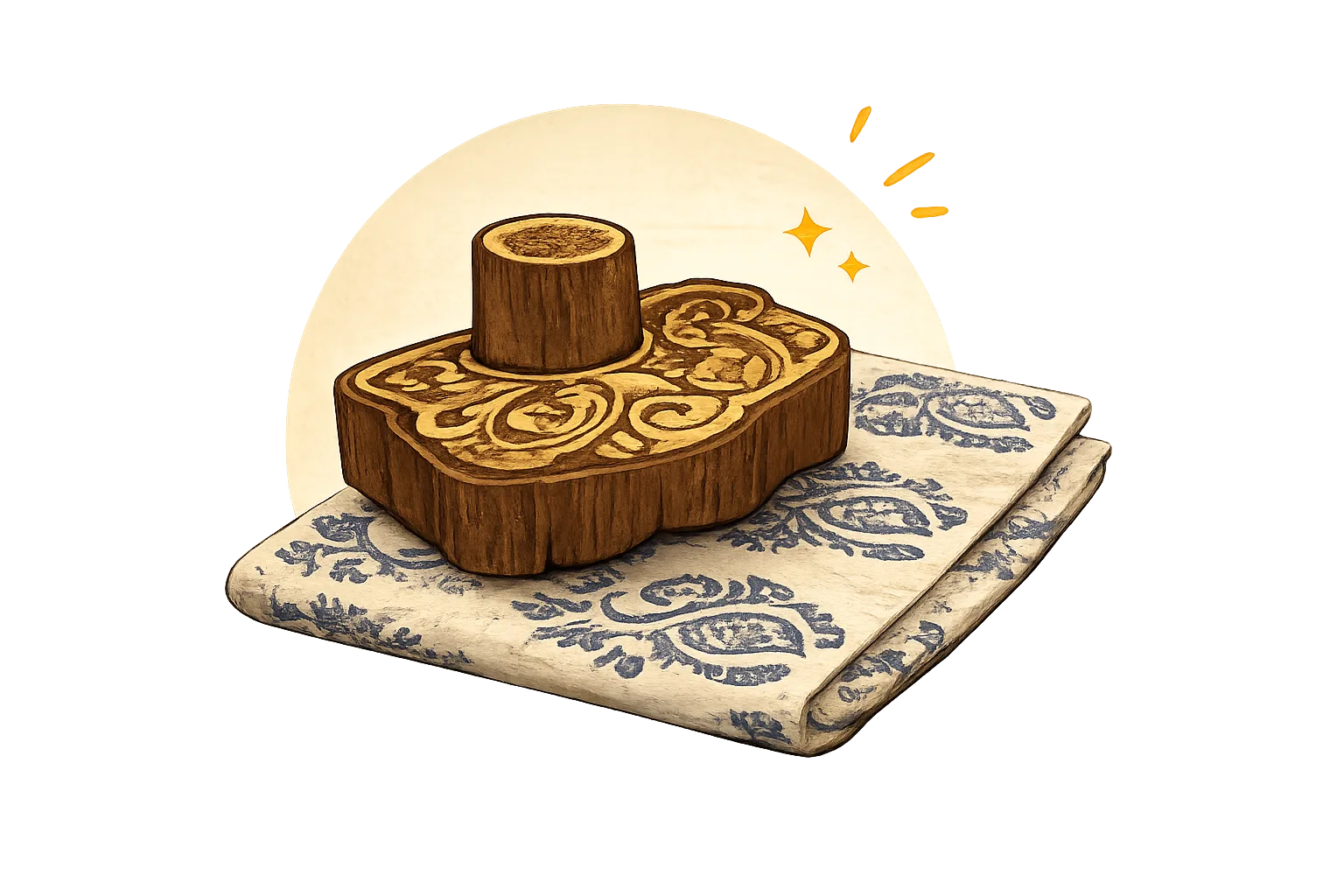
Sanganeri print is a direct printing method. Colour, or a colour-forming mordant, is stamped straight onto prepared white cloth, rather than applied through a mud resist as in Bagru. The traditional sequence looks like this:
| Stage | Local term | What happens |
| Scouring | Teluni | Raw cotton is soaked and washed to strip mill starch and oils. Traditionally this used dung and water; today bleaching is more common |
| Pre-mordanting | Pila Karna | The cloth is treated with harda (myrobalan), whose tannins help colours bond. It leaves a pale yellow tint |
| Outline printing | Rekh | The outline block is stamped, usually in syahi (black) or begar (red) |
| Filling | Datta and gadh | Filler and background blocks add each colour, one full pass per colour, with drying between passes |
| Washing | The cloth is rinsed to remove printing gums without letting colour run onto the white ground | |
| Colour development | The cloth is boiled with madder (alizarin) and dhawdi flowers. The alum turns red, the iron turns black, and the flowers help keep the white ground clean | |
| Sun bleaching | Tapai | The cloth is spread in the sun and sprinkled with water over several days, which bleaches the harda tint back to white and sets the colours |
| Finishing | Final washing, drying, softening and pressing |
The two classic colours are chemistry rather than paint. Syahi is made by fermenting scrap iron with jaggery and water for two weeks or more, producing an iron acetate that reacts with the harda to form a permanent black. Begar is an alum paste, often mixed with red ochre and gum, which only becomes red when boiled with madder.
Some designs add a dabu resist and an indigo dip to colour the background, which is where Sanganer and Bagru techniques overlap. For a full walkthrough of the stages, see our guide to how hand block print fabric is made.
The Sanganeri Motif Vocabulary
Buyers who know these terms can brief a design far more precisely.
Buti is a small, single floral sprig repeated across the cloth. The even, rhythmic spacing of butis on white is the signature of Sanganeri print.
Buta is a larger standalone flower or plant, often used as a focal motif on home linen or placed along borders.
Bel is a continuous vine or creeper border, used for hems, edges and dupatta borders.
Jaal is an all-over trellis or net. It demands the most accurate block registration, because a small misalignment breaks the repeat across the whole length.
The archive of Sanganeri motifs runs to several hundred designs. Common flowers include the lotus, rose, marigold, sunflower and lily, along with the paisley-like keri. Birds such as peacocks and parrots also appear.
Mughal Symmetry and the European Rose
Two influences shaped the look. Mughal taste brought Indo-Persian botanicals such as tulips, poppies and irises, drawn with fine outlines, careful symmetry and plenty of white space. Contact with European buyers is often credited with bringing in looser, fuller roses, sometimes called cabbage roses, adapted to suit Western export markets. Many of today’s best-selling Sanganeri florals sit somewhere between the two.
Motif Scale and Fabric
Scale and cloth go together. Fine, tightly spaced butis are printed on light apparel fabrics such as cambric and mulmul. Larger butas and broad jaals suit heavier sheeting for bedding and table linen. Our guide to natural fabrics from India for block printing covers the constructions and GSM ranges in detail.
Doo-rookhi: Double-Sided Sanganeri Printing
Doo-rookhi means two-faced. In this technique, the printer stamps the design on the front of the cloth and then prints the same motif on the reverse, aligned exactly. On fine mulmul, the printer relies on the slight translucency of the cloth to find each strike point.
It doubles the printing time and dye use, and a small error ruins the piece. Genuine doo-rookhi is now rare and mostly reserved for special commissions and collectors. If you are curious how double-sided printing works in another tradition, our guide to Ajrakh print explains the Kutch method.
Natural Dyes vs Synthetic Dyes in Sanganer Today
Many buyers assume every authentic Sanganeri print is naturally dyed. The reality is more practical.
Only a small number of family units in Sanganer still work exclusively with natural dyes. Most printers now use AZO-free pigments and reactive dyes, largely because export buyers want exact colour matching across large yardage, strong wash fastness and shorter lead times. Natural dyes shift with water chemistry, humidity and harvest, which makes strict colour matching difficult.
The GI specification reflects this. It permits both natural and synthetic dyes, which means a fabric hand printed in Sanganer with AZO-free pigments is still a genuine Sanganeri hand block print. If natural dyes matter to your brand story, specify them in your purchase order and verify them, rather than assuming the name guarantees it. Our guide to spotting real hand block print vs machine-printed imitations explains why printing method and dye type are two separate questions.
GI Protection and How to Verify It
Sanganeri Hand Block Printing is registered as a Geographical Indication:
| Detail | Record |
| Application number | 147 |
| Classes | 24 and 25 (textiles) |
| Filed | December 2008 |
| Registered | 2010 |
| Valid until | December 2028 (after renewal) |
| Registered proprietor | Calico Printers Cooperative Society Ltd., Sanganer |
The GI belongs to the craft and the region, not to one company. Individual printers and exporters must register as Authorized Users to use the name and logo officially. To check a supplier, ask for their Authorized User certificate and compare it against the GI Registry record for Application No. 147. Our manufacturer vetting guide covers what else to request.
Environmental Compliance: The Biggest Pressure on Sanganer
Decades of untreated effluent from dyeing and printing units polluted Sanganer’s groundwater and the Dravyavati river. In 2003, in Vijay Singh Punia vs Rajasthan State Pollution Control Board, the Rajasthan High Court took up the pollution and directed that a Common Effluent Treatment Plant be set up, with costs shared between government and the units.
Progress was slow. India Water Portal reported that the state pollution board served closure notices on around 893 Sanganer textile units, and in 2023 the National Green Tribunal ordered Rajasthan to pay ₹100 crore in interim compensation over river pollution linked to textile printing in Jaipur district.
The direction now is clear. Units are expected to hold a valid Consent to Operate and either connect to a CETP or run their own Zero Liquid Discharge system, which recovers most of the water through reverse osmosis and evaporates the remaining brine to solid salt.
For buyers, this matters commercially. A unit without valid consent can be shut down mid-season, and your order stops with it. Working with an eco friendly clothing manufacturer that can show its consent, treatment connection and waste records protects both your sustainability claims and your delivery dates.
What Sanganeri Print Works Best For
Sanganeri’s light grounds and fine florals suit warm-weather and soft-furnishing categories in the USA, UK, EU and Australia.
Apparel. Fine cambric and mulmul, roughly 50 to 100 GSM, carry Sanganeri prints into resort wear, summer dresses, tunics, kurtas and sleepwear. When choosing a hand block printed clothing supplier for these categories, ask to see how their fine butis hold up on lightweight fabric, since that is where weak registration shows first.
Home linen. Heavier cotton sheeting carries larger butas and jaals for bedding, cushion covers, table linen and the traditional Jaipuri razai quilt. For buyers sourcing block print bedsheets wholesale, Sanganeri florals on white remain one of the most consistent sellers for spring and summer ranges.
Against Bagru’s dark, earthy grounds, Sanganeri sits at the light, airy end of the market, which is why many collections combine the two. Our complete guide to Bagru block printing covers the other side of that pairing.
How to Identify Genuine Sanganeri Print
Beyond the general block print checks, these signs are specific to Sanganeri work:
- Reverse side. On light cambric and mulmul, a hand-stamped Sanganeri print shows clearly on the back. Screen and digital prints leave the reverse faint or blank.
- Outline and fill. Look where the rekh outline meets the colour fill. Small overlaps or hairline gaps are normal in hand work. Perfect registration across every motif points to a machine.
- Edges and depth. Wooden blocks leave slightly soft edges, and colour depth shifts gently along the length as hand pressure varies. Razor-sharp edges and flat, uniform colour suggest screen or digital printing.
- The white ground. Traditional Sanganeri whites have a slightly warm, clean quality rather than an optical-brightener glare, though this varies with modern bleaching.
- Paperwork. Ask for the Authorized User certificate and check it against the GI record.
Challenges Facing the Craft
- Imitations. Screen-printed and digital “Sanganeri style” fabric undercuts genuine printers on price and speed, and is often sold under the Sanganeri name.
- Cost of compliance. CETP connections and ZLD systems require major investment. Many small family units cannot afford them on their own and end up working as piece-rate printers for larger compliant firms.
- Generational change. The work is physically demanding, and younger family members increasingly look for jobs outside the craft.
Three Things Most People Do Not Know About Sanganeri Print
The river was part of the recipe. Printers settled in Sanganer for its water, and its minerals were long credited with the clarity of Sanganeri whites and reds. Water chemistry was as much an ingredient as harda or alum.
One of its best-known roses is partly European. The full, loose rose seen on many Sanganeri prints is often traced to designs adapted for European buyers, quite different from the tighter, symmetrical Mughal florals that came before.
“Sanganeri” does not mean natural dyes. The GI specification allows synthetic dyes, so a GI-compliant Sanganeri print can be made with AZO-free pigments. Dye type is a separate question every buyer should ask.
Conclusion
Sanganeri print has survived royal patronage, global trade, industrial collapse and environmental crackdowns because the look itself keeps finding new buyers. Fine florals on clean white cotton suit how people dress and decorate in warm months, and no machine reproduces the small irregularities that make the hand-printed version feel alive.
For buyers, the work is in the detail: knowing the motif language, asking the right questions about dyes, checking GI Authorized User status and confirming environmental compliance. Working with an experienced block print clothing manufacturer that can answer those questions clearly is what turns a beautiful sample into a reliable supply.
Explore our wholesale catalog at Moharis to see hand block printed clothing, fabrics and home linen made in Jaipur. Or read about the artisan community behind every piece we make.
Moharis is a Jaipur-based manufacturer, exporter and wholesaler of hand block printed clothing, fabrics and home linen. We work with boutiques, sustainable fashion brands and sourcing companies across the USA, Europe and the Middle East. For wholesale inquiries, write to us at info@moharis.com or visit our wholesale page.