Quick Summary
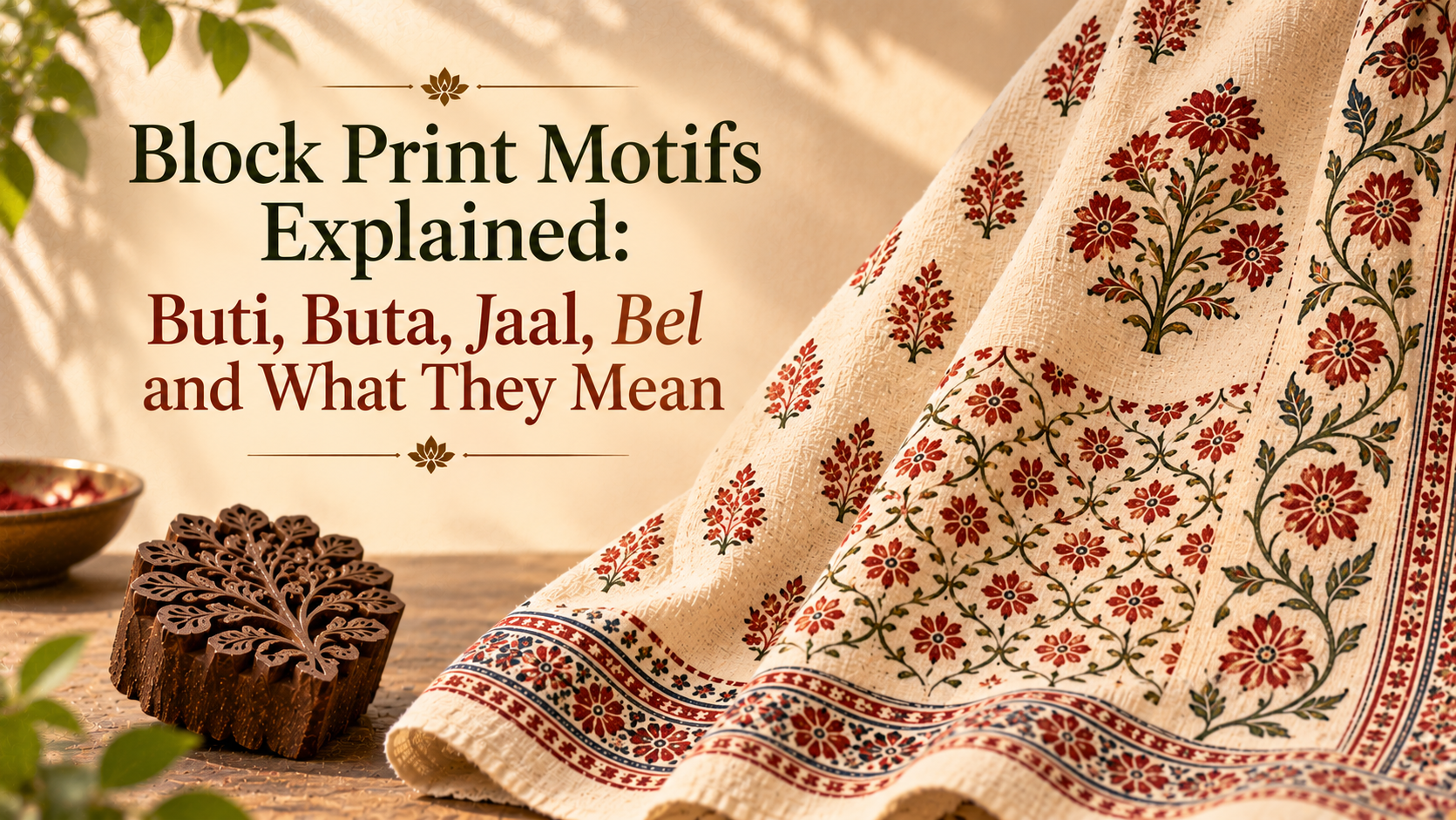
- Indian block print motifs follow a shared structural vocabulary: buti (small sprig), buta (large standalone motif), bel (running vine), jaal (all-over lattice), plus borders and pallus.
- Layout matters as much as the motif. All-over, half-drop, brick, stripe and border-and-field repeats each change how a print reads on a garment or bed.
- Floral motifs evolved through layers of influence: indigenous symbols, Mughal and Persian botanicals, and later hybrid florals made for European buyers.
- Animal motifs like the peacock, elephant and parrot are common in Rajasthan’s Hindu printing clusters, while Ajrakh and Bagh traditions rely on geometry and stylised florals instead of figures.
- Paisley is not Scottish. It began as the Persian boteh, became the Indian keri, and took its English name from the Scottish town that mass-produced copies.
- Every motif needs a set of blocks (outline, filler, background), so motif complexity directly affects carving time and sampling cost.
- Motif scale has to match fabric weight. Fine butis need smooth, light cotton; large butas and jaals suit heavier sheeting.
- Under Indian law, an unregistered custom design can lose copyright protection once it is industrially applied to more than 50 articles. Buyers developing exclusive motifs should register them.
Ask a block printer in Jaipur for “a small flower all over” and you will get a sample. Ask for “a ladoo buti in a half-drop repeat, rekh in black, datta in madder, on 60s cambric” and you will get what you actually had in mind. Block print motifs come with a working vocabulary that has been refined over centuries, and buyers who learn it make better briefs, get faster approvals and avoid costly resampling.
This guide covers that vocabulary, the meanings behind the most common motifs, what each major tradition prints, and the practical side: blocks, scale, briefs and design ownership.
Also Read: What is Hand Block Printing?
The Structural Vocabulary of Block Print Motifs
These terms describe a motif’s size, placement and job within the cloth.
| Term | What it is | Typical scale and placement |
| Buti | A small, standalone motif, usually a floral sprig | Roughly 1 to 3 inches; repeated across the main field |
| Buta | A larger, more detailed standalone motif, such as a flowering plant, paisley or Tree of Life | Roughly 4 to 12 inches; a focal point, often near hems or spaced across home linen |
| Butidar | A layout where the field is covered in repeating butis or butas | Covers the main body of the cloth |
| Bel | A continuous vine or creeper | Usually 2 to 6 inches wide; stripes, frames and edges |
| Jaal | An all-over lattice or net, floral or geometric | Covers the whole field; the most demanding to register |
| Buti-jaal | A jaal with small butis placed inside each opening | Whole field; needs precise alignment between lattice and filler blocks |
| Kinar (border) | The outer edge band that contains the field design | 1 to 8 inches, along the selvedge or hem |
| Pallu | The decorated end panel of a sari, scarf or dupatta | Often 12 to 36 inches deep, with the largest butas and stacked bels |
How Motifs Are Laid Out: Repeat Systems
A good motif can still look wrong in the wrong repeat. These are the layouts printers use most:
- All-over (straight) repeat. Motifs line up in strict rows and columns. Clean and orderly, common for butis on shirting.
- Half-drop repeat. Every second column drops by half a motif height, creating a diagonal flow and hiding the edges of each block. Popular for florals on dresses.
- Brick repeat. Similar to half-drop, but the shift runs horizontally, row by row.
- Stripe layout. Bels or butis printed in vertical or horizontal bands.
- Border-and-field. A central field, often a jaal or buti, framed by a kinar. Common on tablecloths, bedcovers, scarves and saris. The field has to end cleanly where the border begins, which takes careful planning.
Printers keep these repeats accurate across long tables with chalk grids snapped onto the stretched fabric, and with pitch pins: small points at the corners of the block that leave faint dots to guide the next impression. In genuine hand printing those dots wander slightly, which is one of the signs covered in our guide to spotting real hand block print vs machine imitations.
Floral Motifs and Where They Came From
Florals are the backbone of Indian block printing, but they did not arrive all at once.
Early prints leaned towards stylised and geometric forms. The lotus (kamal), tied in Hindu tradition to purity and divine birth, is one of the oldest and most enduring motifs.
Mughal patronage in the 16th and 17th centuries brought a love of gardens and close botanical observation. The rose (gulab), marigold (genda), lily, poppy, tulip and iris entered the printed vocabulary, often drawn with careful, almost scientific detail. Persian taste added symmetry: central flowers balanced by evenly placed leaves and buds.
From the 17th century, European trading companies shaped designs again. As the Metropolitan Museum’s essay on Indian textiles explains, Indian makers adapted their designs for specific export markets, producing flowering trees and hybrid blooms that suited European taste. That blend of Indian, Persian and European elements still defines many florals sold today, especially in Sanganer. Our Sanganeri print guide looks at how those layers show up in Sanganeri work specifically.
Animal Motifs and the Traditions That Avoid Them
Animal motifs are common in Rajasthan’s Hindu printing clusters, including Bagru and Akola, and each carries its own meaning:
- Peacock (mor): grace, beauty and the arrival of the monsoon, which is why it is so loved in desert regions
- Elephant (haathi): strength, royalty and good fortune, often seen on wedding textiles
- Parrot (tota): love and courtship
- Fish: fertility and abundance
- Horse: status and movement
Other traditions take a different path. Ajrakh in Kutch and Barmer, and Bagh in Madhya Pradesh, are practised by Muslim Khatri printing communities, and their classic designs avoid human and animal figures in favour of geometry, stars, lattices and stylised florals. Asking a traditional Ajrakh workshop for an elephant buti shows a misunderstanding of the craft. Our guide to Ajrakh print explains its motif language in more depth.
Geometric and Symbolic Motifs
Paisley (keri or boteh). The teardrop shape began as the Persian boteh and became the Indian keri, linked to the mango and to fertility and abundance. The English name comes from Paisley in Scotland, whose mills mass-produced imitations of Kashmiri shawls in the 19th century. The V&A’s history of the Paisley pattern traces that journey. In northern India the motif is also called kalka.
Tree of Life. A tree linking roots, trunk and branches, often read as a link between earth and heaven, and a signature of block-printed Machilipatnam Kalamkari. See our guide to Kalamkari for more.
Jali (lattice). Drawn from the carved stone screens of Mughal and Rajput architecture, the jali translates filtered light and repeating geometry into cloth.
Trefoil (kakad). A three-lobed cloud form central to Ajrakh, often compared with the pattern on the robe of the Priest-King figure from Mohenjo-Daro.
Chakra, diamond, star and chevron. The chakra suggests cycles and time, stars fill Ajrakh’s night-sky palette, and chevrons and zigzags are often read as flowing water.
Signature Motifs by Tradition
| Tradition | Region | Motif character |
| Sanganeri | Sanganer, near Jaipur | Fine florals, butis, bels and jaals on white or pastel grounds |
| Bagru and Dabu | Bagru, near Jaipur | Bolder florals, folk and geometric motifs on earthy, indigo and dark grounds |
| Ajrakh | Kutch and Barmer | Strict geometric tessellations, stars, kakad and lattices in indigo, madder and black |
| Bagh | Dhar district, Madhya Pradesh | Geometric and floral designs, typically red and black on white |
| Machilipatnam Kalamkari | Andhra Pradesh | Persian florals, Tree of Life, creepers and arabesques |
| Akola Dabu | Chittorgarh, Rajasthan | Bold mud-resist motifs in indigo with a visible crackle |
Bagru is protected under GI Application No. 183, and our Sanganeri vs Bagru comparison sets the two Jaipur traditions side by side. Akola is less known internationally; the craft archive Gaatha documents its dabu motifs and the skirts they were traditionally printed for.
What Artisans Call Their Motifs
Printers often name motifs after everyday things they resemble. Using these names in a brief helps a workshop understand exactly what you mean:
| Motif name | Meaning | What it looks like |
| Ladoo buti | After the round sweet | A small, rounded cluster of petals |
| Mirchi buti | Chilli pepper | A slim, curved, tapering sprig |
| Chameli | Jasmine | A tiny five-petalled flower, ideal as a jaal filler |
| Keri / kalka | Mango / paisley | The teardrop paisley in its many forms |
| Rui phool | Cotton flower | A soft, open bloom with plenty of white space |
Names vary between workshops and regions, so treat these as a shared starting point and always confirm with a drawing.
Motifs in Social and Ritual Life
Block print motifs were never purely decorative. In many Rajasthan communities, the combination of motif, scale and base colour could signal a wearer’s community, occupation or life stage. Particular colours and prints were reserved for weddings, festivals and temple offerings, with red and yellow carrying strong associations with auspiciousness. In Kutch, Ajrakh served as a marker of identity for herding communities, and in Akola, specific dabu prints were made for the skirts of particular local communities.
For brands, this history is a storytelling asset, but it should be told accurately. If you use a motif with ritual meaning, describe it correctly and avoid inventing symbolism.
How a Motif Becomes a Block
Every multi-colour motif needs a set of blocks, usually carved from teak or sheesham. The block print primer from House of Wandering Silk describes the three main types:
- Rekh: the outline block, carrying the finest lines. Very fine outlines sometimes use brass strips set into the wood.
- Datta: filler blocks, one per colour, that print inside the outline.
- Gadh: the background block, which colours the ground around the motif.
Carvers drill small holes through blocks so trapped air can escape when the block is struck, which keeps the impression clean. New blocks are then seasoned in oil before printing. Our guide to how hand block print fabric is made shows where carving fits into the full process.
What this means for buyers: a four-colour buti-jaal can need four or more blocks, and a fine rekh block alone can take a carver several days. Build block carving into your sampling timeline before you expect a first strike-off.
Matching Motif Scale to Fabric
A motif that looks perfect on screen can fail on the wrong cloth.
Light, smooth fabrics such as mulmul, voile, lawn and cambric hold fine butis and crisp rekh lines well. They suit dresses, shirts, scarves and resort wear.
Heavier or textured fabrics such as slub cotton, sheeting and canvas break up very fine lines. They are better for larger butas, bold jaals and dabu resist, where a softer edge adds character. These suit bedding, cushions, table linen and structured pieces.
Our guide to natural fabrics from India for block printing covers constructions and GSM in detail. Buyers working with a handcrafted home textiles supplier should match motif scale to the end product at the brief stage, not after the first sample.
Motif Trends in International Markets
Trend direction for the coming seasons points in two different ways by category.
Apparel and resort wear. Buyers are leaning towards prints that clearly show the human hand: softer edges, slight variation and natural-looking colour. Bold, widely spaced dabu and indigo motifs, geometric and lattice layouts, and pared-back minimal motifs are all getting attention alongside classic florals. The bohemian revival keeps hand block prints central to the category, as covered in our guide to bohemian fashion.
Home linen. Florals remain strong, often in denser, layered arrangements such as trailing stems and buti-jaal combinations, printed on warm neutral grounds like sand, oat and taupe rather than stark white.
Trend reports vary, so treat these as direction rather than rules, and test with sampling before committing to depth.
Who Owns a Custom Motif?
This is the part many buyers overlook. Paying for a block, or even owning it, does not by itself protect a design.
In India, textile designs sit between the Copyright Act, 1957 and the Designs Act, 2000. Under Section 15(2) of the Copyright Act, if a design could have been registered under the Designs Act but was not, its copyright ends once the design has been applied industrially to more than 50 articles. The Delhi High Court applied this in Ritika Private Limited vs Biba Apparels (2011), where a designer’s unregistered prints lost protection after commercial production.
In practical terms, a buyer who commissions an exclusive motif and produces it at scale without registering it may have little legal recourse if it is copied in India. Design registration is handled by the Office of the Controller General of Patents, Designs and Trade Marks. This is general information, not legal advice, so speak to an IP lawyer before bulk production of any exclusive design.
Contracts help too. Use a non-disclosure agreement drafted for Indian law, define who owns the artwork and the carved blocks, and state that blocks made for your design cannot be used for other customers or sold as factory seconds.
How to Brief a Manufacturer on Motifs
A clear motif brief saves weeks. Include:
- The motif and its name: artwork plus the vocabulary (buti, buta, bel, jaal) and any artisan name you are using.
- Scale and repeat: motif size in centimetres or inches, repeat type (straight, half-drop, brick) and repeat size.
- Colour by block: which colour goes on the rekh, each datta and the gadh.
- Dye type: pigment, reactive or natural. Natural dyes will vary slightly from batch to batch, so set realistic shade tolerances.
- Fabric: construction and GSM, matched to the motif scale.
- Strike-off: request a short test print on the actual production fabric before approving bulk.
- Ownership terms: design rights, block ownership and confidentiality, agreed in writing.
An experienced private label clothing manufacturer will ask for most of this anyway. Our manufacturer vetting guide covers the wider supplier checks.
Three Things Most People Do Not Know About Block Print Motifs
Paisley’s name is a historical accident. The motif is Persian and Indian in origin, but it is known worldwide by the name of a Scottish weaving town that copied it.
Air holes are part of the design. The small holes drilled through a block are not decoration. Without them, suction would lift the cloth and blur the print.
The crackle in dabu is the proof. Fine veins of colour inside dabu motifs come from the dried mud resist cracking before dyeing. Buyers sometimes mistake them for faults, but they are one of the clearest signs of genuine mud resist. Our guide to Dabu print explains why.
Conclusion
Block print motifs carry centuries of meaning, but for buyers they are also a practical tool. Knowing the vocabulary, the repeat systems, what each tradition prints and how motifs translate into blocks and fabric makes every brief clearer and every sample closer to what you wanted.
The final piece is ownership. If a motif is meant to be yours alone, protect it before production, not after you see it elsewhere. Working with an experienced handmade clothing manufacturer that understands both the craft and the paperwork makes that much easier.
Explore our wholesale catalog at Moharis to see hand block printed clothing, fabrics and home linen made in Jaipur. Or read about the artisan community behind every piece we make.
Moharis is a Jaipur-based manufacturer, exporter and wholesaler of hand block printed clothing, fabrics and home linen. We work with boutiques, sustainable fashion brands and sourcing companies across the USA, Europe and the Middle East. For wholesale inquiries, write to us at info@moharis.com or visit our wholesale page.