Quick Summary
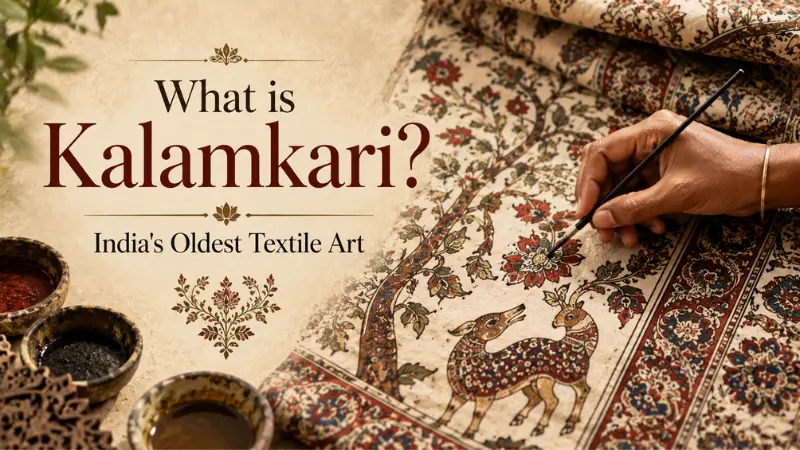
- Kalamkari is an ancient Indian textile art form involving the hand-painting or block-printing of intricate motifs onto natural fabric using exclusively organic, plant and mineral-based dyes. The word comes from the Persian qalam (pen) and kari (craftsmanship), meaning “pen-work.”
- Archaeological evidence links Kalamkari’s foundational mordant-dyeing techniques to the Indus Valley Civilisation at Mohenjo-Daro, circa 3000 BCE. Kalamkari-dyed cotton fragments have also been found in Egyptian tombs, confirming its role in ancient global maritime trade.
- There are two distinct schools: Srikalahasti, which is entirely hand-drawn using a bamboo pen called a kalam, and Machilipatnam, which uses intricately carved wooden blocks to stamp repeating patterns.
- The Srikalahasti process involves up to 23 distinct steps and takes 15 to 20 days per piece. It requires myrobalan fruit tannins, buffalo milk fat, iron-acetate black ink and specific mineral-rich river water at different stages of production. No synthetic chemicals are used at any point.
- The distinctive black outlines in Kalamkari come from Kasim Kaaram, an iron-acetate solution fermented for exactly 21 days in sealed earthen pots. It is not a painted pigment but a chemical reaction with the tannins in the treated fabric.
- Red is achieved when alizarin from the madder root reacts with alum previously painted onto the fabric during a high-temperature boiling phase. The colour does not exist in either ingredient alone. It forms through chemistry.
- Both Srikalahasti and Machilipatnam Kalamkari hold official Geographical Indication (GI) tags from the Government of India.
- A critically endangered third school, Karuppur Kalamkari from Tamil Nadu, incorporates gold brocade work and is currently practiced by only one surviving master artisan family.
- For wholesale buyers, Kalamkari offers a genuinely zero-chemical, fully biodegradable, deeply narrative textile with a verifiable 3,000-year lineage.
There is a textile art that begins with a pen, a piece of bamboo fitted with a cotton reservoir, dipped into an ink that has been fermenting in a sealed clay pot for three weeks. The fabric it touches has already been through cow dung, buffalo milk and river water. The colour that will eventually appear on that fabric does not exist yet. It will only come into being through a chemical reaction during a boiling stage that happens days later.
This is Kalamkari. And it has been practiced in some form for over three thousand years.
What Kalamkari Actually Is
At its most fundamental level, Kalamkari is the practice of painting or block-printing intricate designs onto natural fabric, primarily cotton or silk, using exclusively natural, plant-derived and mineral-based dyes. No synthetic chemicals. No industrial processing. No shortcuts.
The word is Persian in origin. Qalam means pen. Kari means craftsmanship or work. Kalamkari means pen-work. Before Islamic courts gave it this name, the indigenous Telugu-speaking artisans of the Coromandel Coast called it Vraathapani, combining the words for writing and work. The craft existed before it had a Persian name. The Persian name simply reflects the shift from temple-based patronage to international courtly commerce.
What makes Kalamkari genuinely distinct from other Indian textile arts is not just the use of natural dyes. Many traditions use natural dyes. What sets Kalamkari apart is the foundational reliance on a sequential, multi-stage chemical process where colour is not simply applied to fabric but is created through chemical reactions between mordants, dyes, tannins and heat. The artisan is not just a painter. They are, in the most literal sense, a chemist working with organic compounds that have been understood and refined over three millennia.
Kalamkari is also singular in its historical function as a medium of visual storytelling. It was not conceived primarily as textile ornamentation. It was designed to narrate complex mythological epics to agrarian communities who could not read. The fabric was the scripture. The painted figures were the text.
Three Thousand Years of History
The story begins not in a workshop but in the ground.
During excavations at Mohenjo-Daro, archaeologists found fragments of cotton cloth dyed with madder root, dating to approximately 3000 BCE. This is the earliest known evidence of the mordant-dyeing techniques that are fundamental to Kalamkari. The same basic chemistry, madder reacting with a metallic mordant to produce a permanent red on cotton, is still central to the craft today.
The international reach of Indian naturally dyed textiles was established millennia ago. Fragments of Indian mordant-dyed cotton, known as Fustat textiles, were discovered in Egyptian tombs near Cairo, confirming that India’s mastery of applying permanent natural colour to cotton was already facilitating global maritime trade before the Common Era. References to painted textiles, their botanical dye sources and their use in religious contexts appear throughout ancient Hindu Vedic texts and historical documentation of the Coromandel Coast’s maritime economy.
The craft began formalising its contemporary aesthetic under the Pallava and Chola dynasties between the 6th and 13th centuries CE, where painted cotton cloths served as ritual hangings and temple canopies across South India. But Kalamkari’s true golden age arrived under the Vijayanagara Empire between the 14th and 17th centuries. During this era, itinerant storytellers known as Chitrakattis traveled between villages carrying large, hand-painted fabric scrolls, using them as visual aids to narrate the Ramayana, the Mahabharata and the Puranas to audiences who experienced these epics through image rather than text. As temple architecture evolved, these scrolls transitioned from nomadic performance props into permanent devotional objects hung within temple sanctuaries.
The fall of the Vijayanagara Empire in 1565, following the Battle of Talikota, triggered a massive migration of Hindu artisans who relocated to the Deccan region seeking employment under the Islamic courts of the Golconda Sultanate. This migration produced one of the most significant aesthetic transformations in Indian textile history. To suit Islamic sensibilities, which generally discouraged the depiction of sentient beings in religious contexts, artisans adapted their techniques to produce secular textiles. Persian motifs entered the Kalamkari vocabulary: intricate floral arabesques, the Tree of Life, cypress trees, stylised peacocks. The coastal town of Machilipatnam emerged as the primary production and export hub for this new commercial tradition.
By the 17th century, Kalamkari’s technical supremacy had attracted the attention of every major European maritime trading power. The British, French and Dutch East India Companies recognised the commercial value of these colourfast, vibrant textiles, referring to them variously as Calico, Coromandel Chintz, Pintado and Sits. In 1665, French traveler François Bernier documented the exquisite floral fabrics sourced from Machilipatnam used for Emperor Alamgir’s tents, praising the vividness of the natural colours and correctly attributing them to the unique mineral properties of the local water. Kalamkari textiles became a cornerstone of the global spice trade, used as currency in Southeast Asia to secure spices for European markets. The Industrial Revolution and mass-produced machine printing in Europe nearly destroyed the industry by the late 18th and early 19th centuries. The craft survived, as it always had, through the intergenerational knowledge of the artisan communities who carried it.
The Two Schools: Srikalahasti and Machilipatnam
The diverse patronage systems that shaped Kalamkari over centuries produced two primary and distinctly different schools of practice within what is today the state of Andhra Pradesh. They share the same chemical foundations but diverge completely in method, aesthetic and intent.
Srikalahasti: The Temple Tradition
Srikalahasti is an ancient temple town in the Chittoor district of Andhra Pradesh, situated on the banks of the Swarnamukhi River. This school is the direct descendant of the indigenous temple traditions of the Vijayanagara Empire and is intrinsically linked to the Srikalahasti Shiva temple.
Everything in the Srikalahasti style is done by hand. Artisans use the bamboo kalam for every single stage of the process, from the first charcoal sketch to the final detail of colour. There are no wooden blocks, no mechanical aids, no repeated patterns. Each piece is entirely unique.
Because it evolved as a religious craft, the imagery is narrative and devotional. Continuous visual storytelling from Hindu mythology, depicting deities, epic battles, sacred architecture and the complex iconographic vocabulary of South Indian temple tradition. The linework is bold and strong, designed to be legible from a distance in the dim light of a temple interior.
Machilipatnam: The Commercial Tradition
Machilipatnam, on the Krishna district coast, developed as a commercial and export-oriented craft under successive patronage from the Golconda Sultanate, the Mughal Empire and European trading companies. The craft is also concentrated in the neighbouring town of Pedana, giving rise to the term Pedana Kalamkari.
Technically, Machilipatnam Kalamkari is a block-printing tradition. Artisans use intricately hand-carved wooden blocks made from seasoned teakwood to stamp designs onto fabric. The dye chemistry is identical to Srikalahasti, but the block allows for rapid repetition, perfect symmetry and scaled commercial production.
The aesthetic is overtly secular. Persian and Mughal motifs dominate: geometric arabesques, the Tree of Life, flowering creepers, stylised peacocks and parrots, intricate borders. These repeating patterns are highly suited to yardage, apparel and home furnishings, which is exactly what they were designed for.
Karuppur: The Forgotten Third School
While Srikalahasti and Machilipatnam dominate academic and commercial attention, a critically endangered third style exists in Tamil Nadu. Karuppur Kalamkari originated under Chola patronage and reached its peak under the Maratha rulers of Thanjavur in the 17th century. It integrates hand-painting on both silk and cotton using kalams fashioned from palm leaf stems rather than bamboo, and historically incorporated intricate gold brocade work into the painted designs, reserving the textiles strictly for royalty and high-status temple deities.
Today, Karuppur Kalamkari is practiced by only one surviving master artisan family in the village of Sikkalnayakanpet. It is one of the most beautiful and most endangered textile traditions anywhere in the world.
The Srikalahasti Process: 23 Steps, 20 Days, No Shortcuts
The production of authentic Srikalahasti Kalamkari involves up to 23 distinct sequential steps and takes between 15 and 20 days per piece. It is highly dependent on environmental conditions, particularly intense sunlight and the specific mineral composition of local river water. Every stage matters. Skipping or shortening any one of them changes the chemistry and compromises the result.
Fabric Selection and Scouring
The process begins with gaada, a locally produced, unbleached, loosely woven cotton. Its porosity is essential: the fibres must be open enough to fully accept the chemical treatments that follow. The fabric is soaked overnight in water and beaten thoroughly to remove all starches, sizing and surface impurities.
Natural Bleaching with Cow Dung
The scoured fabric undergoes natural bleaching, known as valu. It is treated with a mixture of fresh cow dung and water, then laid flat on the earth under direct sunlight for several hours. The mild bleaching properties of the dung combined with ultraviolet radiation produce a uniform off-white or cream base while maintaining the integrity of the cotton fibres. This is not a quirk of tradition. It is sound organic chemistry. Cow dung contains specific biological enzymes that strip industrial sizing and surface impurities from cotton without degrading the underlying cellulose, an ancient precursor to the enzymatic bio-scouring used in modern sustainable textile manufacturing.
The Myrobalan and Buffalo Milk Treatment
Once bleached, the fabric undergoes the most chemically critical preparatory step. It is steeped in a solution of crushed myrobalan fruit and flowers alongside fresh buffalo milk. For every 10 metres of cloth, approximately four litres of buffalo milk are used. The fabric is repeatedly opened and twisted to ensure the milk’s lipid content is evenly distributed across every fibre.
The myrobalan provides natural tannins that create a vast network of chemical binding sites along the cellulose framework of the cotton. These sites allow subsequent metallic mordants to anchor securely to the fabric. Without tannin treatment, the mordants would wash away.
Buffalo milk is specifically required, not cow’s milk. Buffalo milk contains a significantly higher fat content than cow’s milk. This fat creates a temporary hydrophobic barrier across the surface of the fibres. When the artisan subsequently applies liquid dye with the kalam pen, the fat physically prevents the dye from wicking outward through capillary action, allowing the razor-sharp, detailed linework that characterises the finest Srikalahasti pieces. This is not folklore. It is the physical chemistry of surface tension and capillary action, understood and applied empirically centuries before the vocabulary existed to describe it.
Charcoal Sketching
With the canvas chemically prepared, the artisan sketches the narrative design directly onto the treated cloth using charcoal pencils made by burning tamarind twigs and extinguishing them with sand before they turn to ash. These light, erasable lines provide the foundational geometry for the artwork.
The Kalam and the Black Outline
The artisan takes up the kalam, a sharpened bamboo or date-palm stick fitted with a rolled cotton reservoir secured by thread, and dips it into Kasim Kaaram, the black ink solution.
Kasim Kaaram is not a pigment. It is a chemical solution prepared by mixing rusted iron filings with cane jaggery and water in sealed earthen pots, left to ferment anaerobically for exactly 21 days. When this iron-acetate solution is applied to the myrobalan-treated fabric, the iron ions react with the embedded tannins to form a highly stable, insoluble compound called ferrous tannate, producing a deep, permanent black directly within the fibre matrix. The black does not sit on top of the fabric. It forms inside it.
Alum Application and River Washing
Once the black outlines are established and dried, the artisan paints the areas designated to become red with an alum solution. The cloth rests for a minimum of 24 hours to allow the alum to penetrate the fibres deeply.
Before the red dye can be applied, the fabric must undergo its first major river wash. It is taken to a flowing river, traditionally the Swarnamukhi, and washed thoroughly to remove all excess, unbonded alum and Kasim Kaaram. Running water is specifically required. Still water would allow unbonded chemicals to redeposit onto unintended areas of the cloth.
The Madder Boil: Where Red Is Born
The fabric is then boiled in a large copper vessel containing water and madder root extract (Rubia cordifolia), alongside local bark additives. During the boiling phase, the alizarin molecules in the madder react exclusively with the areas previously painted with alum, forming a stable chemical complex that produces a deep, permanent red. The areas protected only by the myrobalan treatment resist the red entirely. The colour does not exist in the madder alone or in the alum alone. It only appears through the chemical reaction between them under heat. This is mordant dyeing in its purest form.
Second Buffalo Milk Treatment
After boiling and washing, the fabric must undergo a second application of buffalo milk to restore the lipid boundary degraded by the heat of the boiling phase. Without this restoration, the final colour applications would bleed and blur.
Final Colours and River Finishing
Yellow dyes extracted from pomegranate rind, mango bark or myrobalan flowers are applied by hand with the kalam. Blue areas are painted with fermented indigo extract, or in traditional variations, wax resist is applied before the fabric is dipped in an indigo vat. Green is not extracted as a standalone pigment. It is achieved by painting yellow dye directly over areas previously dyed with indigo, the optical mixing producing the colour.
The process concludes with a final washing in the mineral-rich river water of the Swarnamukhi and sun drying. The specific minerals dissolved in this water act as a mild secondary mordant and chemical catalyst during the final washing stage, deepening the saturation and permanence of the natural pigments. This reaction cannot be replicated with processed municipal water. The final visual character of the cloth is chemically linked to the specific geology of the Andhra Pradesh landscape. The river is not a convenience. It is an ingredient.
The Machilipatnam Process: Blocks, Not Pens
The chemical theory governing Machilipatnam Kalamkari is identical to Srikalahasti, but the physical execution uses carved wooden blocks.
Block making is a specialist craft in itself. Intricate designs are hand-carved in relief into seasoned teakwood using tools including the tipni (tracer), tapi (hammer) and compass. Blocks are categorised by function: masa blocks establish the outlines, tapki blocks fill specific colour areas and kappu blocks handle backgrounds. The carved blocks are seasoned in groundnut oil for up to a week before use, preventing the intricate wood details from splintering under repetitive stamping force.
The fabric preparation is identical to Srikalahasti: scoured, bleached with cow dung and treated with myrobalan and buffalo milk. Once dried and stretched across a padded printing table, the masa blocks are stamped first using the Kasim Kaaram solution to establish the bold black frameworks. The tapki blocks then stamp an alum-thickened paste onto the motifs designated to become red.
Because the printing pastes must be thickened with natural gum to adhere to the wooden blocks, the cloth must undergo a critical degumming phase after printing. The cloth dries for two to three days, then goes to flowing water to remove the gum completely. Failure at this stage causes severe dye smudging and cross-contamination during the subsequent madder boil.
What distinguishes Machilipatnam from purely mechanical production is the final stage. Minor details, intricate colour variations and fine touches are applied by hand using a traditional kalam, even on block-printed pieces. The result is a genuine hybrid: the efficiency of block printing combined with the detail and sensitivity of hand-painting.
How Kalamkari Differs from Jaipur Block Printing
For wholesale buyers who source from Jaipur and are encountering Kalamkari for the first time, the distinctions are important to understand. These are not variations of the same technique. They are fundamentally different approaches to colouring textile.
Sanganeri printing is a direct printing method. Pigment or dye paste is stamped directly onto a prepared white or light background. The colour in the paste is the colour that appears on the fabric. What you put in is what you get out.
Bagru Dabu printing is a resist method. Mud paste is applied to protect certain areas of the fabric from absorbing dye. The mud is the tool, not the colour.
Kalamkari, specifically the Srikalahasti method, is a mordant-dyeing process. A metallic salt (the mordant) is applied to specific areas of the fabric. When the fabric is subsequently boiled in a dye bath, colour forms only in the areas where the mordant is present, through a chemical reaction between the mordant and the dye molecule under heat. The colour does not exist until that reaction occurs. This is a fundamentally different and considerably more complex chemical process than either direct printing or resist printing.
Visually, Kalamkari is also entirely distinct. Where Sanganeri produces delicate botanical motifs on white cotton and Bagru produces bold geometric patterns on deep indigo grounds, Kalamkari produces dense, continuous narrative scenes or intricate Persian arabesques on warm off-white or richly saturated backgrounds. The three traditions are complementary rather than interchangeable, each serving different aesthetic markets and product categories.
The Iconography: What Kalamkari Is Actually Saying
Kalamkari operates as a codified visual language. The motifs are not decorative choices made for aesthetic appeal alone. They carry specific, long-established meanings determined by the school and the patronage tradition behind each piece.
In the Srikalahasti tradition, the entire fabric surface functions as a storyboard. Artisans use a continuous narrative method, depicting sequential events from the Ramayana, the Mahabharata, the Puranas and the life of Lord Krishna across a single unified visual plane. The vocabulary is highly standardised. Colour coding communicates character: shades of blue are reserved exclusively for divine entities, Vishnu and Krishna depicted in indigo-dyed areas that announce their divinity to the viewer. Reds and greens indicate demons and antagonists. Yellow traditionally renders female figures and ascetics. Narrative scenes are framed within detailed depictions of South Indian temple architecture, gopurams and mandapams serving as compositional borders that locate the story within the sacred geography of the Deccan.
In the Machilipatnam tradition, the iconography shifted entirely under Islamic patronage. The dominant motif is the Tree of Life, representing cosmic energy and the interconnectedness of all living beings, with twisting roots, blossoming branches and perched exotic birds. Mughal and Persian design elements are central: the mihrab archway, the boteh or paisley, intertwining floral creepers, symmetrical arabesques. Elaborate geometric and floral borders are specifically designed to frame the textile and make patterns highly suitable for tailored garments and interior furnishings. This is a visual language designed not for temple walls but for global commercial markets.
The Communities Behind the Craft
The production of Kalamkari across its history was never the work of a single isolated craftsperson. It was sustained by interconnected communities with distinct and complementary roles.
The Chitrakattis or Chitrakars were the itinerant storyteller-painters who carried the tradition across the Deccan, narrating epics through painted scrolls. But the physical production of the cloth and the execution of the complex dyeing processes were the domain of powerful weaving communities. The Devanga, Padmasali, Kannebhaktulu and Senapathalu communities formed the backbone of the coastal Andhra textile economy. These groups were not merely artisans. They controlled the supply chain, from weaving the specialist cotton substrate to executing every stage of the dyeing process. Their dual role as expert craftspeople and wealthy coastal merchants gave the tradition a commercial resilience that allowed it to survive the fall of multiple empires and adapt to the demands of successive international markets.
GI Protection: Three Schools, Three Legal Protections
The Government of India has granted Geographical Indication tags to all three regional schools of Kalamkari under the Geographical Indications of Goods (Registration and Protection) Act, 1999.
Srikalahasti Kalamkari was registered under GI Application No. 28 in 2005-2006, protecting the hand-drawn tradition of the Tirupati and Chittoor districts of Andhra Pradesh.
Machilipatnam Kalamkari was registered under GI Application No. 90 in 2008, protecting the block-printing tradition of the Krishna district.
Karuppur Kalamkari from Tamil Nadu received GI registration under Application No. 424 in 2021, providing legal protection for the gold brocade-integrated tradition of the Thanjavur district.
These protections establish that only textiles produced within these precise geographic boundaries, adhering to traditional multi-step natural dye processes including the mandatory use of local natural resources such as river water, can legally be marketed under these names. For wholesale buyers in Europe and the United States, GI certification provides the verifiable provenance that increasingly satisfies both consumer demand for authenticity and regulatory requirements for supply chain transparency.
Why the Swarnamukhi River Is an Ingredient
One of the least-documented but most important facts about Kalamkari is the craft’s literal dependence on the specific geology of the Swarnamukhi River.
The artisans of Srikalahasti do not use the river simply because it is close. They use it because its specific mineral content, dissolved compounds from the regional geology of Andhra Pradesh, acts as a mild secondary mordant and chemical catalyst during the multiple washing stages of the production process. These minerals interact with the organic dye complexes already formed in the fabric, deepening colour saturation and improving the permanence of the natural pigments in ways that processed municipal water, filtered water or any other water source simply cannot replicate.
This creates what is, in effect, a terroir for the textile. Just as the mineral content of soil and water shapes the character of wine, the mineral content of the Swarnamukhi shapes the final visual and chemical character of a Srikalahasti Kalamkari piece. The colour you see on the finished cloth is inseparable from the river water that ran through it at multiple stages of its production. This is one of the reasons why authentic Srikalahasti Kalamkari cannot be produced elsewhere, and why the GI tag is not merely a legal formality but a genuine reflection of an irreplaceable geographical dependency.
Kalamkari and the Global Sustainable Fashion Market
For conscious wholesale buyers in the USA and Europe, Kalamkari offers something rare in 2025 and 2026: a textile with a genuinely zero-chemical production footprint that can be documented and verified at every stage of the process.
Every dye in authentic Kalamkari comes from roots, leaves, bark, fruit rind or mineral compounds. Madder root for red. Indigo plant for blue. Pomegranate rind for yellow. Iron and alum for black and mordanting. No petrochemical dyes. No synthetic fixing agents. No substances that cannot biodegrade naturally at the end of the garment’s life.
The fabric substrate is natural cotton or silk. No synthetic fibres. No microplastic shedding in domestic washing. The production relies entirely on human skill, natural materials and solar energy for drying. The carbon footprint of a piece of Kalamkari fabric, calculated honestly, is a fraction of any equivalent industrially produced textile.
The visual character of Kalamkari, its earthy off-white backgrounds, its deep madder reds, its natural indigo blues, its intricate hand-rendered narrative motifs and the organic imperfections inherent in a process that takes three weeks and involves a river, aligns exactly with the Bohemian and slow fashion aesthetics currently driving premium wholesale demand across global boutique markets.
The story behind Kalamkari is also one that conscious consumers in 2025 and 2026 are actively seeking: a 3,000-year-old tradition, practiced by communities whose knowledge is encoded in their hands rather than their documents, producing objects that are chemically traceable to a specific river in Andhra Pradesh. That level of specificity and authenticity is not something a machine-printed imitation can credibly claim.
The Challenges Facing Kalamkari Today
The global appetite for Kalamkari has never been stronger. The craft has also never been under more pressure.
The most destructive immediate challenge is the proliferation of screen-printed and digitally-printed imitations. Industry estimates suggest that up to 80% of textiles sold globally under the name “Kalamkari” are actually chemical screen prints produced in hours rather than weeks, using synthetic dyes rather than fermented iron and boiled madder root. These imitations flood wholesale and retail markets at a fraction of the cost of authentic pieces, creating profound market confusion and systematically undermining the GI protections that took years to secure.
The authentic process also faces an environmental crisis that is partly self-inflicted and partly beyond the craft’s control. The Swarnamukhi River, essential to the Srikalahasti process, is under ecological pressure from urban runoff, agricultural pesticide contamination and the small minority of artisans who have adopted synthetic dyes illicitly. Climate-induced water scarcity in Andhra Pradesh further restricts production capacity.
Economically, the 15 to 20-day production cycle for a single piece yields relatively low financial returns for the physical intensity of the work. Research indicates that 90% of Kalamkari artisans receive only informal cash payments with no social security benefits. The younger generation of artisan families is leaving for urban employment with stable wages and formal contracts. When they go, they take with them knowledge that has been accumulated and refined across hundreds of years of practice and cannot simply be learned from a manual.
For wholesale buyers who want to source authentic Kalamkari, these realities make the vetting of manufacturing partners more important than ever. Asking the right questions about production methods, dye sourcing and artisan compensation is not additional due diligence. It is the minimum required to ensure what you are buying is what you are being told it is.
A Craft That Is Also a Chemistry
Most textile traditions involve applying colour to cloth. Kalamkari involves creating colour on cloth, through a sequence of chemical reactions between organic compounds and metallic salts, mediated by heat, river water and twenty days of patient, skilled work.
The black in a Kalamkari piece formed through a reaction between iron and tannin. The red formed through a reaction between alizarin and aluminium under heat. The blue formed through the reduction and re-oxidation of indigo in a fermentation vat. The green formed by painting one colour over another and watching a third colour emerge.
This is also storytelling in fabric: myths and epics and devotional imagery encoded in the visual language of a craft tradition that predates most of the world’s current civilisations.
That combination of chemical sophistication and narrative depth is what makes Kalamkari genuinely extraordinary. And it is what no screen-printed imitation, however visually similar, can touch.
Moharis is a Jaipur-based manufacturer, exporter and wholesaler of hand block printed clothing, fabrics and home linen. We work with boutiques, sustainable fashion brands and sourcing companies across the USA, Europe and the Middle East. For wholesale inquiries, explore our catalog or write to us at info@moharis.com.