Quick Summary
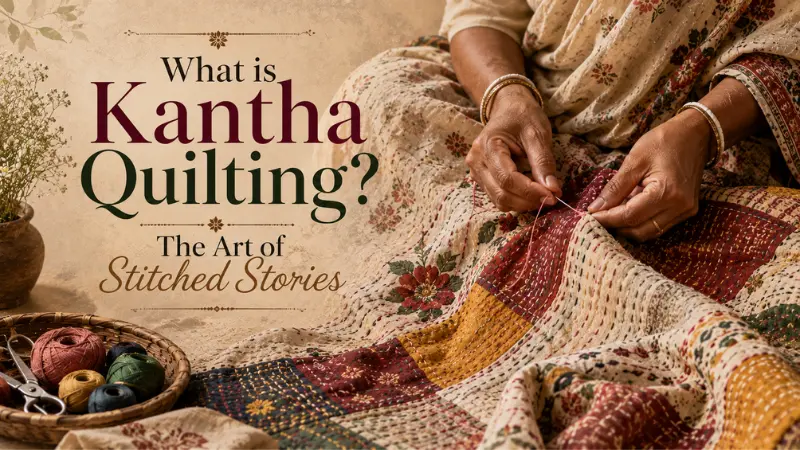
- Kantha is an ancient quilting and embroidery tradition from eastern India, primarily Bengal, Bihar and Odisha, made by layering repurposed cloth and uniting the layers with a continuous running stitch.
- The word Kantha comes from the Sanskrit word kontha, meaning rags or worn cloth. The craft is built on a philosophy of zero-waste upcycling that predates modern sustainability movements by centuries.
- Unlike Western quilting, Kantha uses no batting or wadding. Warmth and texture come entirely from the density of layered fabric and the tension of thousands of tiny stitches.
- The tradition is estimated to be over 3,000 years old, with roots in the pre-Vedic period and the earliest documented literary reference appearing in a 16th-century Bengali text.
- Kantha was historically a completely female-driven craft, practiced across all social classes, used to record family histories, mark life transitions and express what could not otherwise be said.
- There are several distinct regional styles including Nakshi Kantha, Par Tola, Lohori, Sujni and Odishan Kantha, each with different visual vocabularies and stitching methods.
- In contemporary wholesale markets, the most commercially significant innovation is the fusion of Jaipur hand block printing with Kantha stitching, creating reversible, scalable, highly desirable products for global boutique buyers.
- Both Nakshi Kantha (West Bengal) and Sujni Embroidery (Bihar) hold official Geographical Indication (GI) tags from the Government of India.
- The World Crafts Council Award of Excellence, formerly the UNESCO Seal of Excellence, has recognised Kantha products for craftsmanship, cultural authenticity and ethical production.
- Machine-stitched imitations are flooding global markets. Authentic hand-stitched Kantha is identifiable through reverse-side thread knots, organic stitch variation and a soft, rippled surface texture.
Somewhere in rural Bengal, centuries ago, a woman sat down with a worn-out sari, a needle and a length of thread she had pulled from that same sari’s border. She did not throw the cloth away. She layered it with another worn piece, and another, and began to stitch them together, one small running stitch at a time.
What she made was not just a blanket. It was a record. A family history, a prayer, a map of everything she had seen and felt and could not say in any other way.
That is what Kantha is. And it has been happening, in some form, for over three thousand years.
What Kantha Actually Is
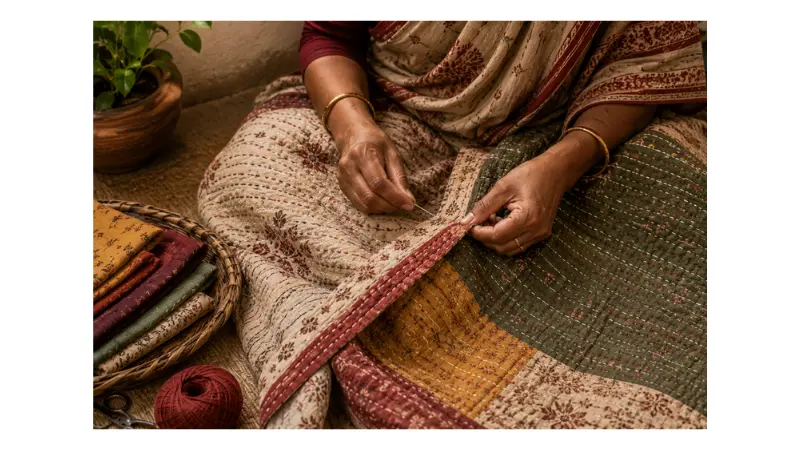
At its most fundamental level, Kantha is the practice of layering repurposed cloth and uniting those layers through a continuous, rhythmic running stitch. The word itself comes from the Sanskrit kontha, meaning rags or worn cloth. In various Bengali dialects it is also called kheta, meaning field, or kentha. Some linguistic scholars connect it to the word for throat, drawing a spiritual link to Lord Shiva and the ritualistic significance these textiles carried in sacred ceremonies.
What makes Kantha genuinely distinct from other global quilting traditions is its foundational philosophy. There is no batting, no wadding, no central layer of filling material. Warmth and structure come entirely from the density of the layered cotton fabrics and the tension of thousands of minute stitches. As each stitch pulls slightly through the layers, it gathers the fabric in tiny increments. Multiply that by thousands of stitches and the fabric develops the characteristic rippled, three-dimensional surface that is immediately recognisable as Kantha. Those ripples are not decorative. They trap pockets of air between the layers, significantly increasing the textile’s thermal insulation.
This approach places Kantha in a category of its own. Japanese Boro and Sashiko traditions share a similar philosophy of visible mending and zero-waste construction. Western patchwork quilting shares the communal, practical impulse. But Kantha’s specific combination of whole-cloth layering, narrative embroidery and the complete absence of new materials in its traditional form is unlike any other textile tradition in the world.
A History Stitched Over Three Thousand Years
The origins of Kantha reach back to the pre-Vedic period, before 1500 BCE. Archaeological evidence from the Indus Valley Civilisation, including unearthed needles and evidence of primitive appliqué techniques, suggests that the foundational concepts of layered, stitched textiles were being practiced in this region several millennia ago.
The earliest documented literary reference to Kantha appears in the Sri Sri Chaitanya Charitamrita, a 16th-century text by the poet Krishnadasa Kaviraja. It describes how the mother of the 15th-century mystic and saint Chaitanya Mahaprabhu crafted a Kantha from old garments and sent it to her son in Puri via travelling pilgrims. That specific Kantha is reportedly still preserved at the Gambhira temple in Puri, a 500-year-old piece of cloth that carries more history in its stitches than most museum collections.
The craft flourished natively in undivided Bengal, gradually spreading and adapting in Bihar and Odisha. The 19th century brought severe disruption. British colonial rule flooded Indian markets with cheap machine-made textiles, devastating indigenous crafts. Kantha came close to disappearing entirely.
Its revival in the 20th century happened in two distinct waves. In the 1940s, Pratima Devi, daughter-in-law of Nobel Laureate Rabindranath Tagore, led an intellectual and artistic revival at Visva-Bharati University in Shantiniketan. Following the Partition of 1947 and the Bangladesh Liberation War of 1971, Kantha emerged as a symbol of Bengali cultural resilience. Then in the 1980s, organisations working with rural women on both sides of the border began commercialising the craft, transitioning it from a purely domestic practice into a viable economic livelihood for thousands of women who had previously had no access to formal employment.
Why Kantha Was Made: The Social and Cultural Context
Kantha was not a craft practiced in royal courts or by professional artisan guilds. It was entirely a female-driven tradition, practiced by women across all social classes, in domestic spaces, during the rainy season and in whatever time could be stolen between household responsibilities.
That democratic character is one of the most important things about it. The wealthy landlord’s wife and the tenant farmer’s wife both created Kanthas of equal technical skill and aesthetic beauty, using whatever cloth was available to them. In a society where rural women were frequently denied access to education, formal literacy or public expression, Kantha became the medium through which they spoke.
It was, quite literally, a diary in fabric. Through their needlework, women recorded family histories, documented village life, articulated things that could not be said aloud, and processed grief. Modern scholars studying historic Kanthas have described them as primary source documents of rural women’s experience, as valuable to social history as any written archive. In Bangladesh, the repetitive, meditative rhythm of the Kantha stitch has even been used in post-trauma recovery programmes, its calming, rhythmic quality proving genuinely therapeutic.
The textiles also marked the most significant transitions in life. Expectant mothers would spend the final months of pregnancy stitching soft Kanthas to swaddle their newborns, embedding protective motifs to ward off illness and misfortune. A young bride leaving her maternal home would carry four to six intricate Kanthas as part of her dowry, each one a layered inheritance of family memory and ancestral blessing. She was not given a blanket. She was given her family’s history.
The Regional Styles: One Craft, Many Voices
While the running stitch unites the tradition, Kantha developed distinct regional variations across the eastern subcontinent, each with its own visual language and technical philosophy.
Bengali Kantha
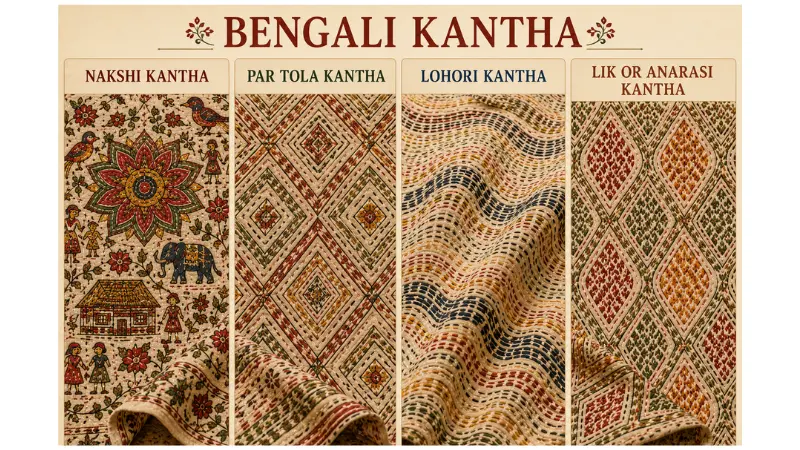
Bengal is the heartland of the craft and home to the greatest variety of distinct styles.
Nakshi Kantha takes its name from the Bengali word naksha, meaning artistic patterns. It is the most figurative and narrative of all Kantha styles, characterised by complex, asymmetrical storytelling motifs, elaborate central lotus forms and dense filling stitches depicting local flora, fauna and village life. A single Nakshi Kantha can tell a story across its entire surface.
Par Tola Kantha comes primarily from the Murshidabad district and is strictly geometric. Evolving under Islamic cultural influences that discouraged the depiction of living figures, Par Tola relies on complex mathematical symmetry. What makes it technically remarkable is that the geometric shapes are formed by looping threads on the front surface only, leaving the reverse side as simple parallel running lines.
Lohori Kantha takes its name from the word for wave. The thick running stitches move in undulating patterns across the fabric, creating a deeply textured surface that ripples and shifts with the light.
Lik or Anarasi Kantha, practiced in the Jessore and Chapainawabganj areas, uses a double-running stitch to create geometric pineapple motifs, a style of extraordinary intricacy and patience.
Bihari Kantha: Sujni and Khatwa
In Bihar, the needlework tradition diverges into two celebrated and very different forms.
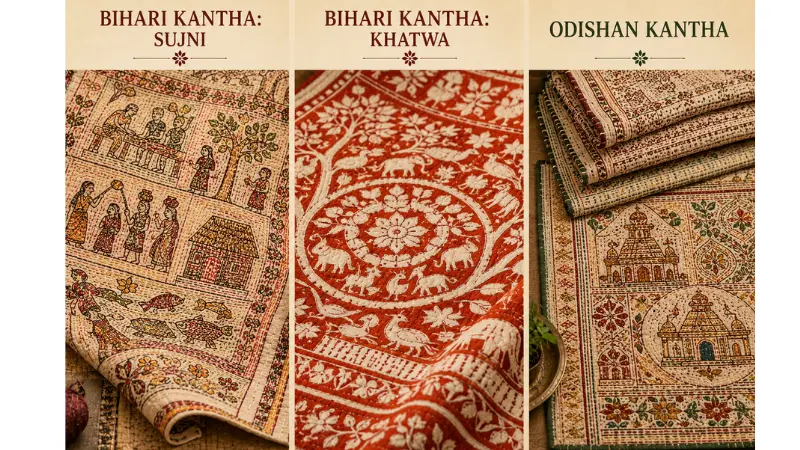
Sujni Embroidery from the Muzaffarpur district is technically distinct from Bengali Kantha. Where Bengali Kantha outlines its motifs with the running stitch, Sujni uses a darker chain stitch for outlines and fills the interiors with the running stitch. Sujni is also unusual in its subject matter. Alongside traditional myths, it frequently depicts contemporary social narratives: women speaking in courts, the evils of the dowry system, scenes of daily rural life as it is actually lived rather than as it ought to be.
Khatwa Appliqué involves cutting intricate shapes from coloured fabric and stitching them onto a base layer. Historically used to create vast tent canopies and shamianas for Mughal nobility, Khatwa combines Kantha stitching with reverse appliqué. The colour palette typically features bright red or orange base fabrics with white appliqué, depicting trees, animals and geometric arabesques.
Odishan Kantha
Odisha developed its own functional variation where women stacked old saris to create thin cushions and sitting mats rather than heavy quilts. The visual vocabulary incorporates local temple architecture aesthetics, and the stitching is often integrated with local appliqué methods, creating a hybrid textile that is recognisably Odishan in character.
The Types of Kantha: Made for Every Moment of Life
Traditional Kantha was categorised by size, thickness and domestic function. Each type served a specific purpose.
Lep Kantha was the heaviest, using five to seven layers of fabric for winter quilts. It is often the only Kantha style made without a central lotus motif, entirely covered instead in wavy geometric designs.
Sujani Kantha was a large, decorative ceremonial spread used for bedcovers and guest seating, featuring elaborate narrative scenes and a prominent central lotus.
Baiton Kantha was square-shaped, used to wrap books, documents and valuable objects, its borders dense with colour surrounding a hundred-petalled lotus at the centre.
Oaar Kantha covered pillows and cushions, its nature-inspired motifs and decorative borders sewn close to the edges.
Durjani or Thalia was a small square piece with three corners folded inward and stitched to form an envelope-like purse or wallet.
Arshilata Kantha covered mirrors, combs and cosmetics, its surface often depicting scenes from Hindu mythology alongside lotuses and scrollwork.
Ashon Kantha was crafted specifically as a sitting mat for a bride during her wedding ceremony.
Gilaf or Batua was made as a protective case to hold a Quran, combining the Hindu Kantha tradition with Islamic purpose, a quiet example of how deeply integrated the two cultural influences became within the craft.
The Kantha Stitch: Simple in Theory, Extraordinary in Practice
The defining technical element of Kantha is the Kantha phor, the continuous running stitch. It is, in theory, the simplest stitch in the textile vocabulary. In practice, its mastery requires years of accumulated skill in tension management, directionality and repetition.
The three-dimensional rippled surface that defines Kantha is not achieved by adding material to the fabric. It is achieved by the density of stitches acting upon layered cloth. As the needle passes through multiple layers, the slight, microscopic variations in human thread tension gather the fabric in tiny increments. When repeated thousands of times across a quilt’s surface, this tension creates the characteristic wavy, micro-quilted topography that makes Kantha immediately identifiable.
Advanced artisans work with a vocabulary of stitch variations beyond the basic running stitch. Chatai phor places parallel stitches tightly together to mimic the woven texture of a grass mat. Kaitya phor staggers stitches to create swirling diagonal effects. Lohori phor moves in continuous waves. Bakhiya phor, a back-stitch, provides rigid outlines to motifs before filling begins.
Long before it became a technique in contemporary Western machine quilting, traditional Bengali artisans practiced echo quilting: stitches radiating outward in concentric waves that mimic the exact outline of each embroidered motif, creating a rippling halo around every figure on the surface.
The Visual Language of Kantha: What Every Motif Means
Kantha’s iconography is a syncretic blend of Hindu, Buddhist, Islamic and indigenous folk belief systems. The motifs are not decorative choices. They are a symbolic vocabulary through which artisans communicated narratives, invoked protection and mapped their understanding of the world.
The Lotus, most often depicted from above with a hundred petals (Satadala Padma), is the central and most universal motif. It represents cosmic harmony, the divine seat of deities, purity and the union of earth, water and sky. Its petals open and close with the sun, making it a symbol of renewal and the returning power of life.
The Tree of Life (Kalpa Vriksha) traces its iconographic roots to the Indus Valley Civilisation. It represents immortality, the interconnectedness of all living beings and the wish-fulfilling abundance of the natural world. It is typically depicted sheltering birds and animals within its branches.
The Kalka or Paisley arrived during the Mughal era, derived from Persian and Kashmiri aesthetics. It represents a stylised leaf, mango or flame and carries associations of fertility, nobility and eternal life.
Fauna carries specific meaning throughout the tradition. The peacock represents grace and divine energy. The elephant symbolises strength and wisdom. The fish is a traditional Bengali symbol of prosperity and agricultural abundance, deeply connected to the rhythms of the river delta landscape where the craft evolved.
Narrative Scenes in Sujani and Nakshi Kantha depict elaborate stories: farmers going to market, wedding processions, scenes from the Ramayana and Mahabharata, and figures from Hindu mythology. In some 19th-century examples, women used their needles for something closer to political satire, depicting the Anglicised elite of colonial Kolkata with pointed wit in the style of Kalighat paintings, proof that the medium was never just domestic but always potentially subversive.
The Intersection with Hand Block Printing: A Commercially Significant Combination
One of the most important developments in contemporary wholesale textile markets is the fusion of Kantha stitching with Rajasthani hand block printing. This is where Moharis’s two craft traditions meet.
In this combination, the base fabric is not assembled from randomly sourced old saris. Instead, new sheets of 100% cotton are hand block-printed with Jaipur’s finest botanical and geometric motifs, using the Sanganeri or Bagru traditions depending on the aesthetic direction. This printed fabric is layered, typically with a complementary or contrasting print on the reverse side. Bengali artisans then execute the traditional Kantha running stitch across the entire surface, binding the layers and adding the characteristic rippled texture.
The result is a product that is more than the sum of its parts. The mathematical precision and depth of colour of the block print are softened and given warmth by the organic, slightly irregular human touch of the Kantha stitch. The two techniques complement each other in a way that is immediately visible and deeply appealing to the global boutique market.
There are specific commercial advantages to this combination that wholesale buyers should understand.
Reversibility is the first. By sandwiching differently printed fabrics on either side and binding them with Kantha stitching, the finished product is fully reversible. A floral Sanganeri print on one face and a geometric indigo Bagru print on the other, united by the same running stitch, creates a product that functions as two different textiles in one. This double utility resonates strongly with boutique consumers seeking versatile home textiles.
Scalability without sacrificing authenticity is the second. When block-printed fabric is used as the base, the artisan focuses entirely on the Kantha stitching rather than spending weeks outlining complex narrative motifs by hand. This allows manufacturers to standardise dimensions for export markets, precise king, queen or twin sizes, while maintaining the genuinely handmade character that global buyers are paying for.
Aesthetic coherence is the third. The deep indigo tones of Bagru Dabu printing against natural fawn, stitched with warm thread in traditional Kantha patterns, produces a textile that sits perfectly within the bohemian and slow-fashion aesthetics currently driving premium home linen demand in the USA, Europe and the Middle East.
Our wholesale catalog at Moharis includes block-printed Kantha quilts, throws and jackets across both Sanganeri and Bagru traditions.
Recognition and Protection: GI Tags and International Awards
Several forms of official recognition protect the authenticity of Kantha and provide wholesale buyers with legally verifiable provenance.
Nakshi Kantha received a Geographical Indication tag from the Government of India in 2006, protecting traditional Kantha produced in the Birbhum, Murshidabad and Nadia districts of West Bengal. This legal framework prevents machine-made imitations from being marketed as authentic Nakshi Kantha.
Sujni Embroidery from Bihar received its GI tag in the same year, protecting the distinct chain-stitch and running-stitch narrative style of the Muzaffarpur and Madhubani districts.
Khatwa Appliqué from Bihar received GI registration in 2015, protecting the appliqué artisans of the Darbhanga and Sitamarhi regions.
Kantha textiles also regularly receive the World Crafts Council Award of Excellence for Handicrafts, which evaluates crafts against four criteria: standard-setting craftsmanship, cultural authenticity, innovative design and environmentally responsible, socially fair production. For international wholesale buyers, this recognition provides an additional layer of assurance about the ethical provenance of the products they are sourcing.
How to Identify Genuine Hand-Stitched Kantha
As global demand for Kantha has grown, machine-stitched imitations have flooded wholesale and retail markets. The difference matters, both commercially and ethically. Here is what distinguishes authentic from imitation.
The reverse side is the most reliable test. On genuine hand-stitched Kantha, the reverse shows a mirror-like pattern of the front with visible, discrete thread knots where the artisan started and stopped. Machine imitations show a nest of looped threads or a rigid, papery chemical stabiliser bonded to the back.
Stitch uniformity is the second marker. Authentic Kantha carries slight organic irregularities in stitch length, spacing and tension across its surface. No two rows are mathematically identical. Machine stitching is robotically uniform, every stitch an exact copy of the last.
Surface texture and drape tell the story clearly. Genuine Kantha is supple, soft and slightly raised, with the thread sitting above the fabric surface in a gentle three-dimensional relief and that characteristic rippled drape. Machine-stitched imitations feel stiff, flat and occasionally plasticky, because the machine pulls thread at uniform high tension that eliminates the organic gathering of the fabric.
Motif density is the final indicator. Authentic Kantha embroidery covers large portions of the fabric densely, with no two florals or paisleys exactly identical. Machine imitations typically use sparse embroidery, often only outlining motifs to save machine time, with each motif a perfect replica of the next.
The Wholesale Opportunity: What the Global Market Looks Like
For boutique brands sourcing for the USA, European and Middle Eastern markets, block-printed Kantha from Jaipur represents one of the strongest value propositions in the sustainable home textile category.
Reversible king and queen size quilts, indigo block-printed Kantha throws, and vintage-style Kantha jackets are currently the highest-performing wholesale categories in Western bohemian and premium home markets. The combination of authentic heritage craft, natural materials and the one-of-a-kind quality that comes from hand production justifies retail price points that create strong margins at boutique level.
For Middle Eastern markets specifically, the premium embroidered Kantha aesthetic, particularly when executed in deep jewel tones or rich indigo Bagru backgrounds, aligns strongly with regional preferences for luxurious, detailed, handcrafted home textiles. The kaftan and kimono robe formats in Kantha-stitched block print are also commercially strong categories in this market.
The storytelling angle is as commercially important as the product itself. A quilt made by hand, from natural fabric, using a 3,000-year-old stitch tradition, printed with a 500-year-old block technique, by a community of women earning a fair livelihood, is not just a textile. It is a complete, verifiable story that conscious consumers in 2025 and 2026 are actively seeking and willing to pay a meaningful premium for.
The Challenges the Craft Faces Today
The global popularity of Kantha brings real commercial pressure alongside cultural celebration.
The most immediate threat is the proliferation of machine-stitched imitations marketed as hand-stitched Kantha. As demand has grown, industrial producers have developed embroidery machines capable of replicating the visual patterns of Kantha at speed and at a fraction of the cost. The market confusion this creates directly harms the artisan communities whose manual skill is the entire basis of the product’s value.
Economic pressure on artisans remains significant. The intense labour required for authentic Kantha is frequently not reflected in the wages paid by intermediaries lower in the supply chain. Younger women in Kantha-producing communities face the choice between the low but stable wages of urban employment and the skilled but economically uncertain path of continuing the craft. The knowledge that leaves when they go does not return.
Quality standardisation for export markets is an ongoing tension. Boutique buyers in the USA and Europe require consistent sizing, colour fastness and finishing standards that can be difficult to achieve at scale without compromising the organic, folk-art character that makes the product desirable in the first place.
At Moharis, our approach to sourcing Kantha is built on long-term, consistent partnerships with artisan communities, pricing that reflects the true labour involved, and quality standards that are worked through collaboratively rather than imposed unilaterally.
A Few Things About Kantha That Most People Do Not Know
The thread came from the cloth itself. In antiquity, Kantha artisans did not purchase new thread. They unravelled the coloured yarns from the woven borders of the saris they were recycling and used those exact threads to embroider the new quilt. This meant the thread was perfectly colourfast, having already been washed hundreds of times over the life of the sari. Zero waste, in the most literal possible sense.
There are deities associated with the craft of mending. In regional Bengali folklore, Chindadeo and Chindadevi are recognised as the Lord and Lady of Tatters. The act of piecing together rags carries spiritual significance in the tradition, with the belief that old cloth provides magical protection from harm. A Kantha was not just practical. It was, in a real sense, a divine shield.
Kantha was used for political satire. During the 19th century, certain Kantha quilts adopted the visual style of Kalighat paintings and depicted pointed satirical commentary on the Anglicised, elite colonial culture of Kolkata. Women used their needles to say what they could not say in any public forum. Quiet rebellion, stitched into cloth.
Craft That Was Never Wasted, Art That Was Never Silent
Kantha began in necessity. Old cloth, worn thin by years of use, layered and stitched back into something warm and useful. That impulse, to refuse to throw away what can still serve, is the oldest form of sustainable thinking the textile world has.
What evolved from that necessity is one of the most extraordinary visual traditions in Indian craft history. A medium that carried family memory, protected newborns, accompanied brides into new lives, commented on political absurdity and mapped an entire world through the movement of a needle through layered cloth.
Today it carries something additional: a story that global buyers actively want, about genuine craft, honest materials, women’s skill and a way of making things that does not deplete the world. That story is true, and it is built into every stitch.
Explore block-printed Kantha quilts, throws and textiles in our wholesale catalog, or learn more about how Jaipur’s hand block printing traditions are made.
Moharis is a Jaipur-based manufacturer, exporter and wholesaler of hand block printed clothing, fabrics and home linen. We work with boutiques, sustainable fashion brands and sourcing companies across the USA, Europe and the Middle East. For wholesale inquiries, write to us at info@moharis.com or visit our wholesale page.