Quick Summary
- The earliest evidence of cotton cultivation and natural dyeing in the Indian subcontinent dates to approximately 5000 BCE at Mehrgarh in Balochistan, predating the Indus Valley Civilisation.
- Excavations at Mohenjo-Daro revealed tightly woven cotton fabrics with up to 44 threads per centimetre and chemical evidence of alizarin and indigo dyeing dating to 3000 BCE, both still central to Indian block printing today.
- By the first century CE, Indian muslin was so prized in Rome that it was given names meaning “woven winds” and “morning dew.” Roman records document the massive drain of imperial gold to India in exchange for textiles.
- Block-printed cotton fragments found in Fustat near Cairo, traced by petrochemical analysis to Gujarat, confirm that Indian artisans were producing export-specific designs for Islamic and North African markets centuries before European colonialism.
- The Mughal Empire created a spectacular synthesis of Persian aesthetic refinement and Indian craftsmanship, giving birth to the classic buti and jaal motifs that still define Sanganeri block printing today.
- By 1700, India accounted for approximately 25% of world GDP, driven largely by textile manufacturing dominance rooted in an exclusive mastery of natural mordant dyeing chemistry that no rival could replicate.
- The British Calico Acts of 1700 and 1721, passed in response to violent riots by English wool and linen weavers, banned the importation of Indian printed cotton and inadvertently catalysed the Industrial Revolution by forcing British manufacturers to invent mechanised alternatives.
- Gandhi’s Swadeshi movement transformed the spinning wheel into a symbol of political resistance and economic independence, reclaiming cloth as a tool of sovereignty.
- India’s GI registry now holds 658 protected products, with handicrafts and handloom textiles accounting for over 52% of all registrations.
- India’s total textile exports reached ₹3,16,334.9 crore in FY 2025-26, growing 2.1% year on year, with handicrafts growing at 6.1%, the fastest category in the sector.
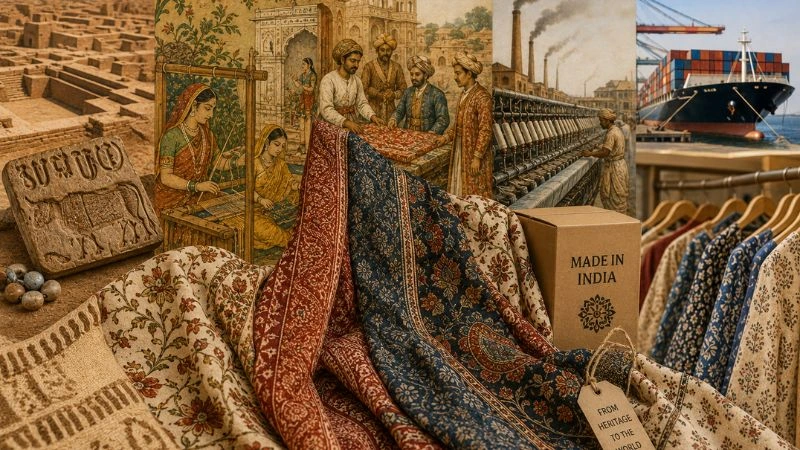
Every piece of hand block printed cloth that leaves Jaipur today carries more history than most people realise. The cotton it is made from descends from plants first cultivated on this subcontinent 7,000 years ago. The indigo that dyes it blue was first fermented in sealed clay jars here over three millennia ago. The madder root that produces its reds left its chemical signature on cloth excavated from Egyptian tombs.
The story of Indian textiles is not a background story. It is one of the central economic and cultural stories of human civilisation. Here is how it actually went.
Before History Was Written: Mehrgarh and the Indus Valley
The story begins before the Indus Valley Civilisation itself, at Mehrgarh in Balochistan, where impressions of cotton fibres preserved on copper beads date to approximately 5000 BCE. This is the earliest material evidence of cotton utilisation anywhere on earth.
By the time the Indus Valley Civilisation reached its urban peak between 2600 and 1900 BCE, the subcontinent had developed what can only be described as an industrial-scale textile economy. Excavations at Mohenjo-Daro, Harappa, Lothal and Dholavira have yielded thousands of spindle whorls made from terracotta, faience and shell, pointing to a highly decentralised yet sophisticated domestic spinning industry. Bone tools crafted from cattle ribs and terracotta beads bearing distinct fabric impressions provide evidence of advanced card-weaving techniques.
The technical precision of what was being produced is remarkable even by modern standards. Mineralised cotton threads recovered from copper artifacts at Harappa reveal fabrics woven with up to 44 threads per centimetre, a thread count that rivals fine contemporary cottons.
The chemistry was equally advanced. Analysis of dye residues found in a dyer’s vessel near Mohenjo-Daro, dating to 3000 BCE, confirms the presence of alizarin, extracted from madder root, and indigo. The ability to execute madder root decoctions with alum mordanting, and to use anaerobic fermentation in sealed jars to produce soluble leuco-indigo, represents a profound command of organic chemistry. Both of these processes, madder with alum and fermented indigo vats, remain central to the Bagru Dabu printing tradition in Jaipur today. The chemistry has not changed in five thousand years because it does not need to.
The famous steatite sculpture of the Priest-King from Mohenjo-Daro, draped in a robe with an intricate trefoil pattern, suggests that patterned and dyed garments were already being used to demarcate social and spiritual status. Textile was not just utility. It was communication.
Mesopotamian records referring to a highly prized “soft cloth” or “plant cloth” imported from Meluhha, the Sumerian term for the Indus region, establish that India’s textile surplus was already reaching international markets before 2000 BCE. The global trade that would define the next four millennia had already begun.
The Vedic Period: Cloth, Ritual and the State
Following the gradual decline of the Indus Valley urban centres, the Vedic period between approximately 1500 and 500 BCE wove textiles deeply into both economic structures and spiritual practice.
The Rigveda explicitly documents the societal roles of artisans, making linguistic distinctions between male weavers (vaya) and female weavers (vayitri), establishing textile production as a shared specialist occupation from the earliest historical record. The literature references garments including the antariya (lower wrap), the uttariya (upper scarf) and the kayabandh (waistband), the three-piece ensemble that evolved into what we recognise as classical Indian dress.
Ritually, unstitched fabric held supreme spiritual purity. The Sutra literature codifying domestic and religious rituals specifies the use of unstitched cloth draped in specific ways during sacrificial ceremonies, a convention that persists in Hindu religious practice today. The Apastamba Srauta Sutra provides the earliest direct textual evidence for printed fabrics through the term chitranta, while the Mahabharata references decorated textiles gifted as political currency between feudatory lords.
The Arthashastra, attributed to Chanakya around 300 BCE, provides the most detailed early picture of textile as state industry. It outlines state-sponsored weaving workshops where wages were determined by the fineness of spun yarn, establishing quality control and performance-based compensation. Textiles were not merely domestic craft. They were state-regulated commodities essential for taxation and foreign trade.
The Ancient Global Trade: Roman Gold for Indian Cloth
By the first century CE, Indian textiles had established a profound presence in the Roman Empire. Roman historians wrote with alarm about the drain of imperial gold to India for luxury goods, foremost among them Indian muslin. This fabric was known in Rome as nebula, gangetika and venti, meaning woven winds, due to its almost transparent quality. Roman senators reportedly proposed legislation banning men from wearing it, on grounds of indecency.
The most compelling archaeological evidence for ancient Indian textile export is found not in India but in Egypt. Block-printed cotton fragments excavated at Fustat near Cairo, with origins traced by petrochemical analysis of their dyes and mordants to the coastal regions of Gujarat, confirm that Indian artisans were producing textiles specifically calibrated for Islamic and North African aesthetic preferences. Floral and leaf motifs printed in indigo blue and madder russet, specifically chosen to resonate with the markets they were destined for. This was not surplus domestic production being sold abroad. This was market-specific manufacturing, five hundred years before the concept of export-oriented industry had a name.
Simultaneously, the Coromandel Coast and Bengal dominated exports to Southeast Asia, where Indian textiles functioned as an international fiat currency. Cloth was traded directly for nutmeg, mace and cloves in the Spice Islands. The trade networks connecting India to Egypt, Rome, the Arabian Peninsula, East Africa, and the Indonesian archipelago were not peripheral commercial activities. They were the spine of the ancient global economy.
The Dynasties: How Each Era Shaped the Cloth
The evolution of Indian textiles across successive empires is a story of patronage, refinement and the constant translation of political power into textile language.
The Maurya period (321 to 185 BCE) saw spinning and weaving transition from decentralised rural activity to organised industry under strict state supervision. The Gupta Empire (320 to 550 CE) elevated dress into a refined system of social stratification. The Ajanta cave paintings, dating to around 600 CE, vividly depict garments featuring Bandhani tie-and-dye and Patolu Ikat weaving, proving that resist-dyeing techniques were highly developed by the middle of the first millennium.
In South India, the Chola Dynasty between the 9th and 13th centuries elevated weaver communities to extraordinary socio-political influence. The Kaikkolar community was integrated directly into the imperial military structure, serving in elite royal regiments. When not engaged in military service, these communities monopolised textile production and controlled powerful merchant corporations like the Ayyavole 500 guild, which controlled trade routes across the Indian Ocean.
The Vijayanagara Empire (1336 to 1646) initiated a golden age of South Indian textiles marked by the mass migration of skilled Saurashtrian weavers from Gujarat, transforming the regional market toward high-value fine cottons, muslins and silks. The empire’s cosmopolitan character, in constant interface with the neighbouring Islamic Deccani Sultanates, produced hybrid fabrics engineered specifically to satisfy Islamic sumptuary laws. Mashroo and himroo were constructed with a cotton warp and soft silk weft, technically allowing Muslim men to wear silk-like luxury without violating the prohibition against silk touching the skin directly. Textile as theology. Craft as legal compliance.
The Mughal Era: Where Persian Refinement Met Indian Craft
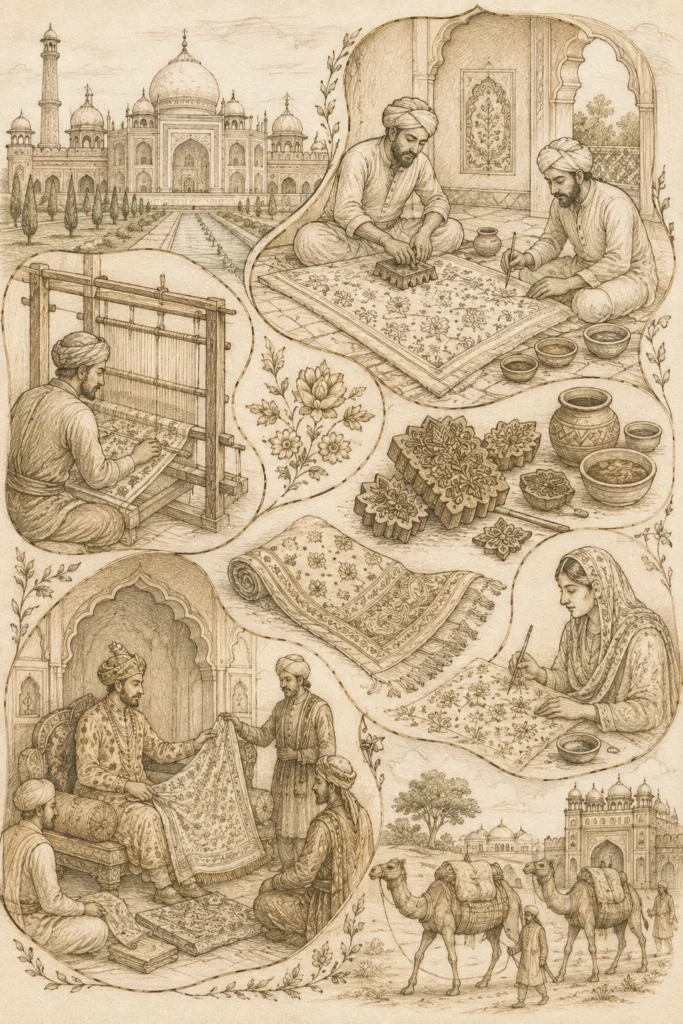
The Mughal Empire from 1526 onward catalysed the most spectacular synthesis in the history of Indian textiles, fusing Persian aesthetic refinement with indigenous Indian craftsmanship in ways whose effects are still visible in every Jaipur block print made today.
Mughal patronage shifted luxury textile production to imperial karkhanas, state-funded workshops in Lahore, Agra and Dhaka, where master artisans produced textiles of unparalleled opulence. The elevation of Bengal muslin, woven as Jamdani with supplementary weft patterns that appeared to float on a translucent background, reached extraordinary levels of refinement. Royal demand produced poetic classifications: Shabnam (morning dew), Ab-i-rawan (flowing water), Baftnama (woven wind). These were not marketing names. They were accurate descriptions of how the fabric behaved in light and air.
The Mughal obsession with formalised gardens and botanical illustration radically transformed block printing across the subcontinent. The integration of Persian floral symmetry with Indian naturalism birthed the classic buti (floral sprig) and jaal (interlocking floral trellis) motifs that became the hallmark of Rajasthani block printing, particularly in Sanganer. These motifs remain central to Sanganeri printing today, carrying within them the specific visual vocabulary of a court that dissolved three centuries ago.
Zardozi embroidery using gold and silver metallic thread was refined to embellish royal garments, tent canopies, wall hangings and elephant trappings. The resulting textile aesthetic was a hybrid that simultaneously satisfied the Islamic preference for non-figurative geometric and floral art and the Hindu tradition of vibrant, nature-inspired ornamentation. It was also, not coincidentally, commercially irresistible to the European trading companies that were beginning to arrive on Indian shores.
The Pre-Colonial Dominance: 25% of World GDP
The scale of Indian textile dominance before European colonialism is difficult to fully comprehend from a contemporary vantage point. Economic historians estimate that by 1700, India accounted for approximately 25% of world GDP. This figure was driven largely by textile manufacturing, and that dominance rested on a specific technological advantage that no rival nation could replicate: the Indian mastery of natural mordant dyeing.
Indian dyers possessed exclusive knowledge of how to permanently bond dyes to cotton fibres using metallic mordants. Indigo and madder, fixed with alum and iron through precise chemical processes refined over thousands of years, produced colours that did not wash out, did not fade in sunlight and did not bleed onto adjacent fabrics. European weavers, Ottoman dyers and Chinese manufacturers could all produce cloth. None of them could produce cloth that held its colour the way Indian cloth did. That single chemical advantage sustained Indian textile exports at global dominance for centuries.
Gujarati merchants exported densely printed cottons westward to the Arabian Peninsula, East Africa and Egypt. On the eastern seaboard, the Coromandel Coast and Bengal dominated Southeast Asian trade. Indian artisans demonstrated acute market intelligence throughout, engineering specific motifs, colour palettes and fabric weights to satisfy the highly localised cultural demands of each export market, from the geometric Islamic aesthetics required for the Middle East to the specific ceremonial dimensions required in the Indonesian archipelago.
The European Companies and the Calico Craze
The arrival of the Portuguese, Dutch, French and British East India Companies restructured the global textile economy. Initially these mercantile corporations acted as facilitators within existing Asian networks, purchasing Indian textiles, known in Europe as calicos (from Calicut) and chintz (from the Hindi chhint, meaning spotted), to trade for spices in Southeast Asia.
But when these vibrant, colourfast, washable cotton fabrics reached Europe in the 17th century, they triggered a consumer phenomenon historians call the Calico Craze. Indian cotton was better than European alternatives in almost every measurable way: lighter, cheaper, more colourful and unlike European wool and linen, it washed without damage. By the late 17th century, the British East India Company was importing millions of pieces of Indian cotton annually, entirely displacing the domestic English wool, silk and linen industries.
The economic panic was genuine. Between 1697 and 1700, London weavers rioted in the streets, attacking the East India Company headquarters and assaulting women seen wearing Indian chintz. The British Parliament responded with the Calico Acts of 1700 and 1721, which strictly prohibited the importation, sale and wearing of printed Indian cottons in England.
Here is the irony that textile historians have documented carefully: the Calico Acts inadvertently catalysed the British Industrial Revolution. By banning finished Indian prints but allowing the import of raw cotton and plain unbleached fabric, Parliament created an artificially protected domestic market for cotton cloth. Denied access to finished Indian goods, British manufacturers were forced to invent mechanical spinning and weaving technologies to meet the domestic demand. James Hargreaves, Richard Arkwright, Edmund Cartwright: the inventors of the spinning jenny, the water frame and the power loom were all, in a specific economic sense, responding to the problem India had created for them.
On the ground in India, the East India Companies were already beginning to dismantle what they had discovered. Recognising European aesthetic preferences, they sent pattern books to Indian artisans commanding design modifications for export markets. As their military and administrative dominance grew, they bypassed traditional merchant guilds and coerced weaver castes into producing plain fabric at suppressed, exploitative rates. The commercial relationship that had begun as a trade between partners was becoming something else entirely.
The Industrial Destruction and the Swadeshi Response
The mechanisation of textile production in Britain during the late 18th and 19th centuries completed the process the East India Companies had begun. British industrial policy aggressively opened the Indian market to heavily subsidised machine-made fabrics from Manchester and Lancashire while maintaining high protective tariffs against Indian exports into Britain. Cheap power-loom cloth flooded the subcontinent at prices that handloom artisans could not compete with.
The Jamdani weavers of Dhaka, who had produced some of the finest fabric in human history for the Mughal court, found themselves without patronage and without a market. By the mid-19th century, the export of fine Indian muslin had entirely ceased. India had been deliberately demoted from the world’s premier manufacturer of finished luxury textiles to a captive supplier of raw cotton for British mills and a forced consumer of British manufactured goods.
The political response came in the early 20th century and it was, deliberately, textile-led. Mahatma Gandhi’s Swadeshi movement urged Indians to boycott British machine-made goods in favour of Khadi, hand-spun, handwoven cloth. The spinning wheel, the charkha, became the central symbol of the independence movement, appearing eventually on the national flag. Gandhi’s genius was understanding that the economic argument and the moral argument were the same argument: independence required the recovery of the means of production, and the most visible means of production in India’s history was cloth.
The Regional Traditions: India’s Textile Map
The resilience of India’s textile heritage is visible in its extraordinary diversity of regional traditions, each representing a unique synthesis of local resources, chemistry and cultural history. Here is an overview of the most significant.
Sanganeri and Bagru Block Printing from Rajasthan represent two fundamentally different approaches to the same craft. Sanganeri, shaped by Mughal aesthetics and the mineral-rich waters of the Dhoondh and Saraswati rivers, produces delicate fine-line florals on white cotton ground. Bagru, shaped by water scarcity and indigenous folk tradition, uses the Dabu mud-resist technique to produce bold geometric patterns on deep indigo and dark natural grounds. Both traditions are covered in full detail in our dedicated comparison, and the Dabu technique itself has its own complete guide.
Kalamkari from Andhra Pradesh divides into two schools. The Srikalahasti school is entirely hand-drawn using a bamboo pen to create continuous mythological narratives on cotton prepared with myrobalan tannins and buffalo milk fat, a process of up to 23 stages. The Machilipatnam school is block-printed, producing secular Persian and Mughal florals and the iconic Tree of Life motif for commercial markets. Both hold GI protections from the Government of India.
Ajrakh from Kutch in Gujarat is a masterclass in applied chemistry. The creation of a single Ajrakh textile involves 14 to 21 distinct stages of washing, printing and resist-dyeing, taking up to three weeks. The fabric is printed on both sides with perfect alignment. The resist paste and the black outline dye are both made from fermented iron preparations that bind permanently to cotton through their reaction with the tannin-rich pre-treatment. The colour palette is strictly indigo blue, madder red, black and the white of the un-dyed cloth.
Ikat in its Indian manifestations involves the resist-dyeing of yarns before weaving, so that the pattern emerges from the alignment of pre-dyed threads rather than from post-weaving printing. Pochampally Ikat from Telangana uses a double-ikat technique where both warp and weft are dyed, creating geometric patterns identical on both sides. Patan Patola from Gujarat, woven by the Salvi community using a mathematical precision so demanding that a single sari can take six months to complete, represents the most technically complex textile tradition in India.
Banarasi silk from Uttar Pradesh draws directly from Mughal opulence, using gold and silver zari threads in heavy brocade weaving to create intricate jaals and paisleys on luxurious silk. Kanjivaram silk from Tamil Nadu uses the Korvai technique, where the body of the sari and its highly contrasting borders are woven separately and interlocked flawlessly on the loom. The motifs draw from Dravidian temple architecture: mythological creatures, temple borders, peacocks.
Jamdani from undivided Bengal is a handwoven muslin using a supplementary weft technique where individual coloured or metallic threads are manually woven into the warp to create floating motifs. Because the pattern is woven from a graph paper reference rather than drawn on the fabric, genuine Jamdani cannot be replicated by a power loom. This is its protection and its limitation.
Kantha quilting from Bengal transforms discarded worn saris and dhotis into layered, stitched textiles through the kantha phor, a continuous running stitch that simultaneously binds the layers and creates the characteristic rippled surface. The decorative variant, Nakshi Kantha, embodies complex visual narratives of rural life, mythology and personal history. The full story of Kantha and its intersection with Jaipur block printing is covered in our dedicated guide.
Bandhani, the ancient art of tie-and-dye practiced predominantly in Gujarat and Rajasthan, involves binding thousands of tiny pinches of fabric with continuous thread before dyeing, creating intricate stippled patterns of un-dyed dots. The Gharchola, a complex grid-patterned Bandhani textile, remains essential to Gujarati bridal tradition.
The Post-Independence Revival
Following independence in 1947, India faced the challenge of rescuing an artisanal economy devastated by two centuries of deliberate colonial de-industrialisation. The response combined cultural, economic and institutional strategies that took decades to bear fruit.
The government established the All India Handicrafts Board and the Crafts Council of India to map, fund and protect regional craft clusters. State emporiums and the Cottage Industries Exposition provided direct retail channels for artisan goods, bypassing the exploitative middlemen who had extracted most of the value from artisan labour for generations. The establishment of the National Institute of Design in 1961 bridged the critical gap between traditional craft communities and contemporary global markets, introducing modern design thinking while preserving traditional methodologies.
This institutional framework proved crucial in stabilising endangered traditions including Jamdani and Patola, transitioning them from vanishing royal arts into premium commodities within a modern democratic economy.
Indian Textiles in Global Fashion: The 20th Century
The integration of Indian textiles into 20th-century global fashion is a story that runs from subcultural rebellion to haute couture collaboration, and includes at least one episode of inspired marketing genius.
In the 1960s, the Western hippie movement embraced Indian block prints, khadi and tie-dye garments as sartorial rebellion against the synthetic aesthetics of post-war capitalism. The Hippie Trail, running overland from Europe through the Middle East to India and Nepal, brought young Western travellers directly into Rajasthan, where they encountered the hand block-printed cotton traditions that had been producing for export markets for centuries. The visual vocabulary of Sanganeri florals and Bagru indigo patterns entered the Western bohemian aesthetic during this period and has never fully left.
In 1958, an American textile importer purchased 10,000 yards of naturally dyed Madras checks from Chennai and sold them to Brooks Brothers. When customers complained that the vegetable dyes bled and faded in washing, advertising executive David Ogilvy reframed the perceived defect as a virtue: “guaranteed to bleed.” Ogilvy placed an article in Seventeen Magazine educating consumers that authentic Indian Madras was supposed to fade into custom, personalised colourings. Bleeding Madras became an instant status symbol for affluent Americans, and the episode stands as one of the most instructive examples in fashion marketing history of turning an authentic material characteristic into a premium brand attribute.
In contemporary luxury fashion, the paradigm has shifted from stylistic inspiration toward active, credited collaboration. European luxury houses including Christian Dior have engaged Indian master embroidery ateliers for highly visible haute couture work. Dior’s Spring-Summer 2022 haute couture show in Paris featured colossal hand-embroidered tapestries produced over three months by 320 artisans, with the atelier prominently credited. The shift from treating Indian artisan skill as an anonymous manufacturing back office to acknowledging it as creative partnership represents a meaningful, if still incomplete, change in how the global fashion industry relates to Indian craft.
The Current State: 2025 and 2026
India’s total textile exports reached ₹3,16,334.9 crore in FY 2025-26, representing 2.1% growth year on year. Within this, the handicraft category grew at 6.1%, the fastest of any segment in the sector, reaching ₹15,855.1 crore. Ready-made garments grew at 2.9%.
Major Free Trade Agreements concluded or enacted over the past year, including the India-EFTA TEPA, the India-UK CETA, the India-Oman CEPA and the India-EU FTA, are reducing tariff disadvantages and deepening India’s integration into global supply chains. Export growth has been recorded across 120 destinations, with particularly strong performance in the UAE at 22.3%, Japan at 20.6% and Spain at 15.5%, alongside significant expansion into African markets.
Within the broader industry, the handloom and handicraft sectors occupy a high-value, high-margin niche. While power looms drive sheer export volume, artisan-made textiles command premium pricing precisely because they cannot be replicated by machinery. The block printing traditions of Jaipur, GI-protected, chemically traceable to specific river geologies, produced by communities whose knowledge is encoded in their hands across generations, are positioned at the premium end of a market that is actively growing.
India’s GI registry now holds 658 protected products. Handicrafts and handloom textiles account for over 52% of all registrations, the largest single category. Our article on why Jaipur is the world capital of block printing covers the specific GI protections and what they mean commercially for wholesale buyers.
Three Things Most Textile Histories Do Not Tell You
The Nakshi Kantha has a specific literary origin. The term Nakshi Kantha is now ubiquitous across Bengal, but its modern popular usage dates to a single poem. In 1929, Bengali poet Jasimuddin published Nakshi Kanthar Math, The Field of the Embroidered Quilt, a tragic folk narrative about a young wife named Saju who stitches her memories, her grief and her declining health into a kantha after her husband is forced to flee their village. She dies, and asks to have the quilt laid over her grave. The poem’s cultural impact was profound enough to rebrand a domestic craft in the popular consciousness, transforming it from a household utility into a symbol of Bengali feminine grief, love and resilience. The tradition existed for centuries before Jasimuddin, but the name we use today is his.
The Ajrakh black outline is made from fermented iron scum. The beautiful, precise black outlines that define Ajrakh block printing are produced from a preparation that involves fermenting scrap iron, jaggery and gram flour for up to two weeks until it forms what artisans describe as a toxic-looking yellowish scum. When this fermented mixture is boiled with tamarind seed powder, it produces a rust-based black dye that bonds permanently to myrobalan-treated cotton. The chemistry that creates one of the most refined-looking visual elements in Indian textile art is, at its source, intentional controlled rot.
The bleeding Madras episode tells you everything about natural dyes and consumer education. When David Ogilvy reframed the bleeding of Indian Madras vegetable dyes from a defect to a feature in 1958, he was not doing something dishonest. He was correcting a misunderstanding. Natural dyes behave differently from synthetic dyes. They shift with light, washing and time in ways that reflect the organic compounds they come from. The fading of a naturally dyed textile is not deterioration. It is the material expressing its own chemistry across time. Any brand sourcing naturally dyed textiles today is still doing the same work Ogilvy did in 1958: educating consumers that authentic material characteristics are not flaws but proof.
Why Ancient Knowledge Is the Most Modern Thing
The global fashion industry in 2025 and 2026 is under intense pressure to reduce its environmental footprint, trace its supply chains, eliminate toxic chemistry and move away from the disposable production model that has defined it for fifty years. The solutions it is searching for, natural dyes, natural fibres, human-scale production, traceable origin, artisan livelihoods, are not new technologies. They are old ones.
India spent five thousand years developing them. The madder and indigo chemistry that began in sealed clay jars in Mohenjo-Daro is still being practiced in Jaipur. The block carving traditions brought by the Chhipa community through Sanganer in the 17th century are still alive in the same lanes. The Kantha stitch that gave Bengali women a medium for private expression is still being worked by hand across the same region where it began.
What has changed is the global context. A world that once tried to destroy these traditions by flooding their markets with machine-made alternatives is now, urgently, looking for what they offer. The sustainable fashion market, the slow fashion movement, the demand for traceable natural fibre products, all of it points back toward an Indian craft ecosystem that never entirely stopped doing what the world has finally decided it needs.
Explore our catalog of hand block printed clothing, fabrics and home linen at Moharis, made in Jaipur using traditions that have survived five millennia, two empires, a colonial industrial assault and a global fast-fashion era. They will survive the current moment too.
Moharis is a Jaipur-based manufacturer, exporter and wholesaler of hand block printed clothing, fabrics and home linen. We work with boutiques, sustainable fashion brands and sourcing companies across the USA, Europe and the Middle East. For wholesale inquiries, write to us at info@moharis.com or visit our wholesale page.
Sources referenced:
- Ministry of Textiles, Government of India, FY 2025-26 Export Data
- Government of India, GI Registry, 658 registered products as of early 2026
- Arthashastra, attributed to Chanakya, circa 300 BCE
- Rigveda, Vedic period textile references
- Apastamba Srauta Sutra, printed fabric references
- Mahabharata, textile gift references
- Ajanta cave paintings, circa 600 CE
- Fustat textile discoveries, Al Fustat, Cairo
- British Calico Acts, 1700 and 1721
- Nakshi Kanthar Math, Jasimuddin, 1929
- National Institute of Design, established 1961
- Chanakya International, Dior Spring-Summer 2022 haute couture collaboration
- Export Promotion Council for Handicrafts (EPCH)
- India-EFTA TEPA (enacted October 2025)
- Rajasthan State Pollution Control Board, Sanganer CETP data 2026
- Jaipur Integrated Texcraft Park Private Limited (JITPPL)