Quick Summary
- Jaipur’s position as the global capital of hand block printing was built over three centuries through a combination of artisan migration, royal patronage, and specific geographical and hydrological advantages that made the region uniquely suited to natural dyeing at scale.
- The city’s block printing ecosystem is not a single industry but a network of distinct artisan clusters: Sanganer, Bagru, Jahota and Kaladera, each with different specialisations that together cover the full spectrum of the global handcrafted textile market.
- Approximately 4,535 micro, small and medium enterprises are engaged in block and tie-dye printing across the Jaipur district, providing direct employment to over 20,750 workers and livelihood support to tens of thousands more in ancillary sectors.
- The craft is sustained by two inseparable artisan communities: the Chhipa printers, whose name literally means “to print,” and the Kharaudi block carvers, whose hand-carved wooden blocks are the architectural foundation of every print.
- The specific mineral composition of Jaipur’s rivers, the Sanjaria in Bagru and the Dhoondh and Saraswati in Sanganer, is not a backdrop to the craft. It is a chemical ingredient in it.
- Both Sanganeri and Bagru hand block printing hold Geographical Indication (GI) certifications from the Government of India, providing legal protection against machine-made imitations.
- In 2015, UNESCO formally designated Jaipur as a Creative City of Crafts and Folk Art, recognising over 53,500 active craft workshops across the city.
- The Jaipur Integrated Texcraft Park (JITPPL), known as Jaipur Bloc, operates a zero liquid discharge eco-park with advanced effluent treatment and solar infrastructure, bridging a 16th-century craft tradition with 21st-century environmental standards.
- The Dabu mud-resist technique, according to local oral history, was discovered entirely by accident when a dyer’s mud-smeared cloth was dropped into an indigo vat.
Jaipur is not the world capital of hand block printing because it has the most factories or the largest export volume, though both of those things are true. It is the capital because of something more specific and more difficult to replicate: the particular combination of artisan communities, river water chemistry, royal investment, geographical concentration and centuries of accumulated knowledge that converged in this part of Rajasthan and nowhere else.
That convergence did not happen by accident. Here is how it actually came to be, and why it matters for anyone who sources, sells or cares about genuine handcrafted textiles.
How It Began: Migration, Patronage and the Founding of a City
The story of Jaipur’s block printing dominance begins not in Jaipur but in Gujarat.
During the mid-17th century, the socio-political landscape of the Kathiawar region was destabilised by successive waves of military disruption. Highly skilled textile artisans from the Chhipa community, carrying with them sophisticated, intergenerational knowledge of mordant dyeing, resist printing and block carving, migrated eastward into the more insulated territories of Rajputana. They settled initially in the peripheral towns of Sanganer and Bagru, drawn by the mineral-rich rivers that their dyeing processes required.
The transformation from scattered artisan settlements into a global production hub was set in motion by Maharaja Sawai Jai Singh II. In 1727, the Maharaja relocated his capital from Amber to the newly planned city of Jaipur and actively invited craftspeople, artists and merchants from across the subcontinent, granting them land and royal protection on the city’s outskirts.
What followed was not simply patronage but institutional investment. According to the Buddhi Vilas, a text composed in 1770 by the Jain poet Bhakhata Rama Shah, Sawai Jai Singh II restructured all thirty-six royal administrative departments, four of which were dedicated entirely to the textile economy. The Toshakhana managed daily-wear costumes. The Siwankhana handled stitching. The Rangkhana oversaw dyeing. And the Chhapakhana was a department wholly dedicated to the administration and advancement of wooden hand block printing. This royal infrastructure elevated block printing from a rural craft to an elite art form, creating a design vocabulary influenced by Indo-Persian Mughal aesthetics that would serve the nobility’s sartorial demands and, within a century, the export demands of European trading companies.
The geography of the region did the rest. Artisan families established their workshops along the banks of local rivers: the Dhoondh and Saraswati in Sanganer, the Sanjaria in Bagru. These rivers provided not just water volume but specific mineral compositions that proved chemically essential to the natural dyeing processes the artisans had brought from Gujarat and refined over generations in their new home.
The Ecosystem: Four Clusters, One Complete Market
Jaipur’s block printing industry is not a monolithic entity. It is a decentralised ecosystem of distinct artisan clusters, each specialising in different techniques, aesthetics and product categories, that together cover the full spectrum of global handcrafted textile demand.
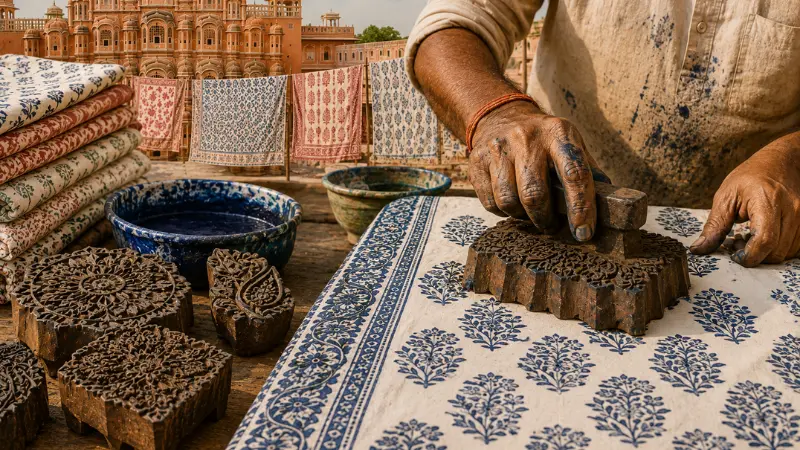
Sanganer, located 15 kilometres south of Jaipur on the banks of the Dhoondh and Saraswati rivers, is the most internationally recognised of the clusters. It specialises in direct block printing: delicate, fine-line floral motifs printed on pristine white or off-white backgrounds, heavily influenced by the Indo-Persian Mughal courtly visual vocabulary. The Sanganeri visual repertoire encompasses over 400 distinct decorative patterns, including the buta (large standalone floral), the buti (small repeating sprig), the bel (creeping vine border) and the jaal (interlocking floral net). By the 18th century, Sanganer had become one of India’s busiest artisan centres, and its textiles were a significant commodity for the English and Dutch East India Companies trading in the region.
Bagru, located 32 kilometres southwest on the Sanjaria river, operates a distinctly different aesthetic and technical tradition. Where Sanganer prints on white, Bagru works on cream, deep indigo and dark natural bases. Where Sanganer uses direct pigment application, Bagru is globally celebrated for its Dabu mud-resist technique, which produces light motifs on richly dyed grounds through a process that is as much applied chemistry as it is craft. The Bagru visual language is bolder, more geometric and more deeply rooted in indigenous folk traditions than the courtly refinement of Sanganer.
Jahota, approximately 30 kilometres north of Jaipur, maintains a 400 to 500-year tradition that bridges these two styles: combining the syahi-begar direct print methodology with Dabu resist and deep indigo dyeing to produce complex, multi-layered, earthy aesthetics that appeal to buyers seeking depth and visual richness beyond either tradition alone.
Kaladera, 40 kilometres northwest, specialises in complex mud-resist dyeing paired with Kalamkari-influenced aesthetic adaptations, deep indigos and intricate grid patterns that serve a distinct corner of the global artisan textile market.
Together, these four clusters allow wholesale manufacturers based in Jaipur to offer a comprehensive, full-spectrum portfolio of handcrafted textiles without sourcing outside the district. That concentration of aesthetic range within a tight geographical radius is one of the most commercially significant advantages Jaipur holds over any other block printing region in the world.
The Scale: What the Numbers Actually Show
The contemporary block printing industry around Jaipur operates at a scale that is genuinely difficult to comprehend from the outside.
Approximately 4,535 micro, small and medium enterprises across the Jaipur district are engaged in block and tie-dye printing, providing direct employment to over 20,750 workers. In Sanganer alone, more than 5,000 block printers work across an estimated 150 to 473 production units. An estimated 25% of Sanganer’s entire population depends directly or indirectly on the printing industry for their livelihood.
Within India’s broader textile economy, Rajasthan exported handicrafts valued at approximately ₹7,987 crore in the 2023-2024 financial year, with hand-printed textiles among the primary revenue drivers. Industry projections indicate growth toward USD 2,140 million by 2030, driven by rising global demand for authentic, artisan-made sustainable textiles.
Across the full value chain, the ecosystem supports tens of thousands of additional workers in ancillary sectors: block carvers, dye manufacturers, fabric scourers, quality control workers, logistics operators and the women who handle pre- and post-printing processes. The industry consensus is that Jaipur produces the overwhelming majority of the world’s commercially exported authentic hand block printed cotton. No other single region on earth comes close.
The Chhipa Community: The People Who Built This
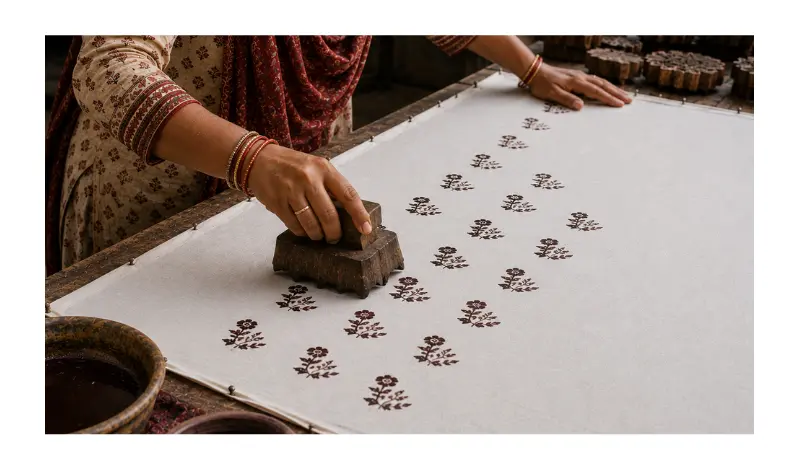
The enduring dominance of Jaipur in textile printing is functionally and culturally inseparable from the Chhipa community. The word itself comes from chhapna, the Hindi verb meaning to print or to stamp, identifying the community directly with their occupational specialisation across centuries.
The Chhipa community maintains a rich and layered origin story. The community claims descent from Rajput warriors who, during periods of intense historical conflict, sought refuge in temples and abandoned their martial status to adopt the craft of dyeing and printing. The Hindi word chhipa also carries the meaning of “hidden,” linking the community’s name to this moment of concealment and transformation. Sant Namdev, a 14th-century mystic poet from Maharashtra who was himself a calico printer by trade, is revered as the community’s patron saint. Shrines dedicated to him dot the printing clusters of Sanganer, and his image adorns the workshops of Chhipa families throughout the region, reinforcing the belief that the creation of printed cloth is an act of devotion as much as labour.
One of the most remarkable aspects of the Chhipa community is its socio-religious integration. While the community maintains its Hindu Rajput origin narratives, historical records document a significant conversion event in 1353 near Nagaur, Rajasthan, where multiple sub-castes embraced Islam. Today, Muslim and Hindu Chhipas work side by side across the same clusters, sharing the same workshops, the same techniques and the same commitment to a craft that neither group claims exclusively. In a country where communal tensions frequently dominate public discourse, the Chhipa community demonstrates what centuries of shared economic and cultural purpose can produce: a working harmony built not on ideology but on the daily reality of making something together.
The community’s knowledge transfer system has been the primary mechanism preserving the craft against industrialisation. Chhipa families historically resided in dedicated printing quarters near water sources, ensuring that dyeing chemistry, stamping technique and block alignment were absorbed by younger generations through apprenticeship rather than formal instruction. The sensitive chemical recipes, the precise pressure required for a clean impression, the eye-calibrated alignment of multiple blocks within a single composite motif: all of this lives in the hands and the memory of people who learned it from their parents, who learned it from theirs.
The Kharaudi Block Carvers: The Unacknowledged Foundation
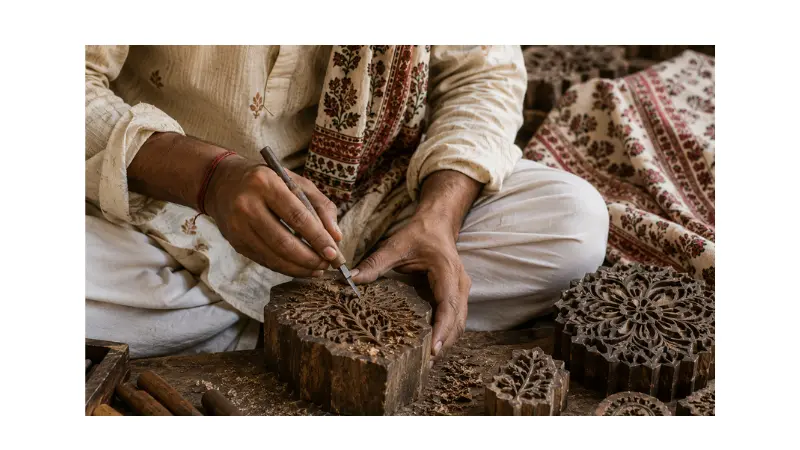
Every block print begins not with a printer but with a carver. The Kharaudi community are the specialist wood block carvers whose work is the architectural foundation of the entire Jaipur block printing tradition. A Chhipa artisan with perfect technique and the finest natural dyes cannot produce a print of quality without a block of equivalent precision. The Kharaudis are the bottleneck of design innovation. The precision of their chisels dictates the limits of what any designer or buyer can commission.
Block carving is executed entirely by hand. The primary woods used are Sagwaan (Teak), favoured for its balance of durability and workability, and Sheesham (Indian Rosewood), preferred for intricate, fine-line motifs that require sharp, enduring edges. A design is sketched on paper, transferred directly to the smoothed wood surface, and then the Kharaudi uses compasses, rulers, hand drills and an array of chisels to excavate the negative space, leaving the printable design standing in relief. Strategic holes are drilled into the wooden base to allow air to pass through, preventing suction and ensuring the clean release of excess dye during stamping.
Because Jaipur block printing is defined by its multi-coloured, multi-layer composite motifs, a single design pattern requires a set of perfectly registering blocks. This set typically includes the gadh (background block), the rekh (fine outline block) and the datta (filler blocks for specific interior colours). Creating a standard-sized block of approximately 5 by 9 centimetres takes between one and three days. A highly intricate Mughal-style design can require up to a month of continuous labour from a skilled carver.
Once carved, raw blocks are submerged in oil for 10 to 15 days. This seasoning softens the grain, prevents warping from repeated exposure to water-based dyes and extends the operational lifespan of the tool. A well-crafted, seasoned block typically lasts for between 600 and 1,000 metres of fabric printing before the edges require recutting. Depending on intricacy, a single block costs between ₹350 and ₹800. Without the Kharaudis’ mastery of spatial geometry and fine woodwork, the multi-layer registration that defines Jaipur’s most celebrated prints would be technically impossible.
The Chemistry of the Rivers: Why Geography Is an Ingredient
The artisan families who settled along Jaipur’s rivers in the 17th century were not making a romantic choice about landscapes. They were making a precise technical decision. The specific mineral composition of the local river water was, and in many processes remains, a chemical ingredient in the dyeing process itself.
The traditional Sanganeri and Bagru printing processes involve a sequence of chemical reactions between organic compounds, metallic mordants and natural pigments that require water of a specific mineral profile to complete correctly. The mineral-rich waters of the Sanjaria in Bagru and the Dhoondh and Saraswati in Sanganer provided the particular calcium, iron and dissolved mineral content that acted as catalysts and secondary mordants in the natural dyeing stages.
The full sequence of the traditional process demonstrates how deeply water is embedded at every stage:
Teluni (Scouring) uses a mixture of camel or goat dung, sesame seed oil, soda ash and water to strip industrial starch and natural oils from raw cotton. The alkalinity of the dung combined with the oil triggers a natural saponification process, creating a bio-detergent that cleans without damaging the cotton fibres. This is not folklore. It is the same chemical principle as the enzymatic bio-scouring used in modern sustainable textile manufacturing.
Pila Karna (Pre-mordanting) treats the scoured fabric with harda, a powder extracted from tannin-rich myrobalan fruit. The high tannic acid content creates chemical binding sites along the cellulose framework of the cotton, allowing subsequent metallic mordants to anchor permanently to the fibre.
Syahi (Black Ink) is prepared by fermenting scrap iron, including old horseshoes and camel shoes, in earthenware vessels with jaggery and water under the desert sun for 15 days. The resulting iron-acetate solution reacts with the harda-treated fabric to produce a deep, colour-fast black within the fibre structure, not on its surface.
Begar (Red Mordant) is a paste of alum, sticky tree gum and a pinch of red ochre stamped onto specific areas of the fabric. When the fabric is subsequently heated in a dye bath containing madder root and alizarin, the red dye bonds exclusively to the alum-treated areas through a coordinate chemical reaction, producing a permanent red that the untreated background resists entirely.
Tapai (Sun Bleaching) spreads the printed fabric on riverbanks, where artisans continuously sprinkle it with mineral-rich river water over eight to ten days. The combination of intense Rajasthan UV radiation and specific water mineral chemistry simultaneously bleaches the unprinted background back to brilliant white and permanently fixes the natural dyes within the fabric fibre.
The Dabu process adds another layer of geographical specificity. The resist paste is made from kali mitti, black clay harvested directly from the dried beds of local ponds and the Sanjaria river itself. This specific clay, combined with lime, tree gum and wheat chaff, creates a paste that dries and cracks in the arid Rajasthan sun in a particular way. As the cracked mud is immersed in the indigo vat, dye seeps through the microscopic fissures, producing the characteristic veined, hazy border around each Dabu motif that global buyers prize as the mark of authenticity and that no industrial process can replicate.
The mineral chemistry of Jaipur’s rivers creates, in effect, a terroir for the textile. The colour you see on a genuine Jaipur block print is, in part, the result of geological processes specific to this part of Rajasthan. That cannot be moved elsewhere.
GI Tags: The Legal Protection of Authenticity
As Jaipur’s block prints gained global commercial prominence, the market was flooded with cheap rotary screen-printed and digital imitations produced by industrial facilities across India and China. These imitations replicated the visual patterns of the craft using synthetic dyes in hours rather than the weeks required for genuine production, undercutting authentic artisans on price while claiming the same heritage.
To protect the authenticity and economic viability of the traditional craft, the Government of India granted Geographical Indication certifications to both primary Jaipur printing traditions under the Geographical Indications of Goods (Registration and Protection) Act, 1999.
Sanganeri Hand Block Printing was registered under GI Application No. 147 in 2010, held by the Calico Printers Cooperative Society Ltd., valid through December 2028.
Bagru Hand Block Print was registered under GI Application No. 183 in 2011, held by the Bagru Haath Thappa Chhapai Dastkar Sanrakshan Avvam Vikas Samiti, valid through August 2029.
Unlike copyrights or trademarks, which are private monopolistic rights, a GI tag is a publicly owned intellectual property right held collectively by the artisans of the designated region. It certifies that a product originates specifically from that geographical area and possesses the unique quality, reputation and traditional characteristics attributable to that locale. Any manufacturer outside the demarcated zones of Sanganer or Bagru, or any entity using mechanised processes like screen printing, is legally prohibited from selling their textiles under these protected names.
For international boutique brands and wholesale buyers focused on supply chain transparency and authentic provenance, partnering with GI-authorised manufacturers provides a legally verifiable guarantee that no imitation can claim. The full commercial significance of these GI certifications for wholesale buyers is explored in our detailed comparison of the two traditions.
Royal and Government Patronage: The Institutional Story
The survival of Jaipur block printing across three centuries of political disruption, industrial competition and economic pressure is not simply a story of artisan resilience. It is also a story of consistent institutional support.
Following the foundational patronage of Maharaja Sawai Jai Singh II, subsequent Rajput rulers continued to commission sophisticated textiles for royal attire, temple hangings and diplomatic gifts, ensuring a steady flow of capital and prestige to the Chhipa community through the 18th and 19th centuries.
In the post-independence era, as traditional systems of royal patronage dissolved, federal and state government bodies assumed the role of commercial custodians. The Export Promotion Council for Handicrafts (EPCH) has been instrumental in transitioning the craft from a domestic commodity to an international luxury export, facilitating global trade through international B2B exhibitions, subsidising artisan participation in trade fairs and conducting export-promotion programmes to help Jaipur manufacturers navigate international compliance standards.
The Ministry of Textiles supports the industry through schemes including the Amended Technology Upgradation Fund Scheme (ATUFS) for MSME modernisation, and the Samarth scheme for artisan upskilling and capacity building. At the state level, the Rajasthan Handicrafts Policy (2022) and the Rajasthan Investment Promotion Policy (2024) classify handicrafts as a formal thrust sector, offering financial incentives, tax relief and regulatory support to the artisan clusters.
International Recognition: Museums, UNESCO and the Wanderlust Controversy
In 2015, UNESCO formally designated Jaipur as a Creative City of Crafts and Folk Art under its Creative Cities Network, recognising the city’s living heritage and the existence of over 53,500 active craft workshops. This designation placed Jaipur in a global network of cities recognised for their exceptional craft traditions, elevating its standing with institutional buyers, design organisations and the sustainable fashion industry internationally.
The craft is also curated and preserved at the Anokhi Museum of Hand Printing, located in a restored 16th-century haveli in Amer. The museum documents the evolution of block printing and hosts live demonstrations by master carvers and printers. In 2000, the restoration of the museum building received a UNESCO award for Cultural Heritage Conservation.
The global visibility of Jaipur’s block printing tradition has not always been comfortable. In 2021, a collaboration between an elite Indian fashion designer and the international fast-fashion retailer H&M launched a collection featuring mass-produced, digitally printed garments that closely imitated traditional Sanganeri block print motifs. The controversy, reported internationally including by The New York Times, drew intense debate about cultural appropriation, GI enforcement and the fair attribution and compensation of the Chhipa artisans whose creative heritage the collection drew from. Whatever its commercial outcome, the dispute served to significantly raise global consumer awareness of the value, the vulnerability and the very specific human authorship behind authentic Jaipur block printing.
Export Markets: Where Jaipur’s Prints Go
According to Export Promotion Council for Handicrafts trade data, the primary destinations for Indian hand-printed textiles are the United States, the European Union with particular strength in Germany, France, Italy and the Netherlands, the United Kingdom, the UAE and Australia.
Recent data from the 2024-2025 period shows robust growth in the UAE at 24.21%, Latin American markets at 18.09% and Germany at 16.23%, demonstrating the widening global footprint of the craft. International buyers primarily source cotton and silk yardage, quilts, bedcovers, cushion covers and a wide range of apparel including resort wear, bohemian dresses, kaftans and tailored shirts.
The market has shifted significantly over the past decade. Previously dominated by high-volume, low-margin ethnic-wear exports, global demand has moved toward high-end slow-fashion positioning. Standard commercial block prints on cotton cambric command pricing starting around $4 to $6 per metre at wholesale. Bespoke, naturally dyed productions in rare techniques like Dabu or Jahota, with low MOQs and full traceability, command significant premiums. Global buyers are demonstrably willing to pay these premiums in exchange for supply chain transparency, authentic provenance and the verifiable imperfections that confirm a product is genuinely handmade.
The Infrastructure Behind the Craft
The most significant modern infrastructural development in the Jaipur block printing ecosystem is the Jaipur Integrated Texcraft Park Private Limited (JITPPL), known as Jaipur Bloc, established in 2006 in Bagru.
Built through a Special Purpose Vehicle formed by the Consortium of Textile Exporters, the ₹49.7 crore eco-park covers 23.42 acres and features a Common Effluent Treatment Plant equipped with Reverse Osmosis technology and solar evaporation systems, operating under a strict zero liquid discharge mandate. Every litre of process wastewater is treated, filtered and recycled within the facility rather than discharged into local waterways.
The park includes comprehensive rainwater harvesting infrastructure designed to capture and recharge roof and surface runoff, alongside substantial integrated solar power generation. These facilities allow modern export manufacturers within the park to assure global buyers that their textiles are produced under strict environmental regulation and social compliance standards, including SA8000 certification for fair labour practices. This kind of verifiable environmental practice is what we document and stand behind at Moharis.
How Jaipur’s Tradition Compares Globally
Block printing as a technique exists in various historical cultures, but what Jaipur does is genuinely distinct from all of them.
Chinese woodblock printing is historically oriented toward paper and Buddhist texts. When applied to textiles, Chinese techniques typically favoured monochromatic designs or functioned as outline guides for subsequent hand-painting. The multi-block, multi-colour registration system central to Jaipur’s tradition has no direct parallel in Chinese textile block printing.
European woodblock printing peaked in the 18th century primarily as a cheaper imitation of Indian chintz. The Industrial Revolution then rapidly made it obsolete, as the European textile industry mechanised toward copperplate and roller printing. The artisanal tradition was abandoned for volume efficiency within a generation.
Indonesian Batik produces similarly intricate patterns but through an entirely different mechanism: wax resist applied via a spouted tjanting tool or copper stamp, rather than direct pigment or mud-resist. The resulting textile has a completely different surface character, the characteristic crackled wax effect rather than Dabu’s organic veined border.
What is genuinely unique to Jaipur is the combination of multi-block registration complexity, often five or six distinct perfectly aligned wooden blocks building a single composite motif, with the Dabu mud-resist technique that exploits the specific drying behaviour of Rajasthan’s riverbed clay in the desert sun, producing a veining effect that is organic, irreplicable by machinery and chemically tied to this specific geography. No other textile tradition in the world combines these elements. That is the actual reason Jaipur is the capital of hand block printing.
Three Things Most People Do Not Know About Jaipur Block Printing
The accidental discovery of Dabu. Local oral histories in Bagru hold that the Dabu mud-resist technique was not invented but discovered by accident. A dyer had his dhoti smeared with thick river mud. When the garment was accidentally dropped into a vat of indigo dye, he found the next day that the mud had acted as a perfect resist, leaving the covered fabric pristine and un-dyed beneath the deep blue. That serendipitous moment, preserved in oral tradition across generations, is held to have birthed one of the world’s most celebrated and technically complex resist-printing techniques.
The ghost print as authentication. While rotary machines apply colour superficially to the fabric surface, the physical force of a Chhipa artisan striking a wooden block drives the dye deep into the weave of the cotton. Genuine hand block prints therefore almost always show a ghost print on the reverse: a partial, visible bleed-through of the ink on the back of the fabric. Machine imitations, which merely deposit colour on the surface, leave the reverse side largely blank. This is one of several authentication markers we explain in our guide to what hand block printing actually is.
The Hindu-Muslim synthesis at the heart of the craft. The Chhipa community maintains a Hindu Rajput origin mythology and simultaneously includes a significant Muslim population, the result of mass conversions in the 14th century under the Delhi Sultanate. Today, Muslim and Hindu Chhipas work side by side across the same clusters, sharing techniques, workshops and a commitment to a craft that belongs to neither community exclusively. In an era defined by communal division, the Chhipa community demonstrates something rare: a working cultural integration sustained not by politics but by the daily, shared act of making something extraordinary.
Why Jaipur Cannot Simply Be Replicated
Other cities have tried to build block printing industries. Some have succeeded at volume. None have replicated what Jaipur has because what Jaipur has is not primarily infrastructure or machinery. It is the accumulation of several centuries of specific, localised knowledge: how the clay of the Sanjaria riverbed behaves in July heat, what the water of the Dhoondh does to madder dye at a specific temperature, how to read the fabric by touch to know whether the harda has penetrated evenly, how to align five blocks by eye across two metres of moving cloth without a single registration error.
That knowledge lives in people. It is passed down through families across generations. It has survived the collapse of the Mughal Empire, the disruption of British industrialisation, the flooding of global markets with cheap imitations and the environmental crises of its own making. It survives because the community that carries it has never stopped working.
At Moharis, everything we make is rooted in this tradition and this community. When you source from us, you are not buying a product that happens to look like Jaipur block print. You are buying the actual thing, made by the actual people, in the actual place, with the actual water.
Moharis is a Jaipur-based manufacturer, exporter and wholesaler of hand block printed clothing, fabrics and home linen. We work with boutiques, sustainable fashion brands and sourcing companies across the USA, Europe and the Middle East. For wholesale inquiries, explore our catalog or write to us at info@moharis.com.