Quick Summary
- Natural fibres are chemically non-negotiable for authentic hand block printing. Cotton, linen, silk and khadi all contain reactive molecular groups that bond permanently with mordants and natural dyes. Synthetic fibres and polyester blends do not, and any print applied to them will wash away.
- Cotton is the dominant fabric for Jaipur block printing because of its high absorbency, wet tensile strength and ability to withstand the extreme physical and thermal stress of the Dabu mud-resist process.
- The eight primary cotton constructions used in Indian block printing are mulmul, voile, lawn, cambric, poplin, slub cotton, dobby cotton and cotton canvas, each suited to different print techniques and end products.
- Cambric (80 to 110 GSM, 92×88 to 132×108 thread density) is the industry standard for Sanganeri printing. Poplin and heavy cambric (110 to 200+ GSM) are the standard for Bagru Dabu printing.
- India produces five key cotton varieties for block printing: Suvin (extra long staple, finest quality), DCH-32, MCU-5, Shankar-6 and organic long-staple cotton. Fibre length directly determines yarn smoothness, which determines print clarity.
- Linen suits bold, large motifs rather than fine detail. Its natural slubs create beautiful interruptions in the pattern that enhance the artisanal character of the print.
- Silk requires degumming before printing. Once the sericin gum is removed, silk bonds with mordants and dyes more efficiently than cotton and produces the most vibrant and luxurious block-printed output.
- Khadi produces a beautifully striated, textured printed surface because the handspun yarn is naturally uneven, absorbing dye differently across thick and thin sections.
- GSM determines dye penetration, print pressure and end-product suitability. Lightweight fabrics at 40 to 80 GSM suit scarves and dupattas. Mid-weight at 90 to 150 GSM suits dresses, kurtis and shirts. Heavy weight at 200 GSM and above suits upholstery and bags.
- Fabric must be completely bone dry before any mordant paste is stamped onto it. Even trace residual moisture causes the dye to wick outward along the fibres, blurring fine outlines irreparably.
- GOTS certification, OEKO-TEX Standard 100 and REACH compliance are the three most commercially relevant fabric certifications for boutique buyers exporting block printed goods to the USA and Europe.
The choice of base fabric is not a secondary decision in hand block printing. It is the first decision, and it determines everything that follows. Which motifs will print cleanly. Whether the natural dye will penetrate evenly or sit on the surface. Whether the fabric will survive the boiling, mud-coating and repeated washing of the Bagru Dabu process. Whether the finished product will drape like a luxury resort dress or hold its shape as a structured home furnishing.
At Moharis, fabric selection is where the conversation with every new wholesale buyer begins. Here is the complete technical picture for anyone who needs to understand it.
Why Synthetic Fabrics Cannot Be Block Printed
Before covering what works, it is worth being precise about what does not.
Natural block printing relies on a chain of chemical bonding events between the fabric fibre, the tannin pre-treatment, the metallic mordant and the natural dye. For this chain to hold permanently, the fibre must contain reactive molecular groups that can attract and bind with the mordant and dye molecules.
Cotton, linen and hemp are cellulosic fibres composed of glucose polymers. Their hydroxyl groups provide the attachment sites for tannins, which then provide attachment sites for metallic mordants, which then lock the dye molecules permanently into the fibre structure through a coordination complex. Without the tannin step, the mordant washes off. Without the mordant, the dye washes off.
Silk and wool are protein fibres containing amine, carboxyl and hydroxyl groups. These are even more reactive than cellulose, bonding directly and efficiently with mordants without the same intensity of tannin pre-treatment.
Synthetic fibres, including polyester, nylon and acrylic, are manufactured from extruded petrochemical polymers. They are highly crystalline, hydrophobic and completely lack the reactive functional groups that natural dyes and mordants need to bond with. When block printing is attempted on polyester or a synthetic blend, the mordant or dye paste sits on the inert surface of the filament and washes away during post-print laundering. Complete colour loss or severe bleeding is the result. Synthetic blends also interfere with discharge printing, which relies on chemically extracting reactive dyes from cellulosic fibres, a reaction that cannot occur on plastic.
This is not a limitation of the block printing technique. It is a consequence of the chemistry. Authentic hand block printing requires a natural base fabric. There is no workaround.
Also Read: The History of Indian Textiles
Why Cotton Dominates Jaipur Block Printing
Cotton is the foundational fabric for Sanganeri and Bagru printing for reasons that are both chemical and structural.
The high absorbency of properly scoured cotton is its most critical property. Once the natural pectins, waxes and processing oils are stripped from the fibre, the porous cellular structure of cotton draws aqueous tannin solutions, mordant pastes and natural dyes deep into the yarn matrix through capillary action. When an artisan stamps a carved wooden block loaded with thickened mordant paste onto cotton, the fabric pulls the paste inward, producing sharp, crisp outlines without excessive lateral bleeding, provided the fabric is completely dry before printing begins.
Cotton is also stronger when wet than when dry, a property that is relatively rare among textile fibres. This elevated wet tensile strength is what allows cotton fabric to survive the extreme demands of the Bagru Dabu process: being coated in heavy clay resist paste, dried under harsh Rajasthani sunlight, submerged repeatedly into cold indigo vats and in some cases boiled vigorously in hot madder dye baths. Lighter, less robust fabrics would distort, warp or tear under this treatment. Cotton holds its dimensional stability throughout.
The quality of the raw cotton fibre determines the quality of the final printed textile directly. Lower quality cotton with short staple lengths produces high yarn hairiness, microscopic surface fuzz that intercepts the printing block prematurely and causes the dye to spread unpredictably. This blurs intricate motifs and produces the frosting effect that ruins fine Sanganeri prints. Long-staple cotton produces smooth, tightly spun, uniform yarn that gives the artisan a pristine, flat printing canvas and the buyer a finished textile with exceptional print clarity and deep dye penetration.
India’s Key Cotton Varieties for Block Printing
India cultivates several distinct cotton varieties and the agricultural quality of the fibre affects everything downstream, including printability, dye uptake and finished fabric quality.
Suvin is the finest Indian cotton and among the finest in the world. An extra long staple variety grown primarily in Tamil Nadu with a staple length of 38 to 40 mm and exceptional fineness, Suvin can be spun into extremely fine, strong yarns up to 120s count. Fabrics woven from Suvin provide a flawless, silk-like surface that allows for intricate block prints with zero capillary bleeding and hyper-crisp edge registration. It is the premium choice for the finest Sanganeri lawn and cambric.
DCH-32 is another extra long staple variety (33 to 35 mm) cultivated in Madhya Pradesh, Karnataka and Tamil Nadu. It produces very low yarn hairiness, which prevents the frosting effect where surface fuzz absorbs dye before it can penetrate the yarn core. DCH-32 is heavily used for the fine yarns required in premium cambric and lawn.
MCU-5 is a long staple variety (32 to 35 mm) grown in Maharashtra, Andhra Pradesh and Tamil Nadu. It strikes an optimal balance between rapid dye absorbency and high tensile strength, making it structurally ideal for surviving the rigours of Bagru Dabu mud-resist printing and boiling.
Shankar-6 is India’s most widely exported cotton, grown primarily in Gujarat across millions of acres. With a staple length of 27.5 to 29.5 mm, it forms the standard agricultural base for the commercial poplins, voiles and cambrics used in everyday block printing. Shankar-6 is prized for its excellent, uniform dye uptake.
Organic long-staple cotton is cultivated from premium seeds without synthetic pesticides, chemical fertilisers or harsh defoliants. Because the fibres are not subjected to aggressive agricultural chemicals, they retain superior structural integrity, produce a softer hand-feel and respond exceptionally well to natural tannin-mordant dyeing. This is the cotton variety behind GOTS-certified block printed fabrics.
Also Read: What is Kalamkari? India’s Oldest Textile Art
The Eight Cotton Constructions for Block Printing
The weave construction of a cotton fabric, its yarn count, thread density and weight, determines how it performs during printing and what it is best suited for as a finished product.
Mulmul (Muslin)
Mulmul is the lightest of all block printing fabrics. Woven from fine yarns typically in the 60s to 100s count range with a loose weave density of 65 to 100 threads per inch, it sits between 40 and 70 GSM. Its sheer, porous structure means dye pastes penetrate entirely, often producing a print almost as vibrant on the reverse as on the face.
Mulmul is not suitable for detailed fine-line Sanganeri motifs because its loose weave allows some lateral dye migration. It works beautifully with bold, flowing patterns and natural indigo dyes. It is the standard outer layer for Jaipuri Razai quilts, and its extraordinary breathability makes it the preferred fabric for lightweight summer scarves, dupattas and baby swaddles.
Voile
Voile is woven with highly twisted yarns, generally in the 70s to 80s count range, which gives it a crisper, slightly stiffer hand than mulmul while remaining semi-transparent. Its tighter construction (typically 92×88 to 100×92 thread density) provides a smoother printing surface that yields sharper print registration than mulmul. It falls between 40 and 60 GSM.
Voile is the preferred fabric for premium summer blouses, sheer curtains and export-quality scarves where the buyer wants lightness with slightly more structural clarity in the print than mulmul provides.
Lawn
Lawn is a silky, smooth plain-weave cotton characterised by a crisp, highly calendered finish achieved through a pressure-rolling process that flattens the yarn surface. Woven with fine yarns (60s to 80s) at a high thread count (100×80 to 120×100), lawn sits between 60 and 80 GSM.
The exceptionally flat, uniform surface of lawn allows the block printer to achieve incredibly sharp, detailed and miniature motifs without interruption from fabric slubs or heavy grain lines. It is the preferred base for luxury dresses, lightweight resort shirts and premium Sanganeri print collections destined for the US and European boutique market.
Cambric
Cambric is the workhorse of Jaipur block printing and the industry standard for Sanganeri printing. Dense, opaque and highly calendered, it is woven with 50s to 60s count yarns at thread densities ranging from 92×88 to 132×108, sitting between 80 and 110 GSM.
The combination of a smooth, flat surface and sufficient body gives cambric the ideal balance of print clarity and structural substance. Fine Sanganeri florals, delicate butis and intricate jaal lattice patterns all register cleanly on cambric without bleeding. It is the preferred fabric for everyday kurtis, boutique dresses, premium shirts and the majority of Moharis’s apparel range. The step-by-step process of how block printing is executed on cambric is covered in our fabric and printing guide.
Poplin
Poplin is distinguished by a fine crosswise rib formed by weaving a finer warp yarn with a slightly thicker weft. Typically constructed at 100×80 to 132×72 thread densities using 40s to 50s yarns, it sits between 110 and 140 GSM, making it the heaviest of the standard block printing plains.
Poplin’s strength, opacity and dimensional stability make it the natural choice for structured shirts, trousers, tailored dresses and the heavier end of home furnishing fabric. It also handles the physical demands of Bagru Dabu mud-resist printing well, surviving the weight of the wet clay paste and the heat of the madder boiling stage without warping.
Slub Cotton
Slub cotton is woven using yarns that intentionally vary in thickness along their length, producing a textured, organic, linen-like visual appearance. Ranging from 90 to 200 GSM depending on the slub weight and density, it provides an inherently artisanal character.
When block printed, slubs absorb dye unevenly, creating slight charming interruptions in the pattern that emphasise the handmade nature of the textile. This is not a defect. It is exactly what the global bohemian and sustainable fashion markets want. Slub cotton is highly sought after for kaftans, bohemian dresses, casual tunics and textured cushion covers.
Dobby Cotton
Dobby cotton is produced on a specialist loom that allows the integration of small geometric woven-in textures or self-design motifs across the fabric surface. Ranging from 110 to 180 GSM, dobby adds a tactile, three-dimensional element to the base cloth.
Block printing over a dobby weave creates a complex, layered aesthetic, as the dye interacts differently with the raised woven motifs versus the flat ground. The visual result is a richly textured printed textile positioned at the premium end of the boutique market. Best suited for high-end shirting, luxury ethnic wear and textured home linen.
Cotton Canvas
Cotton canvas is a heavy, durable plain or duck weave fabric constructed from thick 10s to 20s count yarns, weighing between 200 and 350 GSM and above. At this weight, block printing requires significant physical pressure and a highly viscous dye paste to achieve proper fibre penetration.
Canvas withstands extreme wear and industrial washing, making it the primary choice for tote bags, aprons, structured jackets and robust upholstery. Block-printed canvas has become a strong category in the sustainable lifestyle market globally.
Linen for Block Printing
Linen, derived from the flax plant, shares the same cellulosic chemistry as cotton and follows the same tannin-mordant-dye preparation sequence. But it behaves differently during printing and produces a different aesthetic result.
Linen fibres are longer, thicker and considerably more rigid than cotton fibres. The fabric ranges from 120 GSM for lightweight apparel to over 250 GSM for heavier suiting and home goods. Its natural slubs, thicker sections of yarn that occur organically during spinning, create surface variations that can physically interrupt very fine block print lines.
This is where linen requires a design adjustment. Fine Sanganeri floral motifs with hairline detail do not translate cleanly onto linen. Bold geometric patterns, large florals and the kind of expressive motifs characteristic of Bagru printing work beautifully with linen because the slub interruptions add to the artisanal character rather than disrupting design clarity.
Once properly scoured to strip its heavy natural waxes and pectins, and properly mordanted, linen yields beautiful, slightly muted earthy tones that align perfectly with the sustainable and slow fashion aesthetic. Its exceptional breathability, thermal conductivity and moisture-wicking properties place block-printed linen firmly in the premium category for hot-weather luxury apparel, resort wear, wide-leg trousers, unstructured jackets and high-end home textiles including table runners, napkins and premium bedding.
Cotton-Linen Blends for Block Printing
Cotton-linen blends, most commonly in 60% cotton / 40% linen or 50/50 ratios, are engineered to capture the best of both fibres while resolving the specific challenges each presents in isolation.
Pure linen’s heavy slubs and high crystallinity can disrupt delicate block prints. Blending flax with cotton smooths the fabric surface considerably, allowing for sharper print registration while retaining the organic texture and natural character that boutique buyers want. Cotton absorbs natural dyes slightly faster and yields brighter tones than pure linen. The blend produces a more uniform colour yield across the full mordant-dye sequence.
On the drape side, pure linen can feel stiff and wrinkles severely. Cotton introduces softness and fluidity without losing the linen’s crisp, breathable, durable qualities. Cotton-linen blends have become one of the strongest performing categories for export boutiques sourcing from Jaipur, used for high-end summer dresses, tailored resort wear, lightweight trousers and premium home textiles.
Silk for Block Printing
Silk introduces a different chemistry, a different aesthetic and a higher commercial tier to the block printing process. As a protein fibre, silk bonds with metallic mordants far more efficiently than cellulose, bypassing much of the tannin preparation required for cotton.
India produces three primary silk varieties used in block printing.
Mulberry silk is cultivated from silkworms fed exclusively on mulberry leaves, producing a fine, uniform and highly lustrous fibre. Block printing on mulberry silk yields striking, vibrant clarity with a depth of colour that cotton cannot match at the same dye concentration.
Tussar (Tasar) silk is a wild silk variety with a natural golden hue and a rich, textured hand-feel. Block printing on Tussar produces deep, antiqued colours that read as instantly luxurious. It is highly prized in premium boutique markets in Europe and the Middle East.
Eri silk, often called peace silk because the cocoon is harvested without killing the silkworm, has a matte, wool-like texture. It absorbs dyes deeply, resulting in richly saturated block prints with an earthy, organic character.
Before any of these silks can be printed, the sericin gum that encases the raw fibre must be removed through a process called degumming. Sericin constitutes 17% to 38% of raw silk’s weight and acts as a rigid adhesive that inhibits dye absorption and causes uneven printing. Alkaline boiling or steaming removes the sericin and reveals the soft, lustrous fibroin core beneath.
Once degummed, dye pastes strike the silk surface rapidly. The block printer must use precisely thickened pastes with carefully modulated pressure to prevent immediate bleeding across the lustrous surface. Block-printed silk sits almost exclusively in the premium and luxury export tiers: high-end scarves, evening dresses and artisanal interior pieces.
Khadi for Block Printing
Khadi is defined not by its fibre content but by its manufacturing process. It is handspun on a charkha (spinning wheel) and handwoven on a manual loom, making it simultaneously the most labour-intensive and the most authentic fabric in the Indian textile tradition. Cotton khadi is the most common base for block printing.
Because the yarn is handspun, its twist, tension and density are naturally uneven. Thicker, loosely twisted sections of the yarn absorb liquid mordant and dye rapidly. Tightly twisted, dense sections absorb less. This differential dye uptake produces a beautifully striated, textured printed surface that is impossible to replicate on uniform, mill-made fabric. The visual result is block printing at its most organic and most authentic.
In USA and European sustainable fashion markets, block-printed khadi commands a premium position. Its near zero-carbon manufacturing process, running entirely on human energy rather than industrial electricity, combined with its uniquely textured, highly breathable drape, makes it exceptionally attractive to conscious consumers seeking verifiable artisan narratives. It also aligns naturally with the GOTS philosophy of handcrafted, chemically responsible production.
GSM: What Weight to Specify for Each Product
GSM (grams per square metre) is the international standard for fabric weight and one of the most important specifications a wholesale buyer needs to understand and communicate precisely.
In block printing mechanics, GSM directly affects dye penetration. On lightweight fabrics under 80 GSM, the liquid dye penetrates the full thickness of the yarn matrix, producing a print visible on both sides. On heavy fabrics above 150 GSM, the viscous paste primarily colours the surface layer, leaving the reverse relatively pale. This is not a defect but a characteristic to plan for, particularly for reversible products.
| Product Category | Recommended Fabric | Optimal GSM |
| Lightweight scarves and dupattas | Mulmul, fine voile | 40 to 70 GSM |
| Summer dresses, kurtis, blouses | Cambric, lawn, light poplin | 90 to 130 GSM |
| Tailored shirts and men’s tops | Poplin, slub, dobby, linen blend | 110 to 150 GSM |
| Home linen and bed sheets | Heavy cambric, plain sheeting | 140 to 180 GSM |
| Quilts and throws | Mulmul outer layer, sheeting backing | 60 to 90 GSM outer |
| Heavy upholstery and tote bags | Cotton canvas, cotton drill | 200 to 350+ GSM |
When specifying GSM in a purchase order, always include an acceptable tolerance. Specifying “110 GSM ± 5%” protects against weight variation across a roll that would cause inconsistent dye penetration and uneven printing.
How Sanganeri and Bagru Printing Place Different Demands on Fabric
The two great Jaipur block printing traditions require different base fabrics because they subject cloth to fundamentally different physical and chemical processes.
Sanganeri printing stamps mordants and dyes directly onto a stark white or pastel background, capturing fine, delicate floral butis and intricate vine networks. To hold these micro-details without the dye wicking out of bounds, the base fabric must be exceptionally smooth, tightly woven and free of surface hairiness or slubs. High-thread-count cambric at 80 to 110 GSM is the optimal choice for Sanganeri. Fine voile and lawn also work well. The fabric surface is the canvas and it must be as uniform and uninterrupted as possible.
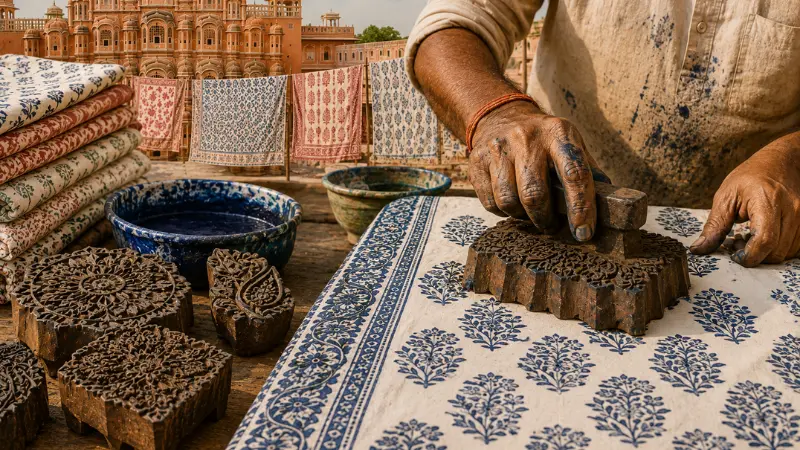
Bagru Dabu printing works completely differently. A heavy, sticky paste of black clay, wheat chaff and lime is block-printed onto the fabric as a physical dye resist. The fabric is then dried in the sun, submerged repeatedly in cold indigo vats or boiled in hot madder vats. It must withstand the physical weight of the wet mud, harsh UV radiation, cold immersion and in some cases vigorous boiling. Lightweight fabrics would warp, distort or tear under this treatment.
Bagru demands sturdy, medium to heavyweight fabrics. Poplin, heavy cambric, cotton canvas, cotton drill and durable slub cotton ranging from 110 to 200+ GSM are the correct specifications. The fabric needs tensile and tear strength that lightweight weaves simply cannot provide.
The same fabric can sometimes be used for both traditions, poplin for example handles both, but the requirements diverge significantly at the extremes. Fine lawn cannot survive a Bagru Dabu boiling stage. Heavy canvas cannot capture the hairline detail of a Sanganeri buti. Fabric selection is technique-specific.
Preparing the Fabric Before Printing
Every fabric that goes under a printing block must first be chemically and physically prepared. This preparation stage is as important as the printing itself. Inadequate preparation produces patchy, fading or completely unmarketable printed textiles.
Scouring strips away natural pectins, waxes, processing oils and environmental dirt from the raw fibre. The fabric is steeped or boiled in an alkaline bath using soda ash and enzyme-rich solutions. It is often left damp for up to 12 hours to allow the enzymes to fully digest the pectins, while the soda ash saponifies the waxes. This opens the fibre matrix and dramatically increases its ability to absorb aqueous solutions. Depending on the desired background colour, scoured fabric may then be bleached using eco-friendly hydrogen peroxide to achieve a pristine white base.
Tannin pre-treatment follows scouring. Because cellulose cannot bond directly with metallic mordants, the scoured fabric is soaked in a hot solution of natural tannin, typically harda (myrobalan) powder at 10% to 15% weight of fabric, for one to two hours or overnight. This imparts the distinctive pale yellowish-grey tint visible on harda-treated fabric before printing. The tannin provides the chemical bridge that allows mordants to anchor to the fibre.
Mordanting is the final preparation stage. In direct printing, the mordant paste, typically aluminium potassium sulfate or ferrous acetate mixed with a thickener like guar gum, is stamped directly onto the tannin-treated fabric via the wooden block. In immersion dyeing, the fabric is boiled in an alum bath. For cellulosic fibres treated with alum, a fixing bath using calcium carbonate or wheat bran solution permanently sets the metallic salts into the fibre before the natural dye is introduced.
And then comes one of the most critical and least discussed rules in block printing: the fabric must be completely, utterly bone dry before the mordant block is stamped. Even trace residual moisture causes the newly stamped liquid mordant to wick outward along the damp fibres through capillary action. The result is a hazy, blurred outline rather than a sharp, crisp print. No amount of skill at the printing table can compensate for a fabric that went under the block with moisture in it.
Certifications: What Boutique Buyers Need to Specify
For boutique buyers exporting block-printed products to the USA and Europe, fabric certification is a commercial and legal requirement, not an optional brand enhancement.
GOTS (Global Organic Textile Standard) is the gold standard. It certifies that cotton is organically farmed without synthetic pesticides and mandates strict environmental and social compliance throughout the entire supply chain. GOTS explicitly prohibits toxic heavy metals, formaldehyde and harmful AZO dyes in the printing and dyeing phases. At Moharis, our GOTS-certified fabric range is available across the key cotton constructions used in our apparel and home linen collections. Our sustainable practices page details how we approach certification compliance.
OEKO-TEX Standard 100 certifies that the finished fabric has been rigorously tested for harmful substances including heavy metals, formaldehyde, phthalates and banned AZO dyes. For export to Europe, OEKO-TEX certification or equivalent REACH Annex XVII compliance is essential. REACH restricts banned amines derived from AZO dyes to under 30 mg/kg in finished textiles. Shipments failing this threshold face customs rejection at European ports.
Better Cotton Initiative (BCI) focuses on training farmers to use water efficiently, maintain soil health and reduce harmful agricultural chemicals. It is not equivalent to organic certification but is a highly relevant, scalable sustainability credential for mid-tier brands seeking to improve their environmental footprint without the premium cost of full GOTS certification.
How to Specify Fabric When Ordering from Jaipur
A professional fabric specification must include the following to protect your order against quality variation.
Construction: State the exact yarn count and thread density. For example, “100% Cotton Cambric, 60s x 60s yarn count, 92 EPI x 88 PPI.”
Weight: Specify GSM with tolerance. For example, “110 GSM ± 5%.”
Width: State the required cuttable usable width. Standard export fabric is typically 58 inches wide.
Certification: State the required certification explicitly. “GOTS certified, Transaction Certificate required for each batch” or “OEKO-TEX Standard 100 certified.”
For export POs, specify the fabric testing standards that must be met before shipment is approved:
| Test | ISO Standard | AATCC Standard | Typical Requirement |
| Wash fastness | ISO 105-C06 | AATCC 61 | Grade 4 to 5 |
| Colorfastness to light | ISO 105-B02 | AATCC 16 | Grade 4 |
| Crocking dry and wet | ISO 105-X12 | AATCC 8 | Grade 4 dry, Grade 3 wet |
| Dimensional shrinkage | ISO 6330 | AATCC 135 | Maximum 5% length and width |
| Spirality | ISO 16322 | AATCC 179 | Maximum 5% |
Shrinkage is particularly important for block-printed natural fibre garments. Specifying a maximum of 5% pre-washing shrinkage and requiring the manufacturer to pre-shrink fabric before cutting prevents the consumer-facing problem of garments coming out of the first wash significantly smaller than labelled.
Common Fabric Quality Issues That Affect Print Quality
Residual sizing is the most damaging pre-existing fabric defect for block printing. During commercial weaving, warp yarns are heavily coated in starch or PVA sizing to prevent breakage during the weaving process. If this sizing is not fully removed during scouring, it acts as a chemical resist. Tannin, mordant and dye all fail to penetrate the sized fibre core, resulting in patchy, uncoloured spots or frosting throughout the print.
Uneven weave and fabric skewing occurs when weft yarns are not perpendicular to the warp. If a geometric block print is stamped onto a skewed fabric, the print appears straight on the printing table. But when the garment is washed and the fabric relaxes to its natural orthogonal state, the printed pattern warps diagonally and ruins the garment. Specifying a maximum skew tolerance in your purchase order is the protection against this.
GSM variation across a roll means the artisan’s standard physical block pressure will produce inconsistent dye penetration, visible as lighter and darker patches along the yardage. Always specify a tight GSM tolerance of ± 3% to protect against this.
Iron mordant degradation is a lesser-known long-term fabric issue. Ferrous sulfate is highly effective for producing deep blacks and dark tones in block printing, but iron is mildly corrosive to cellulose. Over years, heavy iron-printed motifs can degrade and embrittle the cotton fabric faster than the unprinted background. Additionally, ferrous acetate printing pastes oxidise rapidly on exposure to air. A paste left for more than 24 hours turns bright orange, loses its chemical strength and produces unacceptably pale prints. This is a formulation and timing issue at the manufacturing level that buyers cannot test for directly, which is why verifying your manufacturer’s dye and paste preparation protocols matters.
The Right Fabric for Every Collection
Matching fabric to technique, to motif scale, to end product and to market is the craft within the craft in Jaipur block printing. A fine lawn suits the delicate Sanganeri buti on a luxury resort dress. A heavy slub cotton carries a bold Bagru indigo geometric on a statement kaftan. A cotton-linen blend brings the earthy credibility of natural fibre to a premium home linen range. Khadi carries a zero-carbon artisan story that no mill-made fabric can match.
Understanding these distinctions is what separates a sourcing decision made from a catalog from one made with real knowledge of what the fabric will do under the block.
Explore our wholesale catalog at Moharis to see how we apply these fabric choices across our full range of hand block printed clothing, fabrics and home linen. Or read more about the artisan communities and processes behind every piece we make.
Moharis is a Jaipur-based manufacturer, exporter and wholesaler of hand block printed clothing, fabrics and home linen. We work with boutiques, sustainable fashion brands and sourcing companies across the USA, Europe and the Middle East. For wholesale inquiries, write to us at info@moharis.com or visit our wholesale page.