Quick Summary
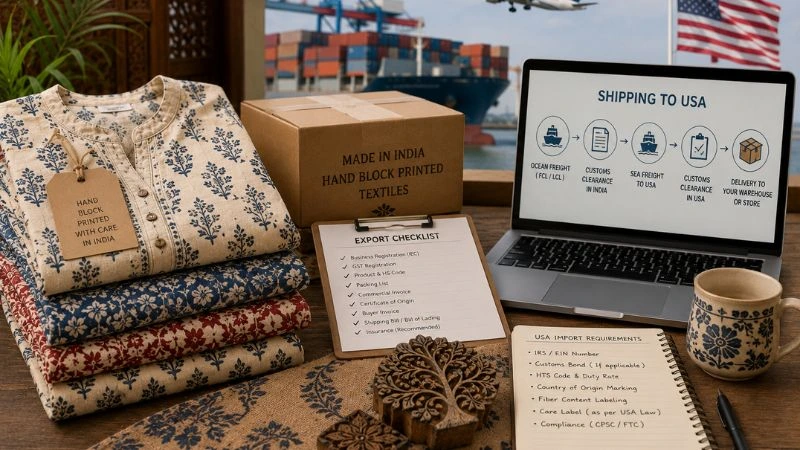
- Importing clothing from India to the USA involves four key parties: the US importer of record, the Indian manufacturer, a freight forwarder and a licensed US customs broker. Each carries distinct legal and financial responsibilities.
- Hand block print clothing from Jaipur is overwhelmingly woven cotton, placing it under Chapter 62 of the Harmonized Tariff Schedule. Duty rates vary by product category: women’s dresses at 8.4%, women’s blouses at 15.4%, men’s shirts at 19.7%, kaftans and kurtas at 8.1%, quilts at 4.4%.
- India lost its Generalized System of Preferences (GSP) status in 2019, so standard Most Favored Nation (MFN) duty rates apply. However, India still holds a significant advantage over China, which faces additional punitive Section 301 tariffs of 10% to 25% on top of standard duties.
- The Uyghur Forced Labor Prevention Act (UFLPA) requires importers to prove their cotton supply chain has no connection to China’s Xinjiang region. This means full farm-to-garment traceability documentation. Shipments detained without this evidence face exclusion or seizure.
- Every garment must carry an FTC-compliant label stating fibre content, country of origin (“Made in India”), manufacturer identification and care instructions in English.
- GOTS certification does not reduce US import duties, but it significantly strengthens UFLPA traceability compliance and protects against FTC greenwashing claims.
- The Section 321 de minimis exemption has been effectively eliminated for non-postal shipments globally as of late 2025. Every shipment from India, regardless of value, now requires formal customs entry and full duty payment.
- For small boutique buyers, DHL, FedEx or UPS express courier shipments under 100 kilograms are the most practical starting point. The courier acts as your customs broker automatically.
- Standard production lead times for hand block print garments are 6 to 10 weeks, plus 1 to 5 weeks for freight. Holiday collections must be ordered 4 to 5 months in advance.
Importing hand block print clothing from Jaipur to the USA is one of the most commercially rewarding sourcing decisions a boutique brand can make. The products are genuinely distinctive, the sustainability story is verifiable, and the price-to-value ratio for quality artisan-made textiles is exceptional. But the import process itself is not simple, and the regulatory environment in 2025 and 2026 has become significantly more demanding than it was even two years ago.
This guide covers everything a boutique buyer or sustainable fashion brand needs to understand before placing their first order and long after. From the correct HTS codes and duty rates to UFLPA compliance, FTC labelling requirements and the collapse of the de minimis exemption, here is the full picture.
Who Is Involved in the Import Process
Before getting into documents and duties, it helps to understand the four parties whose work must be coordinated for every successful shipment.
The Importer of Record (IoR) is the US-based boutique or brand purchasing the goods. This entity assumes full legal liability for the accuracy of customs declarations, the payment of applicable duties and compliance with all US laws. When CBP comes looking for documentation, they come to you.
The Indian manufacturer or exporter based in Jaipur is responsible for sourcing raw cotton, executing the block printing process, assembling the garments and preparing the export documentation required by Indian Customs before the goods can leave the country.
The freight forwarder bridges the geographic gap. They arrange inland trucking from Jaipur or Delhi to the port, book cargo space on ocean vessels or aircraft, and handle export customs clearance at Indian ports including Nhava Sheva in Mumbai or Mundra.
The US customs broker is a licensed professional authorised by CBP who acts on your behalf once the cargo arrives in the USA. They file the entry documents, calculate and remit duties and navigate any CBP holds or examinations. This is not optional for most shipments and is worth every dollar of their fee.
The full timeline from order placement to delivery at your warehouse looks like this: 45 to 60 days for production and quality control, 3 to 7 days for export clearance, 25 to 45 days for ocean freight or 4 to 10 days for air freight, 1 to 3 days for US customs entry, and 2 to 5 days for final inland delivery. Add an additional 2 to 14 days if your shipment is flagged for physical examination. Plan accordingly and never build a buying calendar that cannot absorb a delay at any of these stages.
HTS Codes and Duty Rates: What You Will Actually Pay
The Harmonized Tariff Schedule (HTS) code assigned to your goods determines the duty rate you pay. Getting this right is not optional. Misclassification leads to compliance audits, penalty assessments and landed costs that can destroy your margins across multiple shipments.
Hand block print clothing from Jaipur is overwhelmingly made from woven cotton fabric, placing it under Chapter 62 of the Harmonized Tariff Schedule, which covers woven apparel and accessories. Chapter 61 covers knitted or crocheted garments, which is a different product category entirely.
Here are the primary HTS codes and current Most Favored Nation duty rates for woven cotton goods commonly imported from India:
| Product | HTS Code | Duty Rate |
| Women’s dresses | 6204.42.30.10 | 8.4% |
| Women’s blouses and shirts | 6206.30.30.41 | 15.4% |
| Men’s shirts (dress and casual) | 6205.20.20.66 | 19.7% |
| Women’s kaftans and kurtas | 6211.42.10.92 | 8.1% |
| Scarves and shawls | 6214.90.00.10 | 11.3% |
| Printed bed linen (napped) | 6302.21.70.40 | 2.5% |
| Printed bed linen (not napped) | 6302.21.90.50 | 6.7% |
| Quilts and bedspreads | 9404.40.10.00 | 4.4% |
A few classification points worth knowing before you file anything.
Kaftans and kurtas require particular care. Their classification depends on length, cut and whether they are imported as part of a coordinated set. Depending on these variables, they may be classified as dresses under heading 6204, women’s blouses under heading 6206, or other garments under heading 6211. The wrong call here has real financial consequences.
For scarves and neck coverings, dimensions determine classification. Square articles with no side exceeding 60 centimetres are classified as handkerchiefs under heading 6213. Items exceeding 60 centimetres fall under heading 6214 as scarves or shawls.
To confirm the correct HTS code and protect yourself from future misclassification penalties, use the Customs Rulings Online Search System (CROSS) to review CBP binding rulings on identical or substantially similar garments. For unique artisanal products, your customs broker can submit a physical sample to CBP’s National Commodity Specialist Division to request a formal binding ruling, which legally immunises you from misclassification penalties on that specific item going forward.
CBP Documentation and Entry Requirements
Every textile import into the USA requires specific documents submitted electronically through the Automated Commercial Environment (ACE). CBP enforces not just customs statutes but the regulations of over forty federal agencies, and textiles are among the most scrutinised import categories.
The two core customs forms are CBP Form 3461, used to secure the initial release of goods, and CBP Form 7501, the Entry Summary used for final duty calculation and trade statistics.
Your commercial invoice must contain the full name and address of both seller and buyer, a comprehensive description of the merchandise including whether the fabric is woven or knit, the gender the garment is designed for, fibre content, quantities, transaction value, the agreed Incoterm, country of origin and the specific 10-digit HTS code.
For ocean shipments specifically, an Importer Security Filing (ISF) must be transmitted to CBP at least 24 hours before the cargo is loaded onto the vessel at the Indian port. Missing this deadline triggers an automatic, non-negotiable penalty of $5,000 per violation. Your freight forwarder should handle this, but verify that they have done so.
During examination, CBP will focus on three things: valuation accuracy, ensuring the declared customs value matches the true transaction value; origin verification, confirming the goods were actually manufactured in India and not transshipped from China to evade Section 301 tariffs; and label compliance, verifying that the physical garments carry the required FTC labels matching the documentary declarations.
FTC Labelling: What Every Garment Must Say
Every garment imported into the USA must carry a physical label before the goods can legally enter US commerce. The Federal Trade Commission enforces these requirements under the Textile Fiber Products Identification Act and the Care Labeling Rule. A shipment that fails label inspection at the border does not get released. It gets held until the labels are corrected, which means cost, delay and often destruction of goodwill with your customers.
Fibre content must be stated using generic names and percentages by weight of each fibre, listed in descending order of predominance. For Jaipur block print garments on natural cotton, this is straightforward: “100% Cotton.” Mixed fibre garments must list every component exceeding 5% by weight.
Country of origin must be conspicuously displayed reflecting where the garment was cut and sewn into its finished form. For all Jaipur-made garments this is: “Made in India.”
Manufacturer identification requires either the full corporate name of the manufacturer or a Registered Identification Number (RN) issued by the FTC. Many US boutiques apply for their own RN number, which they then place on the label instead of the Indian factory name. This is standard practice and protects your supply chain from being visible on every garment tag.
Care instructions must be complete and accurate for washing, bleaching, drying, ironing and dry cleaning. ASTM care symbols are standard, but explanatory English text must accompany them. For hand block printed garments using natural or reactive dyes, specific textual warnings such as “Wash Separately” or “Color May Bleed” are not optional. They protect both your customer and your liability position.
All required information must be in English and securely sewn into the garment, typically at the neckline or side seam, remaining attached through the point of sale and the useful life of the item.
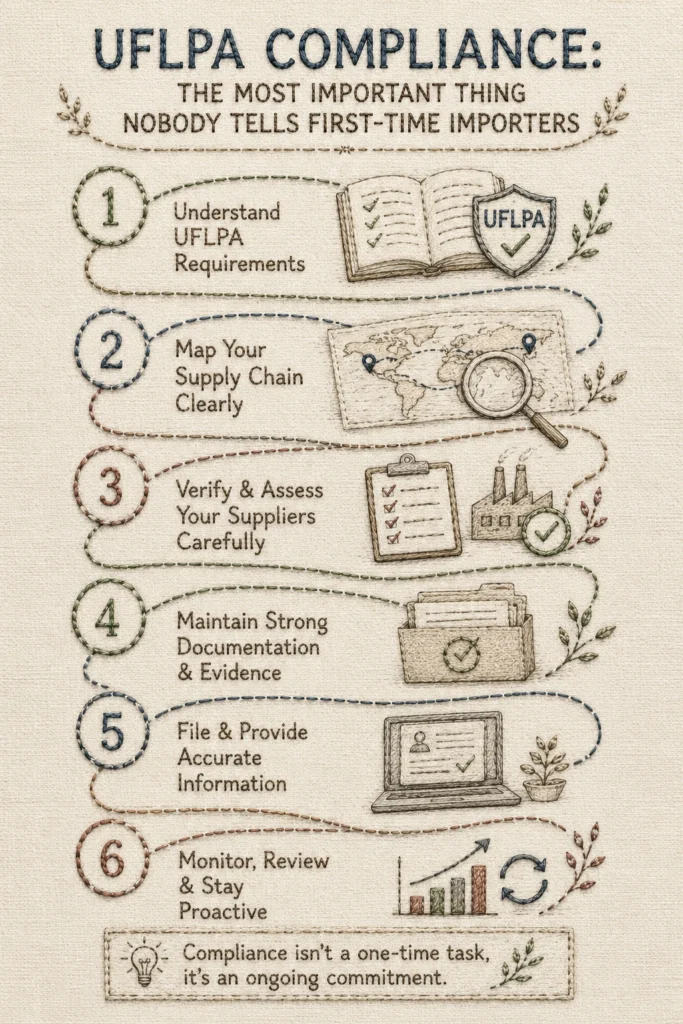
UFLPA Compliance: The Most Important Thing Nobody Tells First-Time Importers
The Uyghur Forced Labor Prevention Act (UFLPA), implemented in June 2022, has changed the risk profile of importing textiles into the USA more fundamentally than any regulation in recent memory. Every boutique buyer sourcing from India needs to understand it completely.
The Act establishes a rebuttable presumption: any goods produced wholly or in part in China’s Xinjiang Uyghur Autonomous Region, or by entities on the UFLPA Entity List, are presumed to be the product of forced labour and are prohibited from entering the United States. The presumption applies even if the finished garment was made in India, if any component of the supply chain touched Xinjiang.
Cotton has been designated a high-priority enforcement sector. CBP routinely detains cotton shipments from India to verify that no Xinjiang-origin cotton, yarn or greige fabric was used at any point in the production chain. If an Indian spinning mill or weaving facility used cotton imported from Xinjiang, your finished garments will be seized at the US port regardless of where they were printed and sewn.
To rebut a UFLPA detention you must provide clear and convincing evidence of a complete, unbroken chain of custody from the agricultural origin of the raw cotton to the finished garment. The documentation required includes farm-level evidence such as harvest records and geolocation data for the cotton fields, processing records including weighbridge tickets and production logs from the ginning facility, spinning mill and weaving and dyeing units, transportation documents and payment records proving the physical movement of the specific cotton batch without any commingling, and supplier affidavits from every entity in the chain legally attesting to the absence of forced labour.
CBP increasingly uses isotopic ratio mass spectrometry to forensically verify the geographic origin of cotton fibres in a detained garment. If your shipment is detained, you have 30 days to produce the required documentation. Failure means exclusion, seizure or destruction of the goods. Total, unrecoverable financial loss.
This is why supply chain transparency is not a sustainability marketing exercise for brands importing into the USA. It is a hard financial and legal requirement.
At Moharis, our cotton sourcing is fully documented and our supply chain is traceable from fibre to finished garment. Our sustainable practices page outlines how we approach this. When you request our UFLPA documentation package, it exists and it is complete.
The Role of a Customs Broker
A licensed US customs broker is your legal agent at the border. They file your entry data with CBP, process duty payments electronically, manage your continuous customs bond and act as the primary point of contact with CBP if any hold, examination or documentation request arises.
Standard brokerage fees for formal entry processing run between $150 and $300 per shipment, separate from the actual duties, the Merchandise Processing Fee (MPF) assessed at 0.3464% of cargo value, and the Harbor Maintenance Fee (HMF) assessed at 0.125% for ocean freight.
Choose a broker with specific experience in Chapter 61 and 62 apparel. Textiles are among the most heavily scrutinised import categories. An inexperienced broker might misclassify a woven cotton blouse that carries an 8.4% duty rate into a similar but higher category carrying 15.4%, compounding across multiple shipments into a significant financial problem. A specialist textile broker audits your commercial invoice, packing list and UFLPA traceability documents before the cargo leaves India, identifying and correcting compliance risks before they become CBP detentions.
Shipping: Ocean vs Air, Ports and Incoterms
Ocean freight is the standard choice for bulk wholesale orders. Cargo is trucked from Jaipur or Delhi to the port of Nhava Sheva in Mumbai or the Port of Mundra, then sails to the US East Coast, principally the Port of New York and New Jersey, in approximately 30 to 35 days, or to the US West Coast via the Ports of Los Angeles and Long Beach in 25 to 30 days.
Air freight suits smaller, high-value or time-sensitive shipments. Cargo flies out of Delhi or Mumbai to US aviation hubs with transit of 4 to 10 days. The cost premium is real: air freight typically adds $2.00 to $4.00 per garment to your landed cost, which must be factored into your retail pricing before you commit to this mode.
On Incoterms, the standard in India-USA garment trade is FOB (Free on Board). The Indian factory covers all costs and risks until the cargo is loaded onto the vessel at the origin port. You cover international freight, marine insurance and all US import costs from that point. This is the most common arrangement and the cleanest division of responsibility for boutique buyers.
EXW (Ex Works) places the maximum burden on you, covering everything from factory pickup in Jaipur onward. CIF (Cost, Insurance and Freight) has the seller paying ocean freight and insurance to the US destination port, with you handling customs clearance and final delivery. DDP (Delivered Duty Paid) is extremely rare for textile shipments because it requires the Indian manufacturer to assume liability for US customs compliance, which is not their regulatory environment to navigate.
The Complete Documentation Package
The document package for a USA textile import from India must be impeccable. Discrepancies between documents are the primary cause of CBP delays.
Commercial invoice: Your definitive valuation document. Must detail both parties in full, garment descriptions including woven construction, gender, fibre content, unit price, total value, the agreed Incoterm and the specific 10-digit HTS code.
Packing list: The physical map of your shipment. Every carton, its exact dimensions, gross and net weights and precise piece counts. CBP uses this during physical examinations.
Bill of Lading or Airway Bill: The contract of carriage issued by the ocean carrier or airline, detailing routing and physical custody of the cargo.
Certificate of Origin: Issued by the Indian manufacturer or a recognised chamber of commerce, certifying the goods were substantially transformed in India.
Textile declaration: Identifies the name and address of the actual manufacturing facility using the Manufacturer Identification Code (MID). CBP requires this to verify origin and enforce forced-labour targeting.
UFLPA traceability package: The full supply chain map, ginning and spinning mill certificates, and purchase orders tracing the raw cotton to a specific agricultural source. This is not optional for cotton garments.
Certification documents: For GOTS certified products, GOTS Transaction Certificates for the specific batch. For natural dye products, REACH compliance reports. These substantiate your marketing claims and strengthen your UFLPA position simultaneously.
Quality Control Before Shipment
Quality control for hand block print clothing requires a more nuanced approach than for mass-produced garments. Artisanal block printing inherently produces minor colour variations, slight registration shifts between blocks and occasional natural dye bleeding. These are not defects. They are authentication markers of the handmade process. Understanding the difference between an artisanal characteristic and a manufacturing defect is explained in our guide to how hand block print fabric is actually made.
Before bulk production begins, establish a written Quality Control Agreement with your manufacturer that clearly defines acceptable artisanal characteristics versus unacceptable defects. The garment industry uses the Acceptable Quality Limit (AQL) standard for this. A standard agreement specifies AQL 2.5 for major defects, broken seams, incorrect sizing outside specification tolerances, large stains, and AQL 4.0 for minor defects such as untrimmed threads or slight print density variation.
Independent third-party inspection agencies including SGS, Intertek and QIMA maintain active operations in Jaipur and Delhi. They conduct Pre-Shipment Inspections (PSI) at the factory before final packaging, selecting a randomised statistical sample based on total order volume and evaluating it against your approved master sample and measurement specification sheets. This gives you eyes in the factory without the cost of being there.
GOTS Certification and Sustainable Credentials at the Border
GOTS certified or OEKO-TEX certified products do not receive reduced US import duties. Standard MFN rates apply equally to conventional and organic cotton garments. The duty rate for a GOTS certified women’s dress is the same 8.4% as for an uncertified one.
However, these certifications carry significant secondary compliance benefits that directly affect your legal and commercial position.
If you market a garment to US consumers as “100% Organic Cotton,” the FTC requires substantive evidence to support that claim. Without documentation, you are exposed to deceptive marketing allegations. GOTS Transaction Certificates for the specific batch of imported goods provide a robust legal defence against any greenwashing allegation.
More practically, the rigorous multi-tier supply chain auditing required for GOTS certification aligns directly with what UFLPA compliance demands. A fully GOTS-certified supply chain already maps every tier from farm to finished garment and maintains the transactional documents CBP requires during a forced labour detention. This means your certification investment does double duty: supporting your consumer marketing and accelerating your response to any CBP inquiry.
India’s Competitive Advantage Over Other Sourcing Countries
While India lost its GSP status in 2019, meaning its textiles are now subject to standard MFN duty rates of 8% to 20%, this still represents a significant competitive advantage over China.
Chinese textiles face the standard MFN duty plus additional punitive Section 301 tariffs often ranging from 10% to 25% on top, making Chinese apparel imports significantly more expensive in total landed cost. Furthermore, the UFLPA creates an extraordinary compliance burden for any supply chain with any Chinese cotton component. India, with its own non-Xinjiang cotton supply chain and its established artisan manufacturing infrastructure, avoids this entire category of risk.
Bangladesh enjoys duty-free access to the EU market, which benefits European buyers. But it does not hold similar preferential access to the USA, levelling the playing field. Vietnam operates as a strong competitor for mass-market apparel, but cannot replicate what Jaipur’s GI-protected block printing clusters offer in terms of genuine artisan heritage, natural dyeing expertise and the specific design vocabulary that drives boutique and sustainable fashion demand.
India’s unmatched infrastructure for handcrafted natural fibre textiles, specifically the Sanganeri and Bagru block printing clusters with their GI certifications and 500-year traditions, gives boutique buyers access to products that command higher retail price points and build brand equity around authentic heritage craftsmanship. The full story of what makes Jaipur’s block printing ecosystem unique is covered in our dedicated article on why Jaipur is the world capital of block printing.
How Small Boutique Buyers Can Import Without a Large Logistics Infrastructure
You do not need a dedicated logistics department or a full container to start importing from India. Small boutique buyers have practical options at every scale.
Under 100 kilograms: Use global express couriers such as DHL, FedEx or UPS. The courier automatically acts as your customs broker, clearing the goods electronically while the aircraft is in transit and billing you directly for duties and a small processing fee before final delivery. No continuous customs bond required. No separate broker relationship to manage. This is the right starting point for first-time importers testing a new supplier relationship.
100 kilograms to 500 kilograms: Digital freight forwarding platforms and Indian consolidation agents combine smaller shipments from multiple Jaipur manufacturers into a single Less than Container Load (LCL) ocean shipment or consolidated air freight pallet. By sharing container space, you benefit from economies of scale significantly below standard courier rates while maintaining predictable transit times.
Above 500 kilograms: A full freight forwarder relationship with a customs broker becomes the standard operating model. At this scale the per-unit freight costs drop meaningfully and the investment in a continuous customs bond and a dedicated broker pays for itself within a few shipments.
Payment terms with Indian manufacturers typically require a 30% to 50% advance via bank transfer (T/T) to fund raw material procurement and, where applicable, the carving of custom wooden blocks. The balance is due on completion of production and receipt of satisfactory pre-shipment inspection results, before the goods leave the factory. Negotiate pricing in USD to keep currency risk with the manufacturer rather than absorbing INR-USD volatility yourself.
The 2025 to 2026 Regulatory Change Every Importer Must Know
The Section 321 de minimis exemption has been effectively eliminated, and this is the most significant change in US customs law in a decade. Every boutique buyer importing from India needs to understand what this means for their cost model immediately.
Historically, Section 321 of the Tariff Act of 1930 allowed any shipment valued at $800 or less to enter the United States duty-free, bypassing formal customs entry. This was used extensively by both fast-fashion platforms and small boutiques to avoid the 8% to 20% duties typical of imported apparel.
The changes came in stages. In May 2025, the de minimis exemption was fully eliminated for all goods originating in China and Hong Kong. In late 2025, CBP issued an indefinite suspension of the de minimis administrative exemption for all merchandise arriving via non-postal modes, meaning air cargo and ocean freight, globally. This explicitly includes India.
From late 2025 onward, any non-postal shipment from India valued under $800 requires formal or informal customs entry and payment of full applicable MFN tariffs. For goods arriving via international postal networks under $800, flat duty rates based on MFN tariff levels now apply, resulting in fees of $80 to $200 per package. Current legislative efforts aim to permanently eliminate the de minimis provision entirely by 2027.
The practical implications for your business are immediate. You can no longer legally structure orders as multiple small parcels to avoid duties. Every shipment of block print dresses, shirts or home linen from India now carries the standard 8.4% to 19.7% duty rate plus Merchandise Processing Fees and brokerage costs, regardless of its value. Recalculate your landed cost formula now, before your next order, to ensure your pricing model remains commercially viable through 2026 and beyond.
A Practical Note on Lead Times and Planning
Hand block printing is not a fast production process. Custom wooden blocks must be carved. Dye vats must be prepared. Natural dyes require sun drying between colour applications that cannot be compressed into a shorter timeline without compromising the output. The full step-by-step production process explains exactly why each stage takes the time it does.
Minimum Order Quantities for hand block print garments from Jaipur typically range from 50 to 100 metres of fabric per print or colourway, translating to approximately 30 to 50 finished garments per style. Some manufacturers, including Moharis, offer MOQs from 20 pieces per style for buyers building boutique collections.
Production lead time is 6 to 10 weeks from order confirmation. Add ocean freight transit of 25 to 45 days or air freight of 4 to 10 days, plus customs clearance of 1 to 3 days under normal conditions. Your total order-to-delivery window is realistically 10 to 16 weeks for ocean freight.
Holiday collections must be ordered 4 to 5 months before your targeted retail launch date. Spring and summer resort collections, which typically drive the strongest demand for block print apparel in the USA, require orders placed in October or November of the previous year.
Plan your buying calendar around these realities from the start, not after your first missed season.
Getting Started with Moharis
If you are sourcing hand block print clothing from Jaipur for the first time or looking for a manufacturer whose compliance documentation is complete and whose supply chain is genuinely traceable, we are ready to support the full process.
Our wholesale catalog covers the full range of block print apparel and home linen from Sanganeri florals to Bagru Dabu indigo prints, with flexible MOQs from 20 pieces per style, full customisation on prints, fabrics, sizing and labels, and complete documentation including UFLPA traceability packages, GOTS Transaction Certificates and REACH compliance reports.
The people and artisan community behind every piece we make are the reason the provenance story holds up under scrutiny. Write to us at info@moharis.com and we will walk you through everything you need to import with confidence.
Moharis is a Jaipur-based manufacturer, exporter and wholesaler of hand block printed clothing, fabrics and home linen. We work with boutiques, sustainable fashion brands and sourcing companies across the USA, Europe and the Middle East.