Quick Summary
- Dabu is a mud-resist hand block printing technique from Bagru, a small town approximately 30 kilometres from Jaipur, Rajasthan.
- The word “Dabu” comes from the Hindi word dabana, meaning “to press,” which describes the core physical action of the craft.
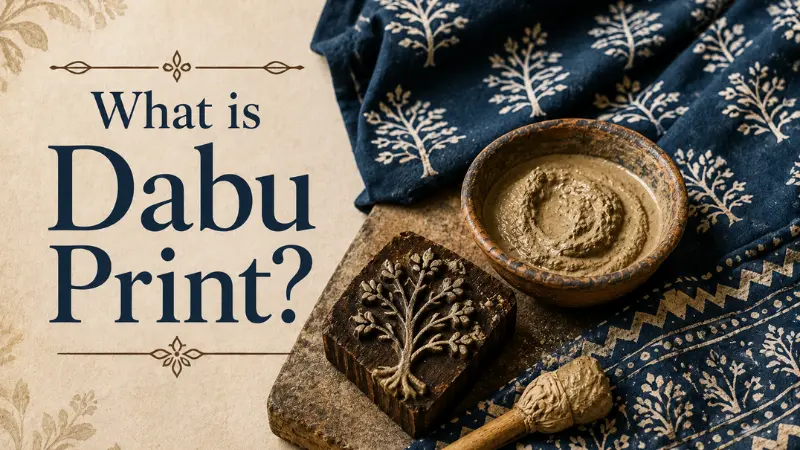
- Instead of printing colour onto fabric, Dabu prints a natural mud paste onto fabric first. The mud acts as a barrier. When the fabric is dyed, only the unprotected areas absorb colour. When the mud washes away, the pattern is revealed.
- The resist paste is made from four entirely natural ingredients: black pond clay, lime, tree gum and worm-eaten wheat chaff. No synthetic chemicals are used at any stage.
- Dyeing must be done in cold water only. Heat dissolves the mud paste and destroys the pattern entirely.
- The soft, slightly hazy edge around each Dabu motif is not a flaw. It is a direct result of the physics of the mud-resist process and is the most reliable mark of authenticity.
- Dabu printing holds an official Geographical Indication (GI) tag from the Government of India (GI Application No. 183), registered in 2011-2012, making it a legally protected regional craft.
- The craft is practiced by the Chhipa community of Bagru, who have maintained this tradition for over five centuries.
- Dabu printed fabrics are used globally for sustainable apparel, resort wear, home linen, quilts, curtains and statement interior textiles.
There is something quietly remarkable about the moment a piece of Dabu printed fabric comes out of its final wash. The mud, which has been sitting on the cloth through the heat of the Rajasthani sun and the depths of an indigo vat, begins to break away. And underneath it, where the earth protected the fabric from the dye, the original colour of the cloth is revealed. Pale against deep blue. Fawn against indigo. Light against dark.
It is a process that has been happening in Bagru for over five centuries. And it begins not with colour, but with mud.
What Dabu Printing Actually Is
Dabu is a resist-dyeing technique. That word, “resist,” is the key to understanding everything about how it works.
In a resist technique, the artisan does not print colour onto fabric. Instead, they print a barrier onto fabric first. A substance that blocks dye from reaching certain areas of the cloth. When the fabric is put through the dye bath, only the unprotected areas absorb colour. The areas covered by the barrier remain the original colour of the fabric. When the barrier is removed, the pattern appears.
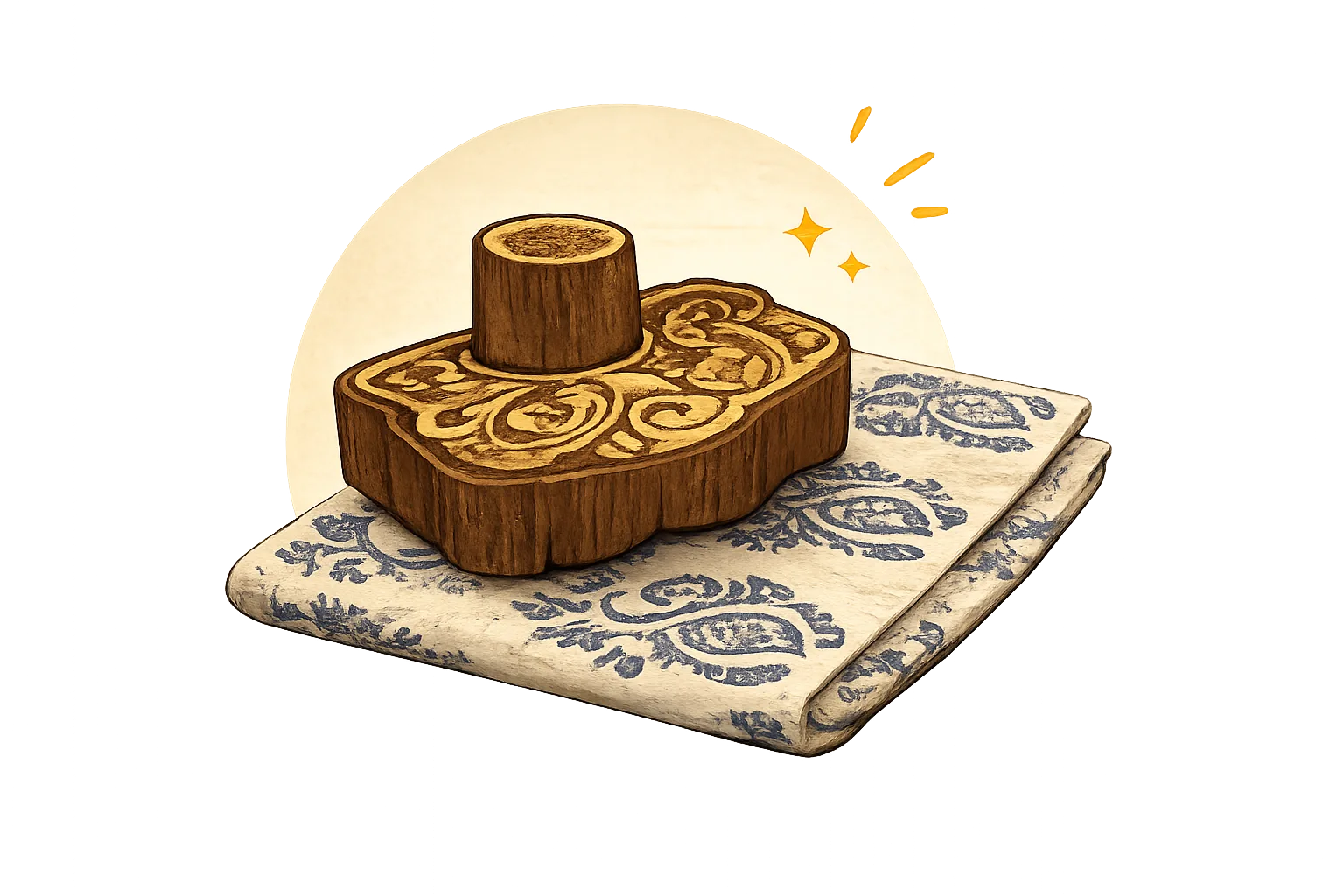
In Dabu printing, that barrier is mud. A precisely formulated, entirely natural mud paste, mixed by hand, stamped onto fabric using carved wooden blocks, sealed with sawdust and hardened under the desert sun before the fabric ever goes near a dye vat.
The name itself comes from the Hindi word dabana, meaning “to press.” The action of pressing a heavy, mud-loaded wooden block firmly and repeatedly onto stretched fabric is physically demanding work. It is not a delicate process. It requires force, consistency and years of practice to execute well.
Where Dabu Printing Comes From
Bagru is a small town established in the early sixteenth century, situated roughly 30 kilometres west of Jaipur on the Agra-Ajmer road. Its identity has been inseparable from textile printing for as long as historical records exist. The Imperial Gazetteer of India, published in 1908, formally documented Bagru as a significant node in the global textile trade, celebrated for its expertly dyed and printed chintzes.
The craft is practiced by the Chhipa community, a hereditary guild of master hand printers whose name, as we have explored in our earlier writing on hand block printing, literally means “to print.” Regional histories suggest that the foundational Chhipa families were invited to settle in Bagru by the local Thakur, drawn there by the mineral-rich waters of the Sanjaria river, which possessed specific chemical properties that proved ideal for natural scouring, mordanting and dyeing.
The craft endured through centuries of shifting trade routes and the disruptions of industrialisation. A significant moment in its modern history came when cultural historian Pupul Jayakar, a Padma Bhushan recipient and former Director of Indian Handicrafts and Handlooms, discovered Bagru’s textile tradition through a Paris museum and subsequently visited the manufacturing units in Bagru directly. Her advocacy led to the Indian government prominently featuring Bagru hand block print in national and international textile exhibitions. The resulting attention sparked a major demand revival in the early 1980s that set the stage for the craft’s current standing in global sustainable fashion markets.
Today, Bagru Dabu holds an official Geographical Indication (GI) tag from the Government of India, registered under GI Application No. 183 during the 2011-2012 period, making it the 150th legally protected GI product in India. This means only fabric produced within the geographic boundaries of Bagru, using authentic traditional methods, natural dyes and genuine wooden blocks, can legally be called Bagru Hand Block Print.
The Dabu Paste: Four Ingredients, Centuries of Ingenuity
The entire Dabu process stands or falls on the quality of the resist paste. Get the paste wrong and the dye bleeds, the edges blur and the pattern is lost. Get it right and the fabric emerges from its final wash with the crisp, earthy, deeply textured character that has made Dabu one of the most sought-after textile traditions in the world.
The paste contains four ingredients. Every single one of them comes from the earth.
Kali Mitti (Black Pond Clay)
The base of the paste. This specific clay is sourced from local seasonal ponds in Bagru, harvested only during the dry summer months when the pond beds are exposed. Not any clay will work. The particular mineralogy of Bagru’s pond clay allows for optimal consistency, smooth stamping and minimal cracking during the rapid sun-drying phase that follows printing. It forms the bulk of the resist barrier.
Chuna (Lime, or Calcium Hydroxide)
Slaked lime is added to control how the paste dries. Without it, the heavy water-logged clay would become brittle and fracture too quickly under the desert sun, allowing dye to seep through the cracks and ruin the print. The lime acts as a plasticiser and structural stabiliser, keeping the mud flexible enough to survive the drying process intact. Its alkalinity also improves the paste’s adhesion to the fabric surface.
Gond (Tree Gum)
Extracted as natural resin from local trees, gum arabic gives the paste its tackiness. It adjusts the viscosity so the paste adheres correctly to the carved wooden block face and grips firmly onto the porous cotton surface when stamped. Without it, the mud would slide off the block and fail to hold its shape on the fabric.
Bidhan (Worm-Eaten Wheat Chaff)
This is the ingredient that stops most people in their tracks when they first hear about it. The Dabu paste does not use fresh wheat flour. It uses wheat that has been specifically eaten and spoiled by weevils. This is not improvisation or poverty. It is empirical bio-engineering of remarkable sophistication.
Standard wheat flour contains heavy, long-chain starch molecules that would make the clay paste rigid and prone to flaking in the dye vat. When weevils consume the wheat, their digestive enzymes break down these complex starches into shorter, highly adhesive molecules called dextrins. Adding this enzymatically modified powder to the mud paste creates a flexible, durable organic adhesive that holds the resist together through the turbulence of the cold dye bath. The artisans of Bagru had, centuries before the language of biochemistry existed, figured out how to use insect digestion to engineer a better adhesive.
The preparation of this paste is itself a craft. Master artisans adjust the ratio of all four ingredients by feel, not measurement, based on the ambient humidity, the season, the temperature of the day and the weight of the fabric being printed. In the hot, dry months before the monsoon, a looser paste is needed. As the monsoon approaches and humidity rises, the paste must be tighter and more adhesive. This calibration is achieved entirely through decades of tactile experience passed down through generations.
The Step-by-Step Dabu Printing Process
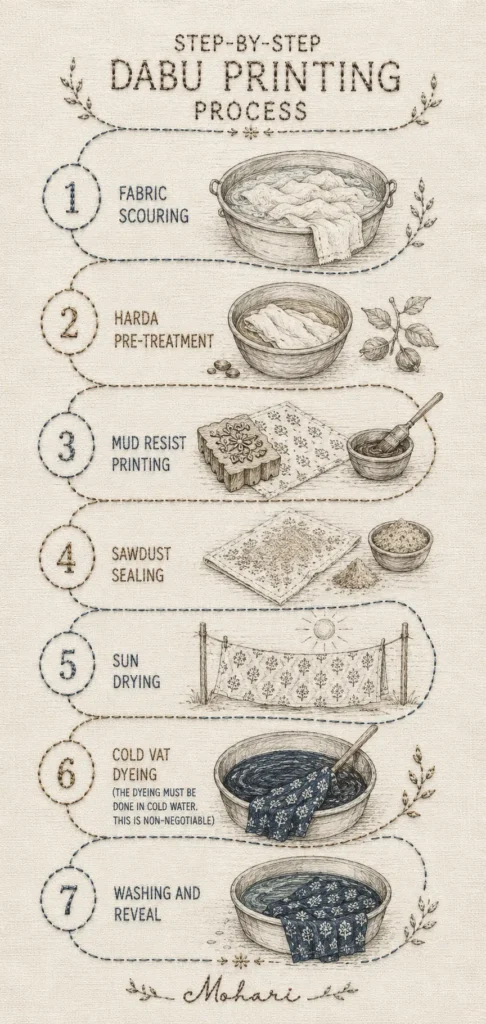
Stage 1: Fabric Scouring
Raw cotton fabric from the mill carries industrial sizing, starch, oils and surface impurities that prevent dye from penetrating the fibres evenly. In the traditional Dabu process, the fabric is soaked in a mixture of water and cow or sheep dung for twenty-four hours.
This is frequently dismissed as rural folklore. It is not. Cow dung is rich in specific biological enzymes that actively digest and strip away the starches and pectins in raw cotton without degrading the underlying cellulose fibres. It is, in effect, an ancient precursor to the enzymatic bio-scouring used in modern sustainable textile manufacturing. After soaking, the fabric is beaten and washed thoroughly.
Stage 2: Harda Pre-Treatment
The scoured fabric is immersed in a solution of harda, an extract of the myrobalan fruit, which is naturally rich in tannin. This treatment prepares the fabric chemically to accept and bond with natural dyes in the later stages. It also leaves a warm fawn or off-white tone on the fabric, which is why the background of an authentic Dabu print is never a stark optic white. It is always slightly warm, slightly earthy. That colour is the harda.
Stage 3: Mud Resist Printing
The artisan loads a carved wooden block with the Dabu paste from a prepared pad and stamps it firmly onto the stretched fabric. The paste is deposited in the exact pattern of the block’s carved design, creating a raised physical barrier over the cotton in those areas.
Because the mud paste is thick and heavy, Dabu block designs must be bold. Fine, hairline motifs would blur and lose their definition under the weight of the paste. This is why Dabu prints are characterised by strong, expressive lines and bold geometric or large floral patterns rather than the fine botanical detailing of Sanganeri printing.
Stage 4: Sawdust Sealing
Immediately after the mud paste is stamped, fine sawdust is sprinkled generously across the entire fabric surface. The sawdust adheres only to the wet mud motifs. It accelerates drying by absorbing excess moisture from the paste and simultaneously creates structural reinforcement around each motif, preventing smudging or spreading when the fabric is handled and moved to the drying area.
Stage 5: Sun Drying
The fabric is laid out flat under the full heat of the Rajasthani sun. This stage is not optional and cannot be shortened. The mud resist must be completely and absolutely dry before the fabric enters the dye vat. If any moisture remains within the clay matrix, contact with the liquid dye will cause the paste to dissolve, the barrier to fail and the dye to flood the protected areas. The crispness of every Dabu print depends entirely on total desiccation.
Stage 6: Cold Vat Dyeing
Once fully dried, the mud-crusted fabric is carefully transported to the dye pits and submerged in cold natural dye, most commonly indigo. The handling must be gentle. Vigorous agitation would crack and dislodge the fragile, dried mud crust before the dye has had time to set in the exposed areas.
The dye penetrates the cotton wherever the fabric is unprotected. The areas sealed under the mud receive no colour.
The dyeing must be done in cold water. This is non-negotiable. Heat increases the solubility of the natural gums and dextrins in the paste, causing the entire mud matrix to dissolve on contact with a hot dye bath. Cold vat dyeing is therefore not a preference in Dabu printing. It is a chemical requirement. This constraint is also why natural indigo is the dominant dye in the Dabu tradition. Indigo is one of the very few dyes that works effectively at cold temperatures.
Stage 7: Washing and Reveal
After dyeing, the fabric is dried to allow the colour to oxidise and set. It is then soaked in water to rehydrate the hardened mud, and artisans beat the fabric against stone slabs to break the paste away from the surface. As the mud washes off, the pattern is revealed. The areas that were protected appear as the original fawn or cream of the harda-treated fabric, standing in sharp contrast against the deep dyed background.
For complex, multi-tonal designs, this entire process is repeated. In the Double Dabu technique, fresh mud resist is applied over the already-dyed fabric and the cloth goes through a second dye bath, building up layers of colour and geometric depth that cannot be achieved in a single cycle.
The Natural Dyes of Dabu Printing
Authentic Dabu printing uses no synthetic dyes. The colour palette is entirely derived from plants and minerals.
Indigo produces the deep resonant blues that define the Dabu visual identity. Natural indigo from the Indigofera tinctoria plant is fermented and reduced into a water-soluble state in deep cold vats maintained at a highly alkaline pH. When the fabric is removed from the vat and exposed to air, the indigo oxidises and permanently bonds within the cotton fibre. A well-maintained indigo vat, fed daily with natural reducing agents like jaggery, can remain active for months or even years, making it one of the most resource-efficient dyeing systems in textile manufacturing.
Madder root from the Rubia cordifolia plant and the bark of the Aal tree (Morinda citrifolia) produce rich reds, maroons and pinkish-reds. Unlike indigo, madder requires a metallic mordant, typically alum, to bond with cotton. The alum forms a chemical bridge between the fibre and the dye molecule, locking the colour in permanently.
Iron mordants, prepared from fermented iron scraps and horseshoe waste, react with the tannin of the harda pre-treatment to produce deep blacks and dark greys directly within the fabric fibre.
Pomegranate rind and turmeric yield natural yellows and greenish-yellows, which when over-dyed with light indigo produce earthy, complex greens.
Every one of these dyes is fully biodegradable. When the dye water is eventually released, it re-enters the environment without introducing synthetic chemicals, heavy metals or carcinogenic compounds. This is central to what we mean when we talk about sustainable manufacturing at Moharis.
The Hazy Edge: Why Imperfection is the Proof
One of the most distinctive visual characteristics of genuine Dabu printing is the soft, slightly blurred border around each motif. It is not crisp and razor-sharp the way a digitally printed or screen-printed pattern would be. It has a gentle haze, sometimes a faint vein-like quality where the dye crept slightly inward toward the edge of the mud.
This happens because of physics. As the thick mud paste dries and shrinks in the sun, micro-scale tensions develop between the rigid clay matrix and the woven cotton beneath it. When the fabric is submerged in the dye vat and the cold liquid presses against the mud barrier through hydraulic force, tiny hairline cracks occasionally form at the edges of the paste. Trace amounts of dye seep through these cracks via capillary action, creating the characteristic soft border.
In a market flooded with machine-printed imitations, some of which now artificially reproduce a pixelated “hazy edge” digitally, this physical phenomenon is one of the most reliable markers of a genuinely mud-resist printed fabric. A machine cannot replicate what physics creates. The authentic Dabu haze has depth, variation and organic character that a digital approximation lacks entirely.
How Dabu Differs from Other Resist Techniques
It is worth understanding how Dabu sits within the broader world of resist-dyeing, because the distinctions matter both aesthetically and technically.
Dabu vs Batik: Batik, primarily associated with Indonesian textile traditions, uses molten wax as its resist. The wax must be heated to liquid state for application and requires violent boiling to remove after dyeing. Dabu uses cold, water-soluble mud. This makes Dabu safer for artisans, eliminates heat energy from the process and produces an entirely different surface texture and edge quality. Batik produces a characteristic crackled wax effect. Dabu produces the organic hazy edge described above.
Dabu vs Tie-Dye and Bandhani: Tie-dye and its regional variants like Bandhani are physical manipulation resists. The fabric itself is folded, bound or knotted to prevent dye penetration into the compressed areas. No paste or barrier material is applied. Dabu requires no physical distortion of the fabric, relying entirely on a topical mud barrier.
Dabu vs Sanganeri Block Printing: Sanganeri is a direct printing technique. Colour is stamped directly onto a prepared white or light background. There is no resist, no mud, no cold vat dyeing. The result is a bright, vibrant, fine-detailed print on a light ground. Dabu produces the opposite: light or fawn motifs on a deep, earthy dyed ground, with bold patterning and organic texture. The full comparison between Sanganeri and Bagru printing is explored in our dedicated article.
The Two Communities Behind Every Dabu Print
A fact that is rarely discussed outside of Bagru itself: Dabu printing is the product of two distinct communities working in an inseparable, centuries-old partnership.
The Chhipa community are the printers. They mix the paste, prepare the fabric, stamp the blocks, manage the dye vats and wash the final cloth.
The Kharaudi community are the block carvers. Using dense seasonal hardwoods, sheesham, teak and rohida (desert teak), the Kharaudi carvers hand-chisel the intricate printing blocks with basic chisels and small drills. The three specialist blocks required for each design, the rekh (outline), the gadh (background) and the datta (filler), are all carved by Kharaudi craftspeople. Without their precision, the Chhipa printers have no tools.
This inter-faith, inter-guild partnership between Hindu printers and Muslim carvers has persisted through centuries of regional political change. It is one of the quiet stories of the craft that rarely gets told, and it is a story worth knowing.
What Dabu Fabric is Best Suited For
The deep, earthy palette and bold, textured character of Dabu printed fabric lend themselves to specific product categories in global wholesale markets.
In apparel, Dabu fabrics are favoured by boutique fashion brands, sustainable clothing labels and resort wear collections. The natural breathability of cotton combined with the organic indigo and madder palette makes Dabu particularly well-suited for flowing kurtas, maxi dresses, co-ord sets, casual shirts and lightweight summer collections for North American, European and Australian markets.
In home textiles, the thick, layered texture and saturated indigo tones of Dabu make it one of the strongest performing prints in premium home decor. Global wholesale demand is particularly strong for Dabu-printed Kantha quilts, duvet covers, heavy curtains, decorative cushion covers and table linen. The rustic, artisanal character of the print aligns perfectly with contemporary interior trends that favour organic textures and natural aesthetics over mass-produced uniformity.
Our wholesale catalog at Moharis includes Dabu printed fabric and finished products across both apparel and home linen categories, with flexible MOQs designed for boutique production runs.
Why Dabu is One of the Most Sustainable Textiles in the World
The sustainability credentials of Dabu printing are not a marketing position. They are built into the chemistry and physics of the process itself.
Every ingredient in the resist paste, the pond clay, the lime, the tree gum and the worm-eaten wheat chaff, is entirely biodegradable. When the mud washes off at the end of the process, it re-enters the local soil without introducing synthetic chemicals or microplastics.
The natural dyes, indigo, madder, pomegranate, iron, are fully plant and mineral derived. They carry none of the carcinogenic risks or heavy metal contamination associated with industrial synthetic dyes. An indigo vat can remain active for months, fed only with jaggery and lime adjustments, producing minimal waste over a very long production lifespan.
The entire printing process runs on human kinetic energy and Rajasthani sunlight. No electric stenters. No industrial steamers. No digital printers. The carbon footprint of a Dabu printed fabric is a fraction of what any equivalent industrially produced textile would generate.
The initial fabric scouring uses cow dung, an agricultural by-product that produces organic effluent biologically benign compared to the industrial scouring detergents used in commercial mills. Modern sustainable textile research is now actively exploring the enzyme chemistry of this ancient method.
For wholesale buyers building brands around genuine sustainability, Dabu offers something rare: a process where the environmental credentials are verifiable at every single stage. Our full sustainability commitments and manufacturing practices are documented here.
The Challenges the Craft Faces Today
Dabu printing is thriving in global markets. It is also under genuine pressure.
The most immediate commercial threat is imitation. Industrial manufacturers now produce rotary-screen-printed and digitally-printed fabrics that visually mimic the patterns of Dabu, some even artificially reproducing a pixelated approximation of the hazy edge. These imitations reach markets at a fraction of the cost of genuinely mud-resist printed cloth, creating serious confusion among buyers who cannot yet identify the physical markers of authenticity.
The second challenge is skill attrition. The physical demands of Dabu printing are significant. Stamping heavy blocks for hours, working with cold indigo vats and managing the precise, tactile calibration of the mud paste recipe is exhausting and requires years to master. Younger generations within the Chhipa community are increasingly drawn toward less physically demanding urban employment. The risk is not just a loss of practitioners. It is a loss of the specific embodied knowledge, the ability to adjust paste viscosity by feel, to read the sky for humidity before mixing a new batch, to know by touch whether the mud is dry enough for the vat. That knowledge cannot be written down and recovered. It has to be lived and practiced continuously.
At Moharis, supporting the artisans who carry this knowledge is not a side commitment. It is the foundation of everything we do.
A Craft Built from the Earth, for the World
Dabu is mud and indigo and sunlight and time. It is a process that looks, to the untrained eye, almost agricultural. Fabric soaking in pits. Mud drying on cloth. Artisans beating wet textile against stone. Nothing about it looks like fashion.
And yet the finished cloth, deep indigo, warm fawn motifs, that characteristic hazy edge, is one of the most visually distinctive and globally coveted textiles being made anywhere in the world right now.
It endured five centuries of shifting trade, industrialisation and market disruption. It survived because the process itself is irreplaceable. No machine produces what mud and cold water and skilled hands produce. No algorithm replicates what a Chhipa artisan knows in their palms after thirty years of pressing blocks.
That is what you are buying when you source genuine Dabu print. Not just fabric. The entire, unbroken chain of that knowledge.
Moharis is a Jaipur-based manufacturer, exporter and wholesaler of hand block printed clothing, fabrics and home linen. We work with boutiques, sustainable fashion brands and sourcing companies across the USA, Europe and the Middle East. For wholesale inquiries, explore our catalog or write to us at info@moharis.com.