Quick Summary
- Sustainable fashion in 2026 is defined by four pillars: environmental integrity, social ethics, supply chain transparency and a circular business model. Organic fabric alone does not make a brand sustainable.
- The first steps before launch include deep supply chain research, defining a genuine brand identity, mapping a certification pathway and building robust financial models.
- Natural fibres, specifically organic cotton, linen and hemp, vastly outperform recycled polyester in verifiable environmental performance. Recycled synthetic blends continue to shed microplastics and are not a credible long-term sustainability solution.
- When vetting Indian manufacturers, the most important questions are around subcontracting policies, multi-year audit history and willingness to allow independent factory inspections.
- The EU Digital Product Passport (DPP), mandated under the Ecodesign for Sustainable Products Regulation (ESPR), will require all apparel sold in the EU to carry a verifiable digital record covering fibre origin, carbon footprint, chemical compliance and recyclability. Brands must begin building this data infrastructure now.
- Greenwashing is now a criminal liability across the EU under the Empowering Consumers Directive (EmpCo), effective September 2026. Terms like “eco-friendly” and “climate-friendly” are banned without independently verified evidence.
- The strategic MOQ sweet spot for emerging sustainable labels is 500 units per style, the threshold at which manufacturing economies of scale make wholesale pricing viable without fuelling overproduction.
- Jaipur hand block printing, both Sanganeri and Bagru traditions, is one of the most commercially and ethically well-positioned supply categories for sustainable brands in 2026.
- The Middle East, particularly the UAE and Saudi Arabia, is one of the fastest-growing markets for sustainable luxury fashion globally.
Starting a sustainable fashion brand is not complicated in the way that people think it is. It is not primarily about finding the right organic cotton supplier or choosing the right certification logo for your hangtag.
It is complicated in a different way. It requires thinking clearly about economics, about law, about the real mechanics of a supply chain, and about what it actually means to tell a true story rather than a convenient one. In 2026, the gap between those two things carries legal consequences, not just reputational ones.
This guide covers all of it. The pillars, the process, the certifications, the regulations, the mistakes, and the specific opportunity that exists right now for brands willing to build something genuinely honest.
What Sustainable Fashion Actually Means in 2026
The definition has expanded considerably. A brand that sources organic cotton and calls itself sustainable is not lying, exactly. But it is describing one corner of a much larger picture.
A genuinely sustainable fashion brand in 2026 operates across four distinct pillars simultaneously.
Environmental integrity means measuring and actively reducing the brand’s full ecological footprint across Scope 1, 2 and 3 greenhouse gas emissions. It means water stewardship, not just water reduction. It means prioritising regenerative agricultural practices that restore soil health and sequester carbon, rather than simply extracting resources in a slightly less damaging way. And critically, it means addressing overproduction, which remains the primary driver of the fashion industry’s carbon output.
Social ethics means the human side of production is held to the same standard as the environmental side. Fair living wages, safe working conditions, ergonomic facility design. For brands sourcing artisan-made goods, it also means actively preserving the traditional crafts and communities at the base of the supply chain, ensuring they are protected from economic marginalisation and exploitative intermediaries rather than simply being used as a marketing story.
Supply chain transparency has moved from optional brand narrative to legal mandate. In 2026, complete transparency means being able to trace a garment’s full journey from raw material to finished product, across every stage of spinning, weaving, dyeing, cutting and stitching. Regulators in the European Union and the United States now require verifiable proof of these journeys to combat illegal waste dumping, human rights abuses and unverified environmental claims.
A circular business model means the linear “take, make, dispose” model is functionally obsolete in this space. Sustainable brands are designing for longevity, repairability and safe end-of-life deconstruction. Resale, repair services and take-back programmes are increasingly core revenue streams, not afterthoughts.
Before You Launch: The Preliminary Steps Most Founders Skip
The most expensive mistakes in sustainable fashion happen before a single garment is produced. The preliminary phase is where the foundation is built, and where it is most frequently rushed.
Research your supply base with specificity. Identifying ethical manufacturers is not the same as identifying the right ethical manufacturer. For brands sourcing artisan textiles, this requires understanding the geographical and cultural nuances of production hubs. The distinction between Sanganer and Bagru in Rajasthan, for example, is not just aesthetic. It involves different water usage patterns, different community structures, different dye chemistries and different regulatory environments. Understanding those distinctions in depth is part of responsible sourcing, not optional background reading.
Define a genuine brand identity before anything else. The identity must be rooted in an operational commitment, not a marketing position. Is the brand championing traditional craftsmanship? Pioneering zero-waste pattern-making? Using exclusively regenerative fibres? This core identity becomes the filter through which every subsequent sourcing, manufacturing and marketing decision is evaluated. Brands that define this clearly at the start are far less likely to drift into greenwashing territory later.
Map your certification pathway from day one. A new brand may not have the capital to secure every certification immediately. But a clear, documented pathway for achieving GOTS, OEKO-TEX, Fair Trade or B Corp must be built into the business plan from the start. Strategically selecting manufacturing partners who already hold these certifications at the facility level is the most efficient way to accelerate your own compliance timeline.
Model the unit economics honestly. Sustainable manufacturing commands a significant premium over conventional fast fashion. Fair wages, certified materials and compliance overhead all carry real costs. Preliminary financial modelling must determine whether a direct-to-consumer model, a wholesale strategy or a hybrid approach will generate the margins required to survive long enough to scale.
Choosing Materials: What Actually Works and What Doesn’t
Material selection is more technical than most brand guides acknowledge. Getting it right requires understanding agricultural impacts, chemical processing and what actually happens to a garment at the end of its life.
Organic cotton remains the cornerstone of sustainable apparel. Grown without synthetic pesticides or fertilisers, it promotes healthier soils and uses significantly less water than conventional cotton. Regenerative cotton advances this further by using agricultural techniques that actively sequester atmospheric carbon, turning the supply chain from a carbon emitter into a carbon sink.
Linen and hemp are both exceptional sustainable materials. Linen, derived from the flax plant, is highly durable, requires minimal water and pesticides, and is fully biodegradable when undyed with toxic synthetics. Hemp grows rapidly with minimal irrigation, naturally suppresses weeds without herbicides, and yields a breathable, durable fabric well-suited for premium apparel.
On recycled polyester: this is where a great deal of well-intentioned sustainable branding goes wrong. Recycled polyester (rPET) sourced from plastic bottles is widely marketed as a sustainability solution. It is not a credible long-term one. Mechanical textile recycling weakens polymer chains with each cycle, meaning the material degrades in quality and is ultimately destined for landfill or incineration. Diverting clear plastic bottles from a highly efficient, closed-loop recycling system into apparel removes them from a process where they could be infinitely recycled. And garments made from recycled polyester continue to shed harmful microplastics into waterways during every domestic wash cycle. For brands making genuine sustainability claims, rPET-dominant collections are increasingly difficult to defend to regulators and informed consumers.
On trims and threads: this is one of the most overlooked details in sustainable garment production. A jacket made entirely from certified organic cotton will fail to naturally biodegrade if it is stitched with conventional nylon thread, uses polyester care labels or has plastic buttons. These synthetic components contaminate mechanical recycling and composting streams. Achieving genuine circularity means specifying natural trims throughout, corozo (tagua nut) or wood buttons, natural fibre threads, and where possible, innovative technologies like dissolvable sewing threads engineered to release during controlled commercial recycling processes.

How to Find and Vet Ethical Manufacturers in India
India is a world-class destination for high-quality artisanal textile manufacturing. Navigating it responsibly requires a vetting process that goes well beyond requesting a certification document.
Ask for references from comparable clients. An experienced, ethical manufacturer will provide these readily. Reluctance is a warning sign.
Review multi-year audit history, not just the most recent certificate. A single, recently obtained GOTS or OEKO-TEX certificate tells you very little. A consistent, multi-year compliance record demonstrates that ethical operations are embedded in the facility’s culture rather than staged for inspection.
Ask about subcontracting policies directly and specifically. This is the most critical question in the Indian manufacturing context. Many facilities hold prestigious certifications at their primary unit while routinely outsourcing overflow production or specific polluting tasks, such as dyeing or washing, to uncertified secondary units in the informal sector. Understanding the complete, unbroken production flow is essential for any brand intending to make compliance claims to consumers or regulators.
Insist on site visits and independent third-party audits. Ethical facilities welcome buyer inspections. Resistance to a factory floor walk is the clearest red flag in the vetting process.
Red flags to exit immediately:
- A manufacturer who agrees to every specification in your tech pack without questions or pushback. They are likely not reading it carefully.
- Demands for 100% upfront payment before sampling. The industry standard is 50% deposit, 50% on delivery or quality inspection.
- Vague production timelines without specific week-by-week milestones.
- Persistent reasons why you cannot visit the production facility.
Building a Traceable Supply Chain
Traceability means being able to verify exactly where every component of a garment came from and how it was handled at every stage of production. By 2026, this is not a marketing differentiator. In the EU, it is becoming a legal requirement.
The most significant regulatory driver is the EU Digital Product Passport (DPP), mandated under the Ecodesign for Sustainable Products Regulation (ESPR). The DPP will require all apparel and footwear sold within the EU to carry a standardised digital record, accessible via QR code, containing verified data on fibre composition, country of manufacture, chemical compliance, carbon footprint, water consumption and end-of-life recyclability.
A common misconception is that the DPP is simply a labelling exercise. The QR code on the garment tag represents approximately five percent of the required effort. The remaining ninety-five percent is building the data infrastructure: collecting granular upstream information from raw material suppliers, spinners, weavers and dyers, across every tier of the supply chain. Gathering this data can take upwards of a year. Brands must begin now.
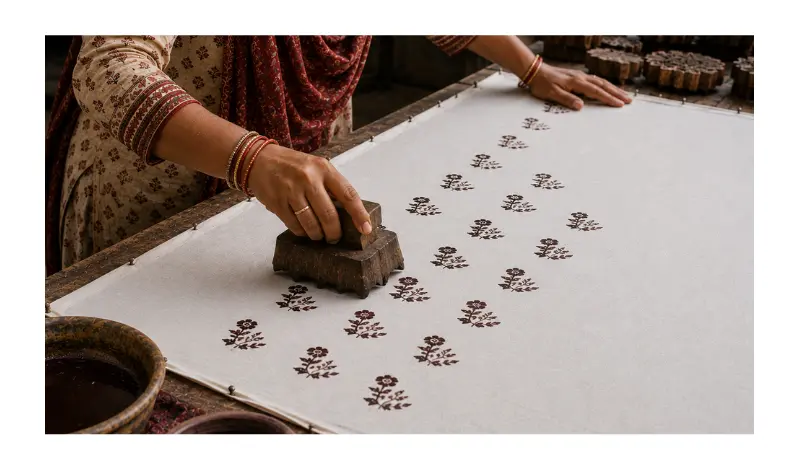
For small and medium-sized brands, the most practical path to DPP compliance is consolidating and shortening the supply chain rather than trying to map a deeply fragmented global one. Working directly with vertically integrated manufacturers or geographically concentrated artisan clusters, such as those in Jaipur, where the distance between raw material and finished product is short and traceable, makes data collection administratively feasible. It is one of the structural advantages of sourcing from an established, heritage-led manufacturing ecosystem. The way block print fabric is made, in contained, traceable stages within a specific community, is a natural fit for the kind of supply chain transparency regulations are beginning to demand.
Pricing a Sustainable Fashion Product Correctly
Sustainable garments cost more to produce. That is not a problem to hide. It is the central truth of the business model, and it needs to be explained clearly to buyers and consumers rather than apologised for.
The costs are real and unavoidable. Certified organic materials, fair living wages, water treatment infrastructure, regulatory compliance overheads and Extended Producer Responsibility fees all land on the cost of goods. Pricing that ignores any of these will eventually collapse.
The standard financial architecture for a sustainable brand with both direct-to-consumer and wholesale ambitions requires a retail price roughly four to five times the cost of goods sold. A brand relying solely on direct-to-consumer can operate on a lower markup, but this creates a structural problem: if the retail price is set too low for DTC margins, the brand cannot offer the standard 50% wholesale discount that independent boutiques need to operate, which permanently closes off boutique distribution as a channel.
The 500-unit MOQ sweet spot. For emerging sustainable labels, industry modelling consistently identifies 500 units per style as the threshold at which manufacturing economies of scale activate meaningfully. Below this, per-unit costs are prohibitive. Above it, overproduction risk escalates. At 500 units, the cost of goods drops enough to make boutique wholesale pricing viable while keeping inventory risk manageable.
Financial modelling for a comprehensively structured sustainable fashion launch in 2026 indicates an initial non-inventory capital requirement of approximately $80,000 covering digital infrastructure, pre-launch overhead, legal structuring and content creation. Seed inventory investment for initial production runs adds approximately $25,000. Projections suggest a realistic 17-month timeline to breakeven from launch, requiring a substantial early-stage cash buffer. These numbers are significant, and founders who underestimate them typically run out of runway before the brand reaches its natural audience.
Brand Storytelling and the Legal Minefield of Greenwashing
The stories that resonate most deeply with conscious consumers in the USA and Europe in 2026 are not about certifications. They are about specificity. About particular artisan communities. About the time a technique takes. About the origin of a dye. About the names of the towns where the cloth was made.
General ecological language has stopped working, not just because consumers have become sceptical, but because it is now illegal in key markets.
The EU Empowering Consumers Directive (EmpCo), applying from September 2026, explicitly bans the use of generic, unsubstantiated environmental terminology in marketing copy. Terms like “eco-friendly,” “green,” “nature’s friend” and “climate-friendly” are prohibited unless directly supported by recognised, independently verified evidence of excellent environmental performance, displayed clearly alongside the claim.
EmpCo also eliminates carbon-offset-based sustainability claims. Brands can no longer describe products as “carbon neutral” or “net-zero” if that status relies on the purchase of external emissions offsets. The claim must reflect actual emissions reductions within the brand’s own supply chain.
The enforcement consequences are already being felt. In 2025, the French Consumer Protection Authority levied a €40 million criminal settlement against Shein for environmental claims it could not substantiate. French courts ordered TotalEnergies to remove misleading carbon-neutral messaging under threat of a €10,000 per day penalty. In the United States, brands have faced class-action lawsuits in California for vague recyclability claims that allegedly contaminated municipal waste streams.
Authentic brand communication in 2026 requires transparency about what the brand does well, honesty about where it is still improving, and independent verification of every claim it makes publicly.
Certifications That Actually Matter
With proprietary sustainability logos now banned across the EU, brands must communicate credentials exclusively through recognised, independently verified third-party certification schemes.
GOTS (Global Organic Textile Standard) is the leading worldwide standard for organic textile processing, covering the entire supply chain from fibre to finished garment. It mandates low-impact chemical use, strict wastewater treatment and safe working conditions. For brands sourcing natural fibre products, this is the most comprehensive and internationally recognised certification available.
OEKO-TEX Standard 100 verifies that every component of a garment, including threads, buttons and labels, has been tested and certified free from harmful substances. It is a consumer-facing label that speaks directly to safety and chemical transparency.
OEKO-TEX MADE IN GREEN combines the chemical testing of Standard 100 with verified guarantees about the working conditions and environmental performance of the manufacturing facility. It is the more comprehensive of the two OEKO-TEX options for brands making supply chain claims.
Fair Trade Certified ensures fair living wages and safe conditions for farmers and garment workers, with direct economic support flowing to the communities involved in production.
B Corp certifies the entire business entity against rigorous standards of social and environmental performance, legal accountability and public transparency. It is the most holistic certification available and carries significant weight with institutional buyers and premium consumers.
Geographical Indication (GI) Tags from the Government of India legally protect authentic regional crafts from cheap machine-made counterfeits. Both Sanganeri and Bagru hand block printing hold GI certifications. For wholesale buyers in Europe and the USA, a GI-tagged supply provides the verifiable regional provenance that increasingly justifies premium pricing and satisfies supply chain due diligence requirements. The full story of what these GI certifications mean for block print buyers is covered in our detailed comparison of the two traditions.
The Regulatory Landscape: What Brands Must Know
In the European Union, the Ecodesign for Sustainable Products Regulation (ESPR), in force since July 2024, bans the destruction of unsold apparel and clothing accessories for large enterprises from July 2026. It mandates detailed reporting on discarded products from February 2027 and is the legal foundation for the Digital Product Passport.
The EU Textile EPR Directive requires all member states to transpose Extended Producer Responsibility rules into national law by June 2027. Any brand placing textiles on the EU market, including non-EU brands selling online to European consumers, must register as a producer, report sales volumes and pay eco-modulated fees to fund textile waste collection and sorting infrastructure.
In the United States, California is leading national regulatory development. California SB 707, the Responsible Textile Recovery Act, is the country’s first mandatory EPR programme for textiles. By July 2026, all qualifying producers selling into California must join the state-approved Producer Responsibility Organisation. Non-compliance carries penalties of up to $10,000 per day, escalating to $50,000 per day for intentional violations.
California SB 253 additionally requires public disclosure of Scope 1 and 2 greenhouse gas emissions from 2026 for large corporations conducting business in the state, with Scope 3 value-chain emissions required from 2027.
These regulations will cascade down supply chains, requiring even small brands to adopt transparent, documented standards to maintain their relationships with larger compliant wholesale partners.
The Hidden Realities of Artisan Supply Chains
There is a version of the Jaipur block print story that is entirely true and entirely incomplete at the same time. The craft is ancient, the technique is beautiful, the output is extraordinary. All of that is accurate.
What is less frequently discussed is the operational pressure the industry is under at ground level.
Rajasthan holds just 1.72% of India’s national groundwater stock. A single dyeing and printing unit can consume up to 1,000 litres of water daily. The unchecked discharge of synthetic chemical dyes historically caused severe pollution of local waterways, leading to National Green Tribunal intervention and significant penalties against the state. Centralised effluent treatment infrastructure, such as the Jaipur Integrated Texcraft Park, now recycles up to 90% of processed wastewater through reverse osmosis, but systemic capacity gaps remain, with hundreds of registered units still unable to access functional centralised treatment.
For the artisans at the base of the supply chain, the economics are under real strain. Traditional hand block printing yields very thin margins for individual craftspeople while the finished garments are marked up exponentially by the time they reach Western retail. This economic pressure, combined with the physical demands of the craft, is driving a quiet generational transition. Younger Chhipa community members are moving toward urban employment. The knowledge that leaves with them, the ability to read humidity by feel and adjust paste chemistry accordingly, to manage a living indigo vat through season changes, does not come back easily.
Building a sustainable fashion brand that sources from this ecosystem responsibly means understanding these realities and building partnerships that address them, not merely acknowledging them in a brand story. It means consistent, long-term orders that provide planning security. It means pricing that reflects the real cost of the process rather than negotiating it down. It means being a buyer who makes the artisan’s operation more viable, not less.
At Moharis, this is the model we have built our business around. Consistent fair wages, above-living-wage compensation, a team where more than half are women, and a commitment to the craft that predates the current global interest in sustainable fashion by decades.
The Opportunity in Jaipur Hand Block Printing
For brands building sustainable collections for boutiques in the USA, Europe or the Middle East, the Jaipur block print ecosystem offers something rare: a supply category where the sustainability credentials are genuinely, verifiably built into the production process rather than retrofitted onto it.
Both major Jaipur printing traditions hold GI certifications protecting their authenticity. The craft runs on human kinetic energy and Rajasthani sunlight. The natural dyes, indigo, madder, pomegranate, iron, are fully biodegradable. The resist pastes are made from locally sourced clay, lime and tree gum. The supply chain is geographically concentrated and traceable. The output is entirely natural fibre. And the visual character, the organic imperfection of the hand-stamped repeat, the depth of natural dye, the characteristic hazy edge of a Dabu resist, is something no industrial process can replicate.
Sanganeri printing, with its fine botanical motifs and vibrant pigments on white cotton, suits resort wear, fine home linen and lightweight summer apparel. Bagru and Dabu printing, with deep indigo backgrounds and bold geometric patterns, anchors the earthier, maximalist end of the sustainable fashion market. Together, they cover a remarkably broad commercial range from a single, coherent, deeply authentic supply base.
For wholesale buyers, the questions worth asking are not whether this supply category is sustainable. They are verifiably answered. The questions worth asking are about the specific manufacturer: their audit history, their subcontracting policies, their wage structure, their water treatment practices, and whether they will let you walk the production floor on any given day.
Explore our wholesale catalog at Moharis to see what genuine, GI-certified, artisan-made Jaipur block print looks like in practice. Or read about the community and people behind every piece we make.
The Brands That Are Doing It Right
Looking at brands that have successfully built around artisan sourcing and genuine transparency provides useful reference points for founders at the start of this journey.
Christy Dawn, based in California, built a fully integrated “Farm-to-Closet” supply chain in partnership with the Oshadi Collective in Tamil Nadu, India. The brand invested directly in organic cotton cultivation, local spinning and weaving, and natural dye block printing within the same community. The result is a supply chain that is traceable from soil to shelf, restorative to the land and genuinely fair to the artisans involved. It is one of the clearest examples currently operating of what a responsible artisan sourcing model looks like at commercial scale.
Mata Traders built their entire marketplace around Fair Trade Federation principles, ensuring ethical production and fair artisan compensation while successfully distributing to broad consumer bases in North America.
What these brands share is not a particular aesthetic or price point. It is a structural commitment to equity within the supply chain, not as an additional cost of doing business, but as the foundational logic of the brand itself.
The Middle East Market: Why It Belongs in Your Launch Strategy
The Middle East deserves specific attention in any sustainable fashion brand strategy for 2026 and beyond.
The personal luxury market in the Middle East, valued at €15 billion in 2023, is projected to approach €30 to 35 billion by 2030. Saudi Arabia alone is experiencing compound annual growth of 10 to 12% in the personal luxury sector, fuelled by the modernisation initiatives of Vision 2030 and a rapidly growing affluent demographic. Crucially, 60% of regional consumers express a distinct preference for brands using verifiable sustainable fabrics.
In the UAE, government regulations now mandate that fashion retailers disclose the environmental impact of their products. This regulatory alignment creates a direct competitive advantage for legitimate sustainable brands whose supply chains are already transparent, over legacy luxury houses struggling to retrofit decades of opacity.
For a Jaipur-sourcing brand, the Middle East opportunity is particularly well-defined. The kaftan is a garment of Middle Eastern and North African heritage that has become one of the strongest wholesale categories in the region, and block-printed cotton kaftans sit precisely at the intersection of regional cultural resonance and global Bohemian demand. Embroidered and intricately printed modest resort wear, maxi dresses with high necklines and long sleeves, and luxury home textiles are all strong commercial categories.
A Final Note on What This Actually Takes
Building a sustainable fashion brand in 2026 is not a simple proposition. The regulations are real and tightening. The economics are demanding. The supply chains are complex. The storytelling requirements are rigorous.
But the opportunity is also real. Consumer demand for genuinely ethical, beautifully made, traceable fashion has never been stronger or more commercially significant. The regulatory environment, while demanding, is also levelling a playing field that has long been tilted toward brands willing to externalise their true costs.
The brands that will endure in this market are the ones that understand their supply chains deeply, price their products honestly, tell true stories, and build genuine long-term relationships with the communities that make what they sell.
That is not idealism. It is increasingly the only viable business model.
Moharis is a Jaipur-based manufacturer, exporter and wholesaler of hand block printed clothing, fabrics and home linen. We work with boutiques, sustainable fashion brands and sourcing companies across the USA, Europe and the Middle East. For wholesale inquiries, explore our catalog or write to us at info@moharis.com.