Quick Summary
- Sanganeri print comes from Sanganer, south of Jaipur. It features fine floral motifs, delicate lines and vibrant colours on a white or light background.
- Bagru print comes from Bagru village, west of Jaipur. It is bolder, earthier and defined by dark indigo or madder backgrounds with geometric and folk-inspired patterns.
- Both traditions are over 500 years old and are practiced by the Chhipa community, whose name literally means “to print.”
- Sanganeri uses direct block printing with pigment or AZO-free synthetic dyes on fine cotton. Bagru relies almost entirely on natural vegetable dyes and a unique mud-resist technique called Dabu.
- Both crafts hold official Geographical Indication (GI) certifications from the Government of India, making them legally protected regional crafts.
- For wholesale buyers: Sanganeri suits resort wear, fine home linen and lightweight apparel. Bagru suits statement fashion, heavy upholstery and earthy interiors.
- The key authentication markers for genuine block prints include slight repeat variations, visible block join lines and colour bleed on the reverse side of the fabric.
Both prints come from Jaipur. Both are made by hand. Both use carved wooden blocks, and both are made by artisans from the same Chhipa community. And yet, place a Sanganeri fabric next to a Bagru fabric, and the difference is immediate and unmistakable.
One is light, delicate, botanical, almost like holding a painting of a Mughal garden. The other is bold, earthy, textured, something that feels like it was pulled from the desert floor and turned into cloth.
These are not two variations of the same thing. They are two entirely different textile traditions that happen to share a geography, a community and a set of basic tools. Understanding the distinction matters, not just for appreciating the craft, but for making smarter decisions as a wholesale buyer, a boutique owner or a brand building a sustainable product story.
Where Each Tradition Comes From
Sanganer: A Craft Built on Royal Patronage
The town of Sanganer, located to the south of Jaipur, was established in the early 16th century. For its first century, it was known primarily for simple bleached and dyed cottons. The transformation into one of India’s most celebrated textile printing centres came later, through a combination of migration and royal support.
In the mid-17th century, skilled artisans from the Khatri and Chhipa printing communities fled the disruption caused by ongoing military conflicts in Gujarat and settled in Sanganer. They chose the location deliberately. The Saraswati River running through the town provided the abundant, mineral-rich water supply their intensive washing and bleaching methods required.
The craft reached its peak under the patronage of Maharaja Sawai Jai Singh II in the early 18th century. Sanganeri artisans catered to the royal court, to temple devotees and to everyday buyers, each requiring different levels of intricacy. Royal patronage pushed the artisans toward refinement and complexity. By the late 17th and 18th centuries, Sanganeri textiles had become a significant export commodity traded through the English and Dutch East India Companies, reaching markets across Europe and Japan.
That courtly heritage is still visible in every Sanganeri print today.
Bagru: A Craft Born from Necessity
Bagru village sits approximately 30 kilometres west of Jaipur, in a noticeably drier, more arid landscape. The printing tradition here is considered older than Sanganer’s and is rooted in something entirely different: utility.
Bagru printing was never court-sponsored. It was a rural craft, made for rural communities, using whatever the local earth and environment provided. The scarcity of water in Bagru fundamentally shaped everything about the way artisans worked. Without the abundant running water that Sanganer relied on for its bleaching and washing, Bagru artisans developed their own chemistry. They leaned into dark backgrounds instead of fighting for white ones. They used mud as a printing tool. They built a technique around what they had, not what they lacked.
The mineral properties of the limited water available in Bagru naturally produced a reddish hue in the prints, a characteristic that became a celebrated part of the style rather than a limitation.
Today, Bagru remains quieter and less commercialised than Sanganer. That is part of its appeal. It has preserved its connection to traditional, pre-industrial methods more completely than almost any other textile tradition in Rajasthan.
The Visual Difference: What Each Print Actually Looks Like
This is where the two styles diverge most obviously, and where wholesale buyers can make the fastest distinctions.
Sanganeri: Delicate, Botanical, Bright
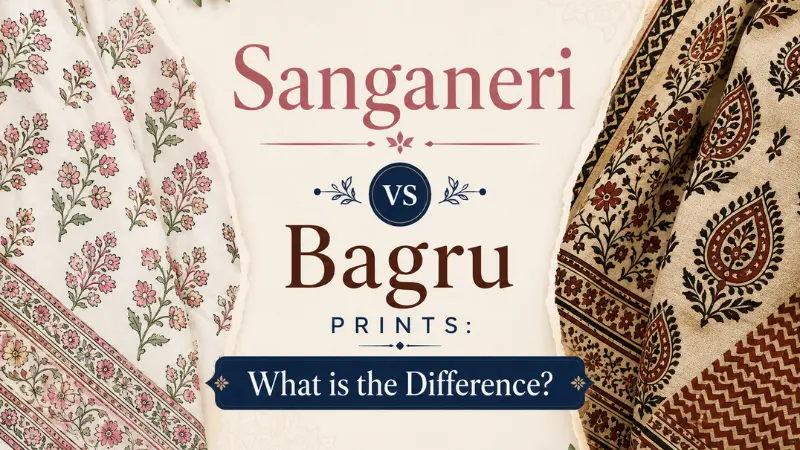
Sanganeri prints are built on a foundation of white or very soft pastel backgrounds. Against this light canvas, artisans stamp intricate, botanically specific motifs in a wide range of vibrant colours.
The motif vocabulary, known locally as bhant, is overwhelmingly floral. Roses, lotuses, sunflowers, marigolds, lilies, peacocks, parrots, interlocking floral nets (jaal), small recurring sprigged motifs (buti) and larger standalone florals (buta) are all central to the Sanganeri visual language. Over centuries of royal patronage and exposure to Mughal miniature paintings and imported European textiles, Sanganeri artisans also incorporated motifs like tulips, irises and lush cabbage roses that did not grow locally in the desert.
The execution is marked by extremely fine outlines (rekh), soft curves and a delicate symmetry. A single complex Sanganeri design can require 10 or more overlapping colours, each stamped with a different block in precise sequence.
Bagru: Bold, Geometric, Earthy
Bagru prints work from the opposite foundation. Dark backgrounds, typically deep indigo, rich red or near-black, anchor large, bold motifs stamped in thick, expressive lines.
While Bagru does incorporate stylised floral elements, its signature character is geometric and folk-inspired. Bold diamonds, interlocking chevrons, concentric circles and structural patterns drawn from the carved stone jaali lattices of Rajasthani forts and palaces define the Bagru visual identity. That architectural inspiration, the translation of rigid stone geometry onto fluid fabric, gives Bagru prints a grounded visual weight that Sanganeri’s organic botanicals do not possess.
The natural dyes and mud-resist techniques inherent to Bagru also produce slight colour variations and organic textures across the fabric, giving each piece a character that no two are exactly alike.
At a Glance
| Points | Sanganeri | Bagru |
| Background | White, off-white, soft pastels | Deep indigo, red, black, natural beige |
| Lines | Fine, delicate, intricate | Bold, thick, expressive |
| Motifs | Realistic botanicals, Mughal florals, birds | Geometric shapes, architectural patterns, folk designs |
| Colours | Wide, vibrant spectrum | Earthy, muted, natural palette |
| Overall feel | Light, refined, courtly | Rustic, grounded, deeply textured |
The Technical Process: How Each Print is Actually Made
The most significant difference between Sanganeri and Bagru is not visual. It is chemical. Specifically, it is about water.
How Sanganeri Printing Works
Sanganeri is a direct printing process. Colour is stamped directly onto prepared fabric, which then goes through intensive washing and sun-bleaching to achieve its characteristic bright white background. This requires a great deal of water.
The process begins with Teluni, a rigorous scouring stage where raw cotton is treated to remove all natural oils, dust and impurities. Traditionally, this involved soaking the cloth overnight in a mixture of animal dung, sesame oil, soda ash and water, repeated nightly for about a week. In contemporary practice, the cloth is bleached for 24 to 48 hours to achieve the same result.
The fabric then undergoes Pila Karna, where it is dipped in a solution of harda (myrobalan powder), a tannin-rich fruit extract that acts as a pre-mordant. This step chemically prepares the fabric to accept and permanently hold dye. It also leaves a faint yellowish tinge on the cloth before printing begins.
The printing itself, Chhapai, uses three different block types in sequence. The Gadd block lays the background colour. The Rekh block stamps the fine outlines. The Datta filler block adds internal colours. The black outlines are printed in Syahi, an iron-acetate ink made by fermenting scrap iron with jaggery and water. Reds are filled using Begar, an alum-based mordant paste.
The final stage, Tapai, is remarkable. The printed fabric is spread outdoors under the intense Rajasthan sun and continuously sprinkled with mineral-rich river water for eight to ten days. This combination of UV light and specific water chemistry simultaneously fixes the dyes deep into the fibres and bleaches the harda-yellowed background back to a brilliant white. The result is Sanganeri’s signature: vivid colour floating on a luminous white ground.
A rare and highly skilled variation is Doo-rookhi, where the fabric is printed identically on both sides, creating a fully reversible textile. Aligning blocks perfectly front-to-back, by eye, across an entire length of fabric, is one of the most demanding skills in all of Indian textile making.
How Bagru Printing Works
Bagru’s signature technique, Dabu, works on an entirely different principle. Rather than printing colour onto fabric, the artisan first prints a resist, a substance that prevents colour from penetrating the fabric, and then dyes the whole cloth. The areas protected by the resist stay light. The rest absorbs deep colour.
The resist paste itself is entirely organic: smooth black clay (kaali mitti), lime, tree gum and rotten wheat chaff, which acts as a natural binder. This paste is stamped onto the fabric with carved wooden blocks. Because the mud is thick and heavy, the motifs must be large and bold enough to prevent blurring during the process.
Immediately after stamping, fine sawdust is sprinkled over the wet paste. The sawdust adheres to the mud, sealing and protecting the motif as it dries.
Once the mud resist has dried completely in the sun, the entire fabric is immersed in a cold dye vat, most commonly natural indigo. This must be a cold bath. Hot water would dissolve the mud and destroy the pattern. The fabric is handled gently throughout.
After dyeing and drying, the fabric is washed vigorously. The hardened mud crust breaks away to reveal the original cloth colour underneath, standing out against the deep dyed background.
One of the most beautiful and unmistakable signatures of authentic Dabu printing is the soft, slightly hazy edge around each motif. This happens because the liquid dye seeps very slightly into the micro-cracks of the mud resist during immersion. It is not a flaw. It is proof of the process, and no machine can replicate it.
Phadat: A Rare Bagru Sub-Technique
Within the Bagru tradition sits a highly specialised historic technique called Phadat, estimated to be 500 to 600 years old. Where standard Dabu uses large, bold blocks suited to thick mud resist, Phadat uses blocks carved with extraordinarily small, intricate, recurring motifs, most often fine florals and leaf forms.
The precision required to carve and print at this scale using Bagru’s natural dye palette is exceptional. Phadat is most traditionally applied to home linens like bedsheets and fine apparel like saris and dupattas. It sits at a fascinating intersection of Bagru’s earthy chemistry and Sanganeri’s intricate scale.
The Dyes: Natural vs Modern
This is one of the most important distinctions for wholesale buyers who need to communicate sustainability credentials to their customers.
Sanganeri uses a combination of traditional organic inks (Syahi and Begar) and, increasingly, modern AZO-free synthetic dyes. The use of synthetic dyes expanded significantly after the 1980s to meet growing global demand for a wider colour palette. Responsible Sanganeri manufacturers, including those at Moharis, use only certified AZO-free, REACH-compliant pigments. The challenge in Sanganer has been that not all producers are this careful, and chemical runoff from less responsible operations has caused documented pollution in local waterways.
Bagru has remained far more faithful to its pre-industrial roots. Authentic Bagru printing relies almost entirely on natural, vegetable and mineral dyes: natural indigo for blues, madder root for reds, iron mordant for blacks and pomegranate rind for ochres and browns. These dyes are entirely biodegradable. They require no chemical fixing agents, which means Bagru printed fabrics need gentle care, cold water washing and no bleach, but they carry an unmatched sustainability story for eco-conscious buyers.
What Each Print is Best Suited For
Understanding this is directly useful for product development and wholesale sourcing decisions.
Sanganeri feels light, airy and refined. It works beautifully for fine home linen (bedsheets, quilts, curtains, tablecloths), lightweight resort and holiday wear (kaftans, kimono robes, summer dresses, pyjama sets) and delicate scarves. The vibrant botanical patterns on white grounds also align naturally with bohemian and Indo-Mughal interior aesthetics.
Bagru feels grounded, structured and richly textured. The dark indigo bases and bold geometric patterns suit heavier statement products: upholstery fabric, floor throws, furnishing drapes, statement cushion covers, structured jackets and heavy cotton tunics. Bagru’s earthy palette sits perfectly within contemporary interior trends that favour natural textures and minimalist design.
At Moharis, our wholesale catalog includes both traditions, and our team can guide buyers toward the right technique based on their product category, target market and brand values.
GI Protection: Both Crafts are Legally Protected
Both Sanganeri and Bagru block printing hold official Geographical Indication (GI) certifications under the Geographical Indications of Goods (Registration and Protection) Act, 1999, Government of India. This means only fabrics produced within the specific geographic boundaries of Sanganer and Bagru, using authentic traditional methods, can legally bear these names in commerce.
Sanganeri Hand Block Print (GI Application No. 147) has been registered and renewed, valid through December 2028. Bagru Hand Block Print (GI Application No. 183) is registered and ongoing.
For wholesale buyers, this is significant. It means that when you source from a verified Jaipur manufacturer, you are purchasing a legally protected regional craft with a traceable, authenticated origin. That is a meaningful part of the story you can share with your customers.
Research published through academic studies of the GI framework has highlighted that a large majority of artisans do not actively leverage these protections commercially, which means the responsibility partly falls on responsible wholesale partners to respect, communicate and uphold these designations. Our commitment to authentic, ethical sourcing is built into every aspect of how we work at Moharis.
How to Authenticate Genuine Block Prints
As both styles grow in global popularity, machine-printed imitations are increasingly common in wholesale markets. Here is what genuinely separates handmade from machine-made.
Slight repeat variation. A machine repeat is mathematically perfect. A hand-stamped repeat carries tiny shifts in pressure, alignment and colour depth across the fabric. Look for it, and you will find it.
Colour bleed on the reverse. Because a heavy wooden block presses liquid dye deep into natural fibre, genuine block prints show clear colour on the reverse side of the fabric. Machine rotary printing sits on the surface and leaves the reverse largely blank.
Visible block join lines. Where one block stamp ends and the next begins, a faint join line is visible. In skilled Sanganeri work, these are nearly invisible but detectable. In Bagru, the slight overlap at joins is embraced as part of the character of the cloth.
The Dabu edge. In authentic Bagru Dabu printing, the edges of light motifs carry a soft, slightly hazy border where dye seeped into the micro-cracks of the mud resist. This effect is impossible to replicate mechanically. If you see it, the print is genuine.
Two Traditions, One Extraordinary Craft Ecosystem
Sanganeri and Bagru are not competitors. They are complements. Together, they represent the full range of what hand block printing from Jaipur can be: from the courtly precision of a fine floral buti on white cotton, to the ancient earthiness of indigo dabu on heavy natural cloth.
Both traditions come from the same hands, the same community, the same city. And both carry the same essential truth: that fabric made slowly, by skilled people, using honest materials, is more valuable than anything a machine can produce at speed.
Explore our range of hand block printed wholesale textiles at Moharis, or learn more about the people and communities behind every print we make.
Moharis is a Jaipur-based manufacturer, exporter and wholesaler of hand block printed clothing, fabrics and home linen. We work with boutiques, sustainable fashion brands and sourcing companies across the USA, Europe and the Middle East. Write to us at info@moharis.com or explore our wholesale catalog.